Reviews and criticism of classic and contemporary films

Wednesday, April 25, 2007

1948: Oliver Twist

Oliver Twist (Lean, 1948) 8/10
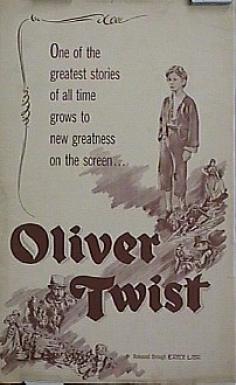
"Please Sir, I want some more" (Oliver Twist)

It is arguably the most iconic demand in British literature. A simple request made by a starving orphaned guttersnipe desperate to nourish his empty stomach. Relayed in David Lean's 1948 adaptation, the second of his Dickens' transfers, this scene is imbued with powerful resonance and shrouded in Wellesian imagery.

Contemporary audiences who recognize and associate Lean's name with illustrious, exotic epics such as Lawrence of Arabia, Bridge On The River Kwai and Dr. Zhivago will see the customary Cinemascope expansiveness of those films, replaced by claustrophobic close-ups and dystopic bedevilled imagery.

Starting in a grimy Dickensian workhouse, the runtish Oliver (John Howard Davies) is transferred to a local undertaker due to his dissenting behaviour at the dinner table. After being the target of abuse from the home's other servants, the boy escapes to London and is taking in by a group of street urchins and pickpockets lead by the Artful Dodger (Anthony Newley). The latter is in the employment of a trio of criminal adults Bill Sikes (Robert Newton), Nancy (Kay Walsh) and Fagin (Alec Guinness) who utilize orphaned boys to commit petty crimes and return with the loot.

But Oliver is unable to make the transistion to this life of crime: resulting in a botched attempt to pickpocket a gentleman outside a fruit stand. Assaulted by the ensuing mob, Oliver is aided by a wealthy elderly gentleman who takes him in; but fails to realize the extent to which Oliver's former associates want their prized asset back.

Like Lean's earlier films such as the Nöel Coward co-directed In Which We Serve, the George Bernard Shaw adaptation Major Barbara and This Happy Breed, Oliver Twist dissects concepts of Britain's rigid post-war class system. Transposing this argument into his Victorian setting, Lean is able to show the cultural trappings which repress and surpress working-class individuals. Lacking an academic education, Oliver is assigned a trade through the Christian workhouse in order to provide him an opportunity in life.

Yet, this technical education is entirely form-fitted for sweaty industrial labour. Nor, is it completed as Oliver soon enrolls into Fagin's pickpocketing program. Here, Oliver learns real survival skills that enable him to perform his new "trade" through criminal activity. Furthermore, his options for ascension within the underworld appear greater than in the glass ceiling society surrounding him. It is only after his adoption by a kindly upper-bourgeois elder that he receives an education capable of allowing him to transcend class barriers.

Within his analysis of the insulated class-based communities, Lean critiques the abusive interactions between adults and children. Throughout Oliver Twist, adults abuse their power against defenceless youths for profit. Francis L. Sullivan's rotund Mr. Bumble exemplifies this societial corruption. Charged in a position of responsibility for orphaned youths, Bumble regularly threatens them for the most basic insubordinate acts. Furthermore, Bumble along with a group of other adults attempt to financially gain from the mysterious mutterings of a dying woman associated with Oliver's deceased mother.

Yet, the most overt examples of child abuse in the film are at the hand's of the film's three working-class thugs: Fagin, Bill Sikes and Nancy. Taking advantage of their follower's destitution, the group operates uncustomary adult relationships with the children. Allowing them a fragile sense of empowerment in a repressive society through their clandestine thefts on the upper-class, the adults are equally vengeful toward their subjects: threatening them to extract information and berating them for failures. Yet, despite their abilities to engage in childish humour, the adults fail to recognize at times that their employed youth are still under twelve: a fact denoted by the children's cries when a lamp becomes extinguished in a dark hideout.

Surrounded by decaying buildings, the perfectly constructed sets by art director John Bryan enliven a world possibly all too familiar to Lean's audience. With countless antiquated Victorian homes still existing in London's East End during this period, there was arguably a sense of realism to the impoverished and pulverized world Oliver resides within.Yet, in a post-war Europe still tattered and broken from the horrors of war, British critics were dismayed at Lean's second Dickens adaptation.

Some complained the picture did not reach the calibre of Lean's earlier Great Expectations; others claimed the film encouraged pickpocketing among youths; while cinematically aligned other parties raged against Lean's decision to direct another Victorian novel whilst Neo-Realist filmmakers in Italy were discussing genuine poverty and urban decay. At the Venice Film Festival, the film did marginally better garnering the Golden Lion and upon its importation into the United States the film received strong reviews, but none of the award nominations Great Expectations had accrued.

In the United States, the film's release was delayed by four years due to complaints of anti-Semetism focusing on Alec Guinness' portrayal of Jewish criminal kingpin Fagin. Utilizing George Cruikshank's original illustrations, Guinness morphed into an almost unrecognizable figure replete with a gargantuan beaked nose, scraggily hair and a wart-strewn face. After excising almost twelve minutes from the film, the picture was released in America with an uncut edition released in 1970.

Guinness' Fagin is a remarkable creation: an example of his unrivaled ability to morph into an array of offbeat characters, a talent he later perfected in Robert Hamer's Kind Hearts and Coronets. Ironically, despite the criticism from critics sympathetic to Zionist causes, British critics of the period slammed the film for supposedly downplaying the personalities and the sheer cruelty enacted by Fagin, Bill Sikes and Nancy: despite the film's infamous and artfully concocted bludgeoning of Nancy by a furious Sikes.

Scenes such as the latter are bathed in a sinister afterglow of German Expressionist influenced light and shadows and Wellesian close-ups. Beginning with the film's tempetuous opening-suggested by Lean's then-wife Kay Walsh- the director foreshadows a world of poverty and pain. Following a pregnant woman across a windswept moor, cinematographer Guy Green's black and white camera captures the blackened sky with tenacity and fervor. Shot using tight mid-shots and high angles, Lean's film is filled with other memorable sequences such as Oliver's trek up a flight of stairs, the mug of beer tossed at Newton's Sikes and the dimly-lit meetings between characters on London Bridge.

Honed with remarkable craftsmanship, David Lean's Oliver Twist is a textbook example of how to turn a literary masterpiece into a cinematic one. With superb performances by the aggressive Newton, Walsh, youngsters Davies and Newley and most notably Alec Guinness as Fagin, Oliver Twist features one of the most impressive acting ensembles assembled in British cinema history. Additionally, the astutely constructed sets by John Bryan and visuals by Guy Green are testament to a film as aesthetically pleasing as it is brilliantly acted.

One of the best British films ever released.

* Oliver Twist is available on R1 DVD through Criterion Home Video and on R2 in a "Double Bill" with Lean's Great Expectations through ITV

Copyright 2007 8½ Cinematheque

Labels: , ,

Saturday, April 14, 2007

1952: Umberto D

Umberto D (de Sica, 1952) 7/10

Underneath the sharp white tinted opening credits of Vittorio de Sica's 1952 neo-realist film Umberto D lies the political and socially conscientious springboard for the genre's penultimate investigation into the destitution of marginalized socio-political classes.

As one's eyes become more attuned to the Roman cobble roads below, one notices the expanding crowd of black-suited figures traversing the screen from top to bottom in a single file. The surprising composition of this group is they are not soldiers or irate youth, but elderly men: former civil servants demanding a pay rise in their pension.

One of those men is Umberto D. Ferrari (Carlo Battisti), an irascible retired civil servant who has worked for the Ministry of Public Works for thirty years, but now struggles to make ends meet on his pitiful income. Living in an ant-infested apartment with his solitary companion, a dog named Flike, Umberto is desperate to raise 15,000 lira in order to escape eviction from his filthy abode. In order to pay off his debts, Umberto must decide whether to live or die: since his pension will provide him barely with enough sustinence.

Scripted by famed neo-realist screenwriter Cesare Zavattini, who also co-wrote other de Sica films include The Children Are Watching Us, Miracle in Milan and Bicycle Thieves, Umberto D is a classic neo-realist analysis of bourgeois capitalism's dehumanizing effects on ordinary people. Utilizing the genre's Christan-Marxist framework, de Sica and Zavattini employ former civil servant Umberto as an archetypal representation of the failure of the state to care for its citizens.

After devoting over half of his life to the betterment of others, Umberto now struggles to obtain assistance from others in order to survive in postwar Italy. The first time we encounter Umberto is during the film's opening political rally, which is closed down by police authorities due to the organization's failure to obtain a permit. Ironically, Umberto's anger is not centered at the state police, but the leftist organizers of the protest for their failure to garner a license. With no family or friends beyond a few passing acquaintances, Umberto still has faith in the government to look after him: a trust tested by his increasing poverty.

But while Umberto yearns for a raise to pay off his debts, his former colleagues simply want the money for material purposes. Residing in a ramshackle apartment with Flike, Umberto's only human friend is the apartment building's pregnant teenage maid Maria (Maria Pia Casilio). To the old-fashioned Umberto's astonishment, Maria is unsure of who exactly is the father of her child since she routinely entertains two soldiers from either end of the country: both of whom deny impregnating her. But Umberto's concern for Maria is more didactic than moral, as he impresses to her the importance of education to avoid being taken advantage of by others in future.

Like Umberto, Maria is a dehumanized figure. Although she is employed for the entire apartment block, Umberto's landlady (Lina Gennari) essentially uses Maria for her personal needs. A part-time opera singer, Umberto's anonymous landlady is presented as a characterization of the spiritual debasement of the bourgeosie. While the apartment building is infested with insects, her apartment is filled with lavish material possessions.

Courting the owner of a local cinema, she routinely entertains her loud cultured friends into the wee hours of the morning, while Umberto tries to sleep in his drafty room. Yet, despite her fondness of haute coutre in her fashion and artistic tastes, she also engages in less salivating practices. When Umberto returns from the rally, he is distraught to find out that his landlady has expropriated his room for the sexual pleasure of her friends. Furthermore, despite his bouts with illness, the landlady is unwilling to grant Umberto any extensions to repay his debts, as she intends to evict him in order to transform his room into a parlour to expand her evening soirees.

Desperate to avoid eviction, Umberto resorts to activities which he finds demeaning and embarassing. His pride is dented as he resorts to eating at a mission for the homeless, where he tries to sell his prized gold watch; and excerbates a bout of toncillitis to extend his stay at a hospital in order to avoid paying for his meals. This descent into poverty reaches its zenith when he begrudingly tries begging, only to be unable to engage in this approach. Such is his depression that Umberto even contemplates suicide as this once proud civil servant is abandoned by his former colleagues and employer.

In keeping with the neo-realist aesthetic, de Sica employed a non-professional actor in Carlo Battasti to play Umberto: a method which imbues heavy doses of authenticity into the performance. Not that the film can escape the genre's requisite doses of sentimentality, with Flike replacing a small child as the source of the film's more syrupy emotions. However, when Umberto loses Flike and searches the streets of Rome for his only companion, de Sica is able to create a highly emotive setting, which typifies the downcast nature of Umberto D.

Despite the film's bright sophisticated feel, de Sica's film contextual approach is filled with sadness and pity. When de Sica gazes upon his characters such as the scene in which he examines Maria's morning routine, we see the ordinary nature of his characters, but also the unnecessary misfortune they have suffered at the hands of others. Interestingly, when Umberto visits the religious orders at the hospital, it is inferred that he has little association to religion in his hackneyed attempt at prayer. While Umberto has substituted religion for politics, we see a character who is too proud to even ask God for assistance; but rather resorts to base tactics in order to survive. Because of this Umberto D never comes across as overly heavy-handed despite its often clichéd mannerisms. Instead de Sica inflects an air of disenchantment in capitalist society in his unfiltered characterizations of people yearning to survive in an inhostile and socially unresponsive world.

* Umberto D is available through Criterion Home Video on R1 DVD and Nouveaux on R2

Other Vittorio de Sica Films Reviewed:
The Children Are Watching Us (1944) 8/10

Copyright 2007 8½ Cinematheqe

Labels: , , ,

Saturday, March 17, 2007

1951: Ace in the Hole

Ace in the Hole (Wilder, 1951) 10/10


“Bad news sells best. ‘Cause good news is no news” (Charles “Chuck” Tatum)

"Fuck them all! It is the best picture I ever made" (Billy Wilder)

In 2003, New York Times reporter Jayson Blair was forced to resign from his esteemed American employer after he was caught fabricating evidence about the Beltway sniper shootings. Blair’s breach of journalistic principle smeared the New York Times’ reputation for accuracy: briefly inducing a public debate about media practices and the distortion of the truth for profit. Ironically the same publication fifty years earlier denounced Viennese director Billy Wilder for the creation of what Times film critic Bosley Crowther called a “preposterous” character: an immoral and opportunistic journalist who misleads the nation with his reporting of a mining accident in rural New Mexico.

In a brilliantly savage and astringent lead performance, Kirk Douglas stars as Charles “Chuck” Tatum, an ace reporter whose intoxicating behaviour has led to his dismissal from every major news publication from New York to Chicago. Arriving in a broken down convertible in Albuquerque, New Mexico, Tatum offers his services to editor Jacob Q. Boot (Porter Hall) for a fifth of his New York salary. Boot agrees on the condition that the openly alcoholic and reckless Tatum maintains his sobriety and adheres to the paper's chief policy: ”Tell The Truth.”

Believing in his own hype, Tatum expects his newly acquired Alburquerque position to last no more than a few weeks; before being once more snapped up by a large Eastern paper. One year later however, the increasingly agitated Tatum is still attached to his desk in a sweaty New Mexico office. Desperate for his break, Tatum begrudingly accepts his latest assignment: a report on an annual rattlesnake hunt in the baking desert. Along the way, he and the paper’s junior photographer Herbie (Bob Arthur) stop at a local gas station were the windswept monotony of the summer is broken by a wailing police siren heading toward a Native American cliff dwelling.

Following the police car, Tatum learns that the gas station’s propertier Leo Minosa (Richard Benedict) is trapped in a collapsed cave in a failed attempt to steal some burial pots. Climbing into the sacred cave in order to interview and photograph the local entrepeneur, Tatum sees that Leo’s legs are trapped under a mass of debris: rendering his escape from the mountain impossible without a rescue squad. Sensing his good fortune, Tatum builds a story around a Native American curse, a trapped war hero and Lorraine (Jan Sterling) his grieving wife.

According to the engineers who arrived on the scene however, the removal of Leo from the crevice is little more than a sixteen hour operation involving the butressing of the failing walls. Dismayed at this fact and dreaming of glory and financial gain, Tatum works in tandem with a corrupt sherriff (Ray Teal) and a servile former truck driver-turned-contractor to use an alternate drilling method, which will take days rather than hours to complete. Luckily, for Tatum, Leo’s cynical Baltimore-born wife equally wants her husband to remain trapped in the cave. Bored and trapped in their diminutive outpost, Lorraine tells Tatum of her hunger to head East and her desire to quench her sexual thirst for him.

Slightly intrigued by her sexual advances, Tatum quickly realizes that Lorraine’s planned desertion of Leo will hurt the appeal of his articles. With his stories producing a media frenzy, the remote outpost is quickly beseiged by tourists who fill the coffers of Leo and his parents small store and subsequently fund Lorraine’s temporary loyalty to her husband. Yet, as more vacationers enter the Minosa property, the quiet and somber desolation is replaced with vivaciousness. Sightseers begin paying a fee to visit the area, while the S&M Entertainment Company erects a carnival and a train service shuttles in more visitors; as the area turns into a media circus driven by profit and greed, rather than the desire to save a dying man.

Ace In The Hole is arguably the most caustic and cynical film ever to come out of the studio system. Wilder took his idea from a real life cave-in, which Douglas mentions in the film. In 1925, cave explorer Floyd Collins was trapped in a Kentucky mine for eighteen days. Before Collins’ death- almost three weeks after his intial entry into the mine- his story was told by a local reporter, who eventually won the Pulitzer Prize for his riveting accounts. Collins’ fateful foray was even fictionalized into a best-selling novel “The Cave” by “All The Kings Men” author Robert Penn Warren. Yet, as writer, producer and director, Wilder- unlike other Hollywood producers- was less interested in the human interest story, but the possibilities of the explotation of a human interest story. Fresh off his acclaimed Sunset Boulevard, Wilder was ready to continue with his interest in the more sadistic and immoral elements of human nature: greed, lust, betrayal and murder.

But in an era when critics held great sway and audiences expected even the most sinister of protagonists to acquire a degree of moral growth, Ace in the Hole was a bitter pill to swallow. Critics of the period derided Wilder’s treatment of their profession; while audiences were unable to accept the personal motives of one of cinema’s most repellant protagonists in Douglas’ Charles Tatum, nor the masses jocund lust for such a depressing story of turning tragedy into entertainment. Yet in an era when the private destructive streaks of fallen pop stars and minor celebrities become tabloid fodder and gossip channel filler, one can see that Wilder’s film was merely not in bad taste as his critics concluded, but simply far ahead of its time.

Flawlessly acted and directed, Ace in the Hole is a scathing, yet brutally honest delight: a gritty alternative to present-day Hollywood in which yesteryear's forum of images and ideas has now been replaced by a visually and contextually vacuous contingent of moribund plots and critical dormancy . Lauded at the Venice Film Festival and popular throughout Europe, the picture was Wilder’s first critical and commercial flop, which reduced his standing at Paramount as the film lost money despite a name change (Big Carnival) and radical attempts to briefly release the film on television. Whether, the screen was silver or small, audiences turned away in numbers: shunning Kirk Douglas’ star power and Wilder’s acidic vision.

Contrary to popular belief, Wilder’s sardonic approach to life was not a rarity in 1951. In the 1940’s Preston Sturges had created a bitter portfolio of films such as Sullivan’s Travels and Unfaithfully Yours; Orson Welles had directed two particularly abrasive films in 1942’s The Magnificent Ambersons and 1948’s The Lady From Shanghai, while Welles himself had appeared as the charming, yet immoral Harry Lime in Carol Reed’s 1949 film The Third Man. Chaplin’s Monsieur Verdoux and Hitchcock’s Rope both featured sinister characters comparable to Welles’ Lime. In Mark Robson's 1949 film Champion Kirk Douglas played a brutal pugalist, the Academy Award for Best Picture in 1950 was won by Joseph L. Mankiewicz’s biting All About Eve and even Stanley Donen and Gene Kelly’s Singin’ In the Rain is a masterpiece of alkaline perceptions and bittersweet sentiments.

And of course in 1950, Wilder himself had written and directed Sunset Boulevard: a film which bears striking similarities to Ace in the Hole. Both films featuring failed writers down on their luck who arrive at their respective unlikely destinations via a malfunctioning convertible. Each character attempts to use this improbable situation to get their careers back on track. For Gillis’ his job re-writing Norma Desmond’s infantile script is meant to provide him with the resources to pay off his creditors and perhaps through his job moonlighting at Paramount on a screenplay, he can revive his career. For Tatum, his job in Albuquerque is simply an attempt to revive his reputation and start anew back East.

However for both immoral protagonists, they are unable to escape this situation. Each becomes tied down to the financial and material gains extracted from their jobs, as well as the unwanted guilt which comes with it. Joe Gillis realizes he has a “long term contract, with no options” as Norma’s ghostwriter-cum-gigolo who is distraught by his attempts to leave her side; Tatum knows that his career rests on Leo’s fate, which produces sparse and pithy outbursts of emotional responsibility. Additionally, both mortally expire at the hands of the unwanted women who they have used for financial gain in return for sexual favours.

More so than Sunset Boulevard, Ace in the Hole also delves into the cult of celebrity and the perversity of human entertainment. Thanks to Tatum’s “way with words,” a small community springs up in the Mojave wasteland around the Minosa family trading post. On their way to a lakeside cottage, the grounds' first batch of visitors inform Tatum and Lorraine that they are simply passing through and wish to visit the cliffs for thirty minutes since the experience will be educational for their small children. Yet almost a week later, the family are still there: collecting Indian souvenirs, riding the Ferris Wheel and trying to promote the father’s insurance company.

The community spirit fostered in this event is as suitabilyconnected to the concept of celebrity as Tatum’s desire to maintain Leo’s struggle. By embarking on a journey to Escadero, the participants can claim their kinship with Leo, while failing to understand or appreciate his struggle. At the film’s finale, when travellers begin to cry their false tears represent a loss of the entertainment associated with this circus, rather than any pity for Leo. His plight is the catalyst for their journey, but not their reason for remaining longer than half an hour in an infertile area

It is in this barren state, that codes of morality disintegrate. Trapped and alone, Leo worries for “grieving” wife Lorraine. Yet, Lorraine is unmoved by Leo’s situation and only remains at her in-laws home in order to reap the financial benefits of the media circus and woo Tatum, as he spends boozy hours bartering contracts for his exclusive story. In Lorraine’s restaurant, the corrupt local sheriff brokers a partnership with Tatum for favourable sentiments in his articles: informing Tatum that the region’s only contractor owes his position to the sheriff’s baseless tactics. Meanwhile, as the media-hungry crowds outside begin to swell, Leo’s Hispanic parents and the local Native American tribe hold vigils and ceremonies for Leo. These attempts of goodness however are chastized by the racist and inept officers, as well as Lorraine who objects to Tatum’s insistence of going to a vigil/photo-op as “kneeling bags my nylons.” Thus, Wilder’s film becomes a critique of Western morality: prophetically showing a culture which kneels at the altar of celebrity and feeds off the rotting carcass of the human spirit for little more than fifteen minutes of fame.

One of the best American films from the 1950's

* Ace in the Hole is currently unavailable on DVD. Although Criterion is rumoured to be releasing a R1 edition in late 2007.

Copyright 2007 8½ Cinematheque

Labels: , , ,

Friday, March 16, 2007

1955: Smiles Of A Summer Night

Smiles Of A Summer Night (1955, Bergman) 8/10


In 1955, Swedish director Ingmar Bergman was almost at the end of his rope. Literally. With a series of bleak critical and commercial flops in his native Sweden, Bergman was given one last chance to repair his tattered career by his bosses at Svenskfilmindustri. Despite being regarded as an extremely talented figure, the esteemed playwright and theatre director had not yet manage to transcend his literary and theatrical success onto the big screen. Wondering, whether he should end his life, Bergman thankfully decided to press ahead and gathered his stock theatre troupe for one last gasp at cinematic glory. The result was a worldwide and critical success that put Scandinavian cinema on the map: the film was Smiles of a Summer Night.

Ingmar Bergman's enchanting 1955 comedy of manners Smiles of a Summer Night is a witty, aphrodisiacal and salacious film about destiny, humiliation and jealousy. Drawn from Bergman's theatre background, the film pays homage to the satire of Moliere and the bawdy sexuality of Shakespeare and feels as equally theatrical as it does cinematic. Set in turn of the century Sweden, the film chronicles the relationships of a group of Swedish aristocrats who realize their true desires and identities at a lavish party on an isolated country estate.

The fulcrum of the film is the character of Frederik Egerman (Gunnar Bjornstrand). The affluent, middle-aged lawyer has been unable to consummate his relationship with his young bride Anna and still holds feelings for his former mistress: renowned theatrical performer Desiree Armfeldt (Eva Dahlbeck). After unconsciously revealing his desires for Desiree in a dream, Egerman begins to seek out his former lover for advice about the relationship with his wife Anna (Ulla Jacobsson).

Soon Egerman realizes he got more than he bargained for as Desiree begins her own quest to recapture the father of her child. Utilizing the influence of her aristocratic mother (Naima Wifstrand), Desiree invites the Egermans, her current lover Count Carl-Magnus (Jarl Kulle) and his wife Charlotte (Margit Carlquist), as well as Frederik's grown son Henrik (Bjorn Bjelvenstam) to a vast country estate were covert dealings and games of chance reveal the true fates of those involved.

Smiles of a Summer Night is often considered an anomaly in the angst-ridden director's career. Filmed during the lowest creative period in Bergman's life, the film is surprisingly cheerful and magical in portraying the wants and desires of a group people blind to the desires of those around them and within themselves. The film's 1900 setting allows for class distinctions to be more defined and for the differences of custom and moralities to be showcased to hilarious effect. In the case of Frederik Egerman, while he appears to be an honest and upright husband, there are facets to his past with Desiree that are scandalous as he courted several women at once.

Bergman's meditation on chance and circumstance is a delightful wonder brimming with enthusiasm and barbed wit. It is through this wit that the film's focus on humiliation and jealousy is realized. On a spoken level, the wit is used to outclass another. In context to the rest of the picture, the wit allows characters to reveal their fears, desires and humiliations, which brings about waves of jealousy and frustration. What is interesting however, is the way Bergman analyzes these frustrations.

For the most part these disappointments occur only with the film's upper and middle-class characters such as the Egermans. A perfect example is in the character of Henrik, who for all his moralizing desperately wants to engage in sin, thus he is firstly embarrassed about abandoning his priestly virtues for lust. Secondly, when Henrik attempts to sleep with his father's housemaid Petra (Harriet Andersson), he is unable to do so because of his own impotence. Similarly, his father Frederik cannot consummate his marriage to his own wife, who is in return embarrassed about not being able to do so. However, in the context of the entire picture the humiliation suffered by characters such as Henrik allows them to see their predetermined fates in the game of love.

The film becomes an exercise in carefully crafted dialogue and poised acting through some of the best comedic performances in cinematic history. The performances are all excellent, especially the work by the four female leads: Eva Dahlbeck, Ulla Jacobsson, Margit Carlquist and Harriet Andersson. Each of these women adds their necessary character traits with astute perfection: Dahlbeck's refinement, Jacobsson's naivety, Carlquist's resentment and Andersson's overt sensuality.

Mixed with the central male protagonists, Bergman manages to create a polished comedy that works on many levels. As Bergman had previously worked with the majority of the cast before in his theatre group and in other films, which allowed for the director to best exploit his actors talents and resulted in strong chemistry between the major players, particularly between Dahlbeck and Gunnar Bjornstrand.

The film's cinematography by Gunnar Fischer is one of the most endearing in black and white photography. Unlike American cinematographers of the period, Fischer does not turn the film into an overtly romantic piece, but rather drew on ancient Swedish traditions of pagan fantasy allowing for wonderful dashes of light outdoors and elegant scenes indoors.

Controversial upon its initial release in America, the film's overt lasciviousness and frank musings on adultery, fornication and passions caused quite a stir. It is often quite noted by film makers such as Martin Scorsese that religious authorities at the time placed the Catholic Film Office's infamous list of films that were deemed to be morally unacceptable.

Despite its earlier controversy, the tragicomic Smiles of a Summer Night still proves to be a mesmerizing, yet bittersweet affair. For all the jovial abandon displayed by his characters, Bergman is unafraid to display the dark side of romance: bitterness, regret and pretentiousness. Yet, Bergman is able to cast an overall product that is bright, punctilious and impulsive, brimming with aged earnestness and youthful ambivalence. With its spirited performances, overt sensuality and flavorful wit, Smiles of a Summer Night earns its reputation as one of the best romantic comedies of all time: a rare film that titillates with life, as well as intellect and pleasure.

* Smiles Of A Summer Night is available through Criterion Home Video

** I have also previously published this review on Rottentomatoes.com

Copyright 2006 8½ Cinematheque

Labels: , ,

Wednesday, March 14, 2007

1959: Black Orpheus

Orfeu Negro/Black Orpheus (1959, Camus) 7/10


The Greek tragedy of Orpheus and his lover Eurydice is perhaps the most popular ancient fable in contemporary culture. Countless operas, a collection of poems by Rainier Maria Rilke, a play by Tennessee Williams and a present-day adaptation by Jean Cocteau are just a few of the varied transplantations of the Orpheus myth into modernity. One of the most celebrated adaptations is Marcel Camus’ 1959 film Orfeu Negro (Black Orpheus): winner of the Palme d’Or at the 1959 Cannes Film Festival, as well as Best Foreign Language awards at the Oscar, BAFTA and Golden Globe ceremonies. A Brazilian-French co-production, Orfeu Negro was adapted by Camus and Brazilian playwright Vinicius de Moraes from the latter’s play Orfeu da Conceição.

De Moraes play and Camus film place the Orpheus legend in a modern context. Set amongst the hillside favelas (slum communities) atop Rio de Janeiro during Carnival, the film tells the story of tram driver and playboy Orfeu (Breno Mello) who is pressured into marrying his girlfriend Mira (Lourdes de Oliveira). When the presiding legal clerk, in reference to the Greek myth, inquires whether Orfeu loves Eurydice, the dim-witted Mira angrily assumes there is another woman in his life. Incensed Mira and Orfeu return to the former’s hilltop shack, where Orfeu finds that his neighbour Serafina (Lea Garcia) has a visiting cousin who is fatefully named Eurydice (Marpessa Dawn).

Eurydice is a poor country girl who has fled to the city to hide from a man she believes wants to kill her. Orfeu attempts to placate her fears through his renowned singing and the two begin to secretly fall in love. But during the frenzied pre-Carnival ceremonies, Eurydice’s stalker returns dressed as an Angel of Death and informs Orfeu that they will soon meet again: resulting in a scenario in which Orfeu will relinquish his beloved Eurydice forever.

From its opening credits, there seems to be something wholly unique about Camus’ Black Orpheus. In the opening moments, a classical Greek frieze explodes to reveal a carnival-esque hilltop atmosphere highlighted by the saturated colours of Jean Bourgoin’s cinematography and the pulsating rhythms of Luiz Bonfa and Antonio Carlos Jobim’s samba score. Here a colourful joie de vivre reigns supreme amongst the poverty and the grassy pre-industrial enclaves: filling its residents with a captivating passion for life.

Yet, despite the stunning shots of Rio’s affluent districts, the mountains and the sea below, there is something highly unnerving about Camus’ film. The director’s photographic contrast of rural and contemporary Rio exemplifies the socio-economic shift produced by modernization in Brazil during the era of President Kubitschek: enabling feats such as development of the capital city of Brasilia. the construction of the National Congress of Brazil and the dramatic unequal distribution of wealth which dominates Brazil to this day.

Yet, through Bourgoin lens, Camus' film represents something more akin to a tourist board production complete with mandatory references to Carnival. With its lush colours, customary stereotypes and quaint, happy characters this could easily have been a product of the Hollywood studio system either as an adventurous short or a lavish, semi-indigneous production in the style of Otto Preminger’s Carmen Jones. The trappings of poverty including starvation, illness and crime are virtually non-existent in Camus’ film. Lawlessness in the favelas is replaced by a colourful tale of jealous jilted lovers set to the appealing backdrop of the Carnival season. And although he deploys non-professional actors in Black Orpheus, the inauthentic state of Camus’ film continues into his casting choices such as Marpessa Dawn, a professional dancer from Pittsburgh in the role of his naive, rural heroine Eurydice.

In his work on German cinema entitled Weimar Cinema and After, film historian Thomas Elsaesser has promoted the concept of cinematic “historical imaginary.” Although Elsaesser applied his research into notions of communal identity in Weimar Germany, one can see in his concept of an “imaginary” the building blocks for other imagined visual states, with perceived notions of national self replacing true identity politics. One could therefore argue that Camus’ status as an outsider has produced not the “real” Brazil that the patrons of Cinema Novo (the Brazilian New Wave) would later formalize in response to Black Orpheus, but rather an idealized Brazil based on Eurocentric assumptions and stereotypes concerning Carnival, the poor and Brazil’s African traditions.

Although Camus is able to induce a frenetic atmosphere to the proceedings, it is interesting to note how lethargic and stagnant the film’s visually vibrant opening quarter is in relation to the rest of the picture. While there is an intrinsic grace and movement to the film’s festive moments, there is also a distinct lack of fluidity in Bourgoin’s camerawork in capturing this physical magic. Thus, the film fluctuates between moments of choreographed brilliance such as Eurydice’s flight from her oppressor in Orfeu’s workplace and prosaic documentary-style Carnival footage: as though Bourgoin and Camus are unaware of how to capture the essence of the raw material in relation to the more structured traditional set-pieces.

Camus’ film subsequently operates on a smoother level when working within quasi-traditional settings: creating a potent blend of quasi-religious symbols and philosophical musings throughout Orfeu Negro. Several characters, including small children often speak to one another in eloquent philosophical language with classical overtones from the ancient Mediterranean world. However, the most dominant metaphor discussed and displayed in Camus’ film is the notion of heaven and hell. With its utopic kinship and greenery, the favelas are a source of heavenly bliss for several characters.

Although they meet earlier on the streets of Rio, it is in Serafina’s house that Orfeu and Eurydice truly connect and grow to love one another. The Carnival which operates at sea level becomes a metaphysical purgatory in which benign characters suffer for their sins: producing imprisonment, assault and death. Hell is found in the dimly-lit tunnels, morgues and blood-soaked hospital rooms where anguish remains eternal.

The remaining religious allusions in Black Orpheus appear to take on elements of New Age and voodoo, rather than traditional Christianity. Whereas the selfish Mira is hedonistic in her choices, Eurydice is a strong proponent of the zodiac: offering Orfeu a scarf adorned with the astrological signs. Orfeu himself appears to have been raised on indigenous folk tales and beliefs,as he convinces two small children that by playing his guitar he can make the sun rise in the morning. But as with his women, Orfeu is too fickle to adhere to anything too long. After being courted into an underground cellar, he asks a group of voodoo practioners to help him find his lost Eurydice. But when an elderly woman channels Eurydice’s spirit, Orfeu is unwilling to believe her or anybody else whom he cannot physically control or possess.

Orfeu Negro is also a film about identity. With its emphasis on masks and disguises, Carnival allows for a rare instance of social equalization. It is an outlet through which its participants can escape their impoverished homesteads and become whoever they wish to be. In Black Orpheus, idealized personality traits and interests come to the forefront in the choice of costume and attention to detail. Mira diguises herself as an 18th century courtesan which demonstrates her appreciation for high taste and her blatant materialism; Orfeu on the other hand is a majestic Roman warrior prepared to battle for his true love; while Eurydice is disguised in her cousin’s costume: analogously enhancing her inability to remain invisible for both loving eyes and hateful spirits.

Integral to the global success of Black Orpheus was the use of traditional Brazilian jazz. The seductive melodies of Bonfa and Jobim’s samba score replete with its whistles, drums and guitars added a sexy South American tinge to the picture and sparked an entire craze for Brazilian Jazz in Europe and North America: Astrud Gilberto and Stan Getz’ English language version of "Girl of Ipanema" being the greatest samba crossover of the period. The omnipresent music is arguably the film’s greatest legacy on modern culture today, as it still manages to breathe life and tempo in Camus’ film.

While time has not eradicated the charming exotic qualities of Orfeu Negro such as its score and suffused palette, it has dented the film’s naive sense of realism. The stereotyped settings, caricatured performances and stilted narrative have certainly taken away some of the film’s original allure which captivated audiences in the late Fifties whose images of South America were limited to musicals such as Down Argentine Way and Flying Down To Rio. Yet, in Camus' Brazilian imaginary there is an appealing and enjoyable narrative imbued with enough mysticism, classical tragedy and philosophical intrigue to separate it from its lesser Hollywood cousins.

* Black Orpheus is available through Criterion Home Video

Copyright 2007 8½ Cinematheque

Labels: , ,

Tuesday, March 13, 2007

1946: La Belle et la Bête

La Belle et la Bête (1946, Cocteau) 10/10


Was there a greater and more definitive “Renaissance” man of the early 20th century than Jean Cocteau? Noted today for his surrealist films, Cocteau was also an esteemed sculptor, painter, playwright, essayist and set designer.

Beginning with 1930’s Blood of a Poet, he followed in the footsteps of his Spanish contemporaries Salvador Dali and Luis Buñuel in creating a series of groundbreaking experimental films that challenged contemporary social mores and broke artistic boundaries. Yet today Cocteau’s reputation is less publicly renowed than either Dali or Buñuel: often relegated to the annals of academia and the reclusive world of the cineaste. But there is one film in Cocteau’s canon which the vast majority of the general public have at least felt the impact of in popular culture.

When in 1991, Disney released Beauty and the Beast the majority of its viewers did not realize that as with the company’s 1973 adaptation of Robin Hood, the studio had borrowed heavily from an earlier classic picture. While elements of Disney’s Robin Hood border on plagarism with Michael Curtiz’ excellent 1938 Errol Flynn vehicle The Adventures of Robin Hood, there is a less overt, but still noticeable tinge to Disney’s animated version of Beauty and the Beast and Jean Cocteau’s masterful 1946 film La Belle et la Bête.

Although there have been countless versions of Madame de Beaumont’s 1756 fairytale- ranging from Czech adaptations to animated direct-to-video features-Cocteau’s film is not only the most faithful to the source material, but also the definitive cinematic account of de Beaumont’s story. In Cocteau’s adaptation there are no singing candlesticks, Celine Dion ballads or puns on the Baroque period. Instead there is an innate childlike joy fused with an artistic complexity both in terms of its visuals and narrative. Like Marcel Carne’s Les Enfants du Paradis released a year earlier, this is a triumph of style and auteuristic vision over lamentable filmmaking conditions.

With postwar France left impoverished and in tatters by the Second World War, Cocteau’s film is a perfect example of the power of an artist’s vision overcoming tragic circumstances to create an incredible artistic statement. Malfuctioning equipment, limited electricity, insufficient costume materials and an unsure producer could have easily sent Cocteau’s vision to a cinematic wasteland. Today, it is even difficult to imagine the difficulties which beset Cocteau in finding pristine white blankets for the film’s laundry scene. But as with Les Enfants du Paradis, one does not see the supply shortages and ration cards. Instead the mis-en-scene is bolstered by Georges Auric’s blithe score, Hagop Arakelian’s superb make-up and the magisterial beauty of Henri Alekan’s gorgeous cinematography. Together with Cocteau’s vision they create a lush visual essay brimming with enchantment, intelligence and a serene innocence.

In deploying his most orthodox narrative, Cocteau created a film accessible to all audiences, but specifically children. With the devastation around France, one can see in Cocteau’s film both a reprieve from this desolate world, but also the formation of a morality play on diametric feelings of goodness and greed within the human soul. The results are entertaining, aesthetically stunning, yet inclusively didactic. The viewer’s eyes, heart, mind and soul are all richly rewarded by Cocteau’s efforts.

La Belle et la Bête tells the story of a bankrupt merchant (Marcel Andre) who believes his ship has literally come in to port. Presuming that the sale of his goods from the ship will allow him and his family to live in comfort, the merchant is dismayed to find that his creditors have already ransacked the ship. At home, his materialistic eldest daughters and foolish son have already overspent beyond their father’s means; the latter in particular signing his gambling debts from a local tavern over to another creditor who successfully sues the boy’s father for payment: leaving him in further destitution. Only his youngest daughter Belle (Josette Day) truly cares for her father: asking for only love and simple gifts, rather than the fine jewels and lavish clothes desired by her siblings.

When riding back from the port on a dark, foggy night the merchant loses his way and stumbles on a castle filled with eccentricities and magic. Upon exiting the castle, he plucks a rose from a bush for his daughter Belle; only to be reprimanded by the castle’s owner: a Beast (Jean Marais) who informs the merchant he will die for his act of theft within three days. Overcome by grief, the ill merchant returns home to tell his family. Desperate to not have her father die, Belle agrees to take her father’s place and returns to the castle to confront the Beast. Soon, the Beast falls in love with Belle, but she does not reciprocate or acquiesce to his marraige proposals out of her fidelity to a handsome prince named Avenant (also Marais). When Belle’s father becomes ill, she pleads with the Beast to let her return for one week: testing not only the Beast’s faith in Belle, but also Belle’s faith in the morality of the outside world.

At the core of Cocteau’s film is a focus on internal and external beauty. With his animalistic appearance, the Beast is hardly an attractive fellow in comparison to the matinee idol visage of Avenant. But with his tenderness, compassion and thoughtfulness, the Beast is the antithesis to the vain and greedy Avenant. Although Cocteau successfully disguises his lead actor in Arakelian’s fantastic make-up, his decision to have Marais cunningly play both Avenant and the Beast not only enhances Cocteau’s adherance to the source material, but also addresses his central thesis on the internal versus the external in regard to codes of beauty.

Furthermore, Cocteau’s overt critique of materialism would hold great resonance amongst his peers not only due to his leftist sympathies, but also for his educative application of common sense in a nation filled with material paucity. While the merchant’s other children beg for illustrious gifts, Belle asks for a simple rose. Her choice of gift exemplifies her preference for the natural world in terms of commodities, behaviour and ideals. Her siblings on the otherhand prefer the artificial and falsely adhere to the belief that the artificial wins over nature. Even the Beast to a certain extent is drawn to this notion by offering Belle pearls and fine clothing. She is taken aback by the Beast’s generosity, but prefers gifts of kindness such as the opportunity to visit with her ailing father.

Upon visiting her father, Belle attempts to offer the necklace to one of her gormandizing sisters. However in a brilliant piece of special effects, when the item is placed in her sister’s hand it turns into a thorny weed; only for it to return to its normalized state once it hits the floor. The magic wrought in these items represents the inner sanctum of the bearer’s soul. When Belle stares in the Beast’s mirror, we only see her goodness; when her sister’s attempt the same feat, they turn into beasts themselves.

Much of the enchantment of La Belle et la Bête is to be found in its superlative inducing special effects, make-up,costumes and production design. Despite the paucity of props, Cocteau is able to create a haunting, surreal world in which halls are lit by candlebras that are human arms, while human faces smirk and grin from fireplaces and walls. The layered symbolism in these simple props transcends to Cocteau and Alekan’s aesthetic palette of ideas; concepts which are never addressed in a forceful method, nor fashioned to insult the audience’s intelligence.

From the film’s opening credits scrawled on a school blackboard, we (the audience) get the sense of Cocteau’s intentions to spread his message to the masses and particularly to children. This notion is re-inforced when Cocteau himself abruptly stops the film in order to provide an opening prologue informing his audience of his intentions and the childlike sense of wonder, which one’s heart, mind and soul must be filled with in order to truly appreciate the picture. In the film’s visual construction, Cocteau appears to have researched, analyzed and dissected all modes of previous cinema (from the silent era to the present) in order to provide an aesthetic template with which to work alongside to provide cinematic consistency, yet simultaneously break new ground. Naturally, the results are astounding.

Here, Alekan creates a romantic blend of exterior impressionism and interior gothic tones heightened by the film’s extraordinary special effects and variety of peculiar angles. In arguably Alekan’s greatest sequence in the film, the arrival of Belle is remarkably shot in perhaps the most romantic application of slow-motion ever committed to celluloid. It is this type of exquisite eye for detail and ability to harness light, which Alekan would later bring to Wim Wenders’ masterpiece Wings of Desire: another tale of unrequited love in which Alekan is able to confer basic human emotions through a rich and endearing form of photography. The extraordinary performances of Josette Day and Jean Marais add further endearing qualities of hope, compassion and humanity to the picture.

At the denouement of La Belle et la Bête, when love conquers all, it is interesting to note the reaction Cocteau received in the period following the film’s initial release. Although not overtly negative, many viewers sighed in letters to Cocteau about the transformation of the Beast: dismaying their sadness at the loss of the title character in exchange for a glistening matinee idol. Unbeknowst to them however, their collective disconsolation pleased the surrealist filmmaker. In an essay he later wrote about the film, Cocteau confided to his readership that their unified grief was the exact emotional response he had wished to lure from his viewers. For while they were initially afraid of the Beast, they too like Belle came to see beyond his looks and realized that in our internalized bodies there lies the great possibilities for one to become either a beauty or a beast.

Along with Carne’s Les Enfants du Paradis, one of the greatest French films ever and one of the most beautiful artistic endeavours period.

* La Belle et la Bête is available through Criterion Home Video

Copyright 2007 8½ Cinematheque

Labels: , ,

Sunday, June 25, 2006

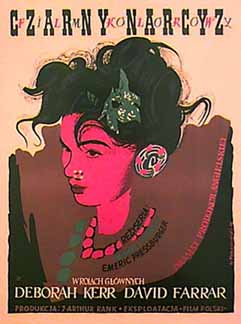
1947: Black Narcissus

Black Narcissus (1947, Powell-Pressburger) 10/10

"I told you this was no place for a nunnery. There is something in the atmosphere that makes everything seem exaggerated." (Dean)

Atop a cliff in mountainous northern India eight thousand feet above sea level, there lies a small disused palace amongst the harsh rocky terrain called Mopu. With its jagged architecture and crumbling windswept exterior, this isolated former bordello of an Indian General seems an unlikely place for spiritual and cultural enlightenment. Yet, thanks to the gracious offering by the Europeanized General (Esmond Knight), the Order of the Servants of Mary, an Anglican convent in Calcutta have been offered the opportunity to transform this earlier house of sinful pleasure into a house of God: a place were Christ's work and imperial interaction will mould a nation of reluctant "savages" into a class of civilized citizens.

For Sister Clodagh (Deborah Kerr) this mission is her first taste of real authority. Along with a carefully selected group of nuns including garden expert Philippa (Flora Robson), a talkative social butterfly Honey (Jenny Liard), a strong-willed women in Briony (Judith Furse) and the convent's hypochrondiac Sister Ruth (Kathleen Byron), Sister Clodagh attempts to succeed were her Anglican brethern have failed in colonizing the mountain community for Britain's use. Yet, within a few months the calm and attentive young woman we meet in the stalid white convent offices in Calcutta is little more than a tattered relic of her former self: a mentally, emotionally and spiritually broken women whose faith in God and Empire have been permanently questioned.

At its onset, Black Narcissus appears to be little more than a triumphant vindication of British morals, western culture and institutionalized Christianity: elements on the wane for British audiences following the film's post-World War II release. In his often plagarized quote, film critic Geoff Andrew described Black Narcissus' depiction of India as a "state of mind" rather than a place: a notion which holds true throughout. What unfolds in Powell and Pressburger's adaptation of Rumer Godden's 1939 novel is less a structured film plot-driven film about spirituality and community and more a film about ideas and images; textures and tones; atmospheres and aromas as noted by the emphasis on Jack Cardiff's beautiful cinematography and Alfred Junge's jaw-dropping sets. Rather, than solidifying classical European-thinkng, the film is a harsh critique of the aforementioned ideas, as well as an examination of modern womanhood, sexuality and humanity's futile attempts to control nature. Brave subject matter for 1947.

With its colourful erotic frescos Mopu becomes the imperial battleground upon which the Sisters attempt to wage war on Eastern spiritualism, morals, ethics and sensuality in constrast to the bare plainess of their clothing and Calcutta office. Through education, healthcare and the addition of Christian monuments Sister Clodagh believes her subjects and environment can be altered to fit European norms. They are not an order based on pious meditation, but rather they claim to preach universal interaction and acceptance in the footsteps of Christ. Yet, their attempts to do this are undermined by both exterior and interior factors. Despite the promise of free education, the local population are not endeared to the nuns and are often paid by the General in order to learn European languages, mathematics and sciences. Their faith is placed not in the sisters, but in a local silent Holy Man who sits at the edge of the grounds in endless meditation. Only the Sisters' European medicine entices the citizens to straddle up the treacherous mountainside to Mopu, despite the Sisters' reluctance to dispense it to an uneducated population whom they hold in contempt.

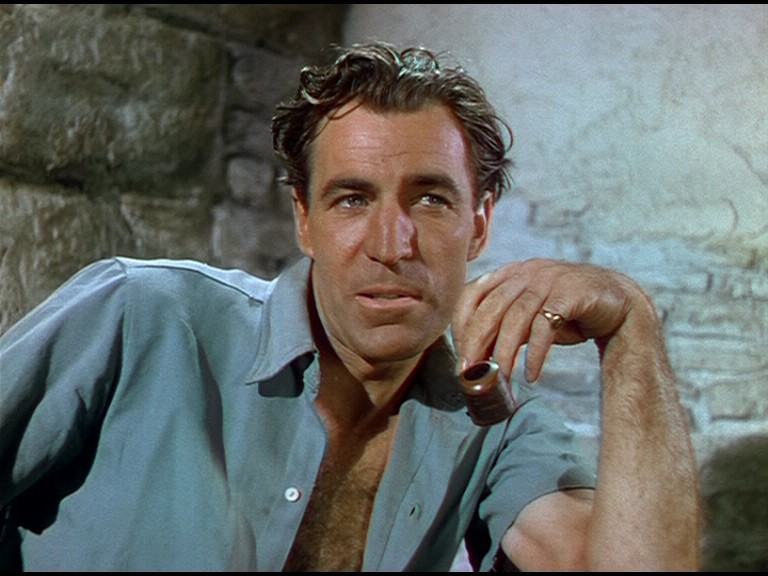
With its constant wind and cool temperatures, the Sisters begin to feel the thin mountain air and purified water is affecting their senses, spoiling their slumber and causing them to become ill. Yet, the climate is not necessarily a source of their ills, but a catalyst for their hidden desires and feelings. In his lush cinematography Jack Cardiff utilzes shadows to repeatedly demonstrate the aura of foreboding darkness entering the hearts and minds of the nuns, which has been triggered by their isolated habitat. Throughout Black Narcissus, Sister Clodagh and her fellow nuns attempt to foster a spirit of female independence, which will allow them to prosper as servants of God and the community were their Anglican brethern previously failed after five months in solitude. The Sisters wish to confer with the citizens, maintain Mopu and continue God's work without the assistance of men including the General's agent, lusty British ex-pat Dean (David Farrar). The clash between masculinity and feminity is at the core of Black Narcissus .

As with Powell-Pressburger's other films, the female protagonists in Black Narcissus conform to one of two distinct classes of women: as either dependents or independents. In these films dependent female characters attempt to wield individual authority through repressing their sexual identity and feelings in order to fulfill their expected potential in prestigious roles. However, the dependents such as Sister Clodagh and Moira Shearer's character Vicky in The Red Shoes require the skills of utility and authority bestowed by their male counterparts in order to survive; the independents such as Sister Ruth or seventeen-year old Indian temptress Kanchi (Jean Simmons) or Catriona Potts in I Know Where I'm Going display a rigourous vitality and unorthodox approach to their gender roles, which unsettles dependent female characters such as Kerr's Sister Clodagh who see them as a threat and a danger to the symbolic order: yet who are undermined by their own inadequacies to cope with the situation at hand.

Yet, Dean is not the only man who inspires the women. Although they initially reject the General's nephew (Sabu) because of his gender into their education program, the Sisters are conversely smitten by him and his luxurious clothes, attentive charm and use of the manly aroma Black Narcissus, which he purchased at a London Army and Navy store. In contrast to the primal, macho and hyper-masculine Dean, the General's nephew is sensitive, intelligent and caring toward women: seeing them as equals, rather than future lovers. Despite his wealth and status, Sister Clodagh reacts angrily to the General's nephew's secret acquaintance with the erotically charged Kanchi whom the Sisters only accept at Dean's polite behest. It is the unwanted presence of men like Dean and the General's nephew which trigger romantic memories, colourful ideas and causes the order to lose sight of its Christian goals to in-fighting and sensual pleasures. Through veiled windows and brief interactions with Dean, the already fractious relationship between Sisters Ruth and Clodagh disintegrates as Sister Ruth becomes even more independent and attempts to take on a more important role. This is noted in her reception to saving a dying woman's life. With her blood-soaked clothes and joyous response, the imagery here seems to metaphorize a real sexual awakening in Sister Ruth, which undermines Clodagh's ability to control her. Additionally, Sister Philippa abandons her mandatory attempts to grow vegetables in favour of the sensual power of luminous wild flowers, while Sister Clodagh reminisces of her failed Irish romance, which thrust her into God's work in a faraway land despite her earlier admission that she would never leave Ireland. These psychological awakenings are critical in the film as they humanize the nuns from obedient servants to questionable disciples.

Ideas of time and space are integral to Black Narcissus and demonstrate the inability of humanity to repress its most basic desires and thoughts over an elongated period. In her misinterpretation of this questioning of faith as treachery rather than human nature, Clodagh loses control of the Order. The casual elements of institutionalized religion such as Dean's notion of Jesus being consumed as "daily bread" are scorned. Rather, than accept change Clodagh blames the changing emotions on the inhospitable weather and topography rather than the unearthing of repressed incontrollable human emotions: prescribing further hard labour rather than open communication as a cure for the ills of Mopu. As a result of her inability to no longer control others, the Order retreats away from the community; becoming less of a welcoming sanctuary and more a violent prison of the soul. With the slow eradication over time of the formal codes of conduct within the Order, raw emotion spills over and produces perhaps the film's most memorable sequence in which Sister Ruth abandons her yearly vows: and in the process becomes an almost anti-Christ figure in the eyes of Sister Clodagh with her seering eyes, daring dress and sultry red lipstick. This fantastic scene can be shown in stark contrast to the delicate naivety shown by Jean Simmons' Kanchi who understands her sexuality and allows her ideas to come to the surface rather than repressing them in the name of upholding traditional gender roles and cultural standards.

Although the sub-plots involving Kanchi and the General's Nephew are wastefully underdeveloped, they provide a solid counterpart to the stubborn European superiority complex which collapses on foreign soil. The failure of the Sisters to acclimatize to their surroundings demonstrates Powell-Pressburger's critique of traditional European society's inability to nurture independent citizens. In Black Narcissus, British imperialism retreats from the unknown to the sanctuary of traditional British values, due to the limitations placed on the possibilities for women and for non-European cultures within the colonial world. Unlike Kanchi or Sister Ruth, Sister Clodagh is unable to separate spiritual and emotional independence from one another. Additionally, she is unwilling to accept an interdependent community in which Europeans, Indians, men and women work together, nor does she equip herself and her colleagues with the tools to prosper in an inhospitable environment. In their abhorrant treatment of the native citizens and ideas of Anglo-European perfection, the nuns eliminate future participants such as Dean or the Nephew's General who could create a hybrid community in which the Holy Man and the Christian Sisters could harmoniously flourish. As a result, their already fractured relationships produce further tension and undermine both their Christian vows and their mission of peace and civility.

* Black Narcissus is available through Criterion

Other Powell and Pressburger Films Reviewed:
A Matter of Life and Death (1946) 8/10


Copyright 2006 8 ½ Cinematheque.

Labels: , ,

Saturday, June 24, 2006

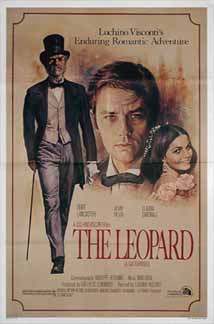
1963: The Leopard

The Leopard (1963, Visconti) 10/10

"We were the leopards, the lions, those who will take our place will be jackals and sheep, and the whole lot of us- leopards, lions, jackals and sheep- will continue to think ourselves the salt of the earth" (Prince Don Fabrizio Salina)

The Leopard is a film about the ascension of one class and the decension of another. Set in the mid-19th century, the film explores the uprooting of traditional Italian society as a result of the cultural and political movement of the Risorgmento (or resurgance). In the decades following the defeat of Napoleonic Europe, the age of empire was unknowingly on the wane. The liberation of communities from imperial forces and the rise of romanticism in fractured "nations" sparked desires for statehood and the unity of a people.

Alongside the German "nation", the Italian people were a group desperate to bring a political unity to their separate kingdoms and myriad of city-states which composed the Italian nation in order to create a single Italian state. This resurgance in Italian national identity after generations of foreign conquest had troubling consequences for tradtional Italian society. The country was split over the political identity of this new state as a constitutional monarchy, a confederation under the leadership of the Vatican or a democratic republic. It is within this historical context that The Leopard takes place in which the ancien riche and nouveau riche jostled for the leadership and power of this new Italian nation-state. The film's title is most likely taken from an Italian term "Gatopardismo" (the term awkwardly translates into English as Leopardism) when according to historian Tony Judt individuals change their political "spots" or affiliations in order to avoid conflict in changing political situations.

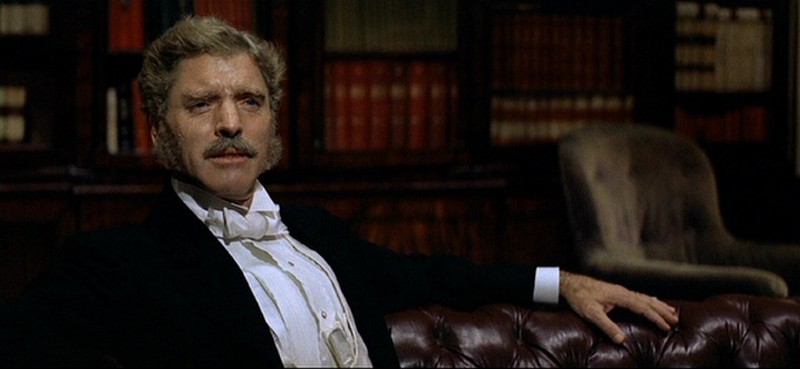
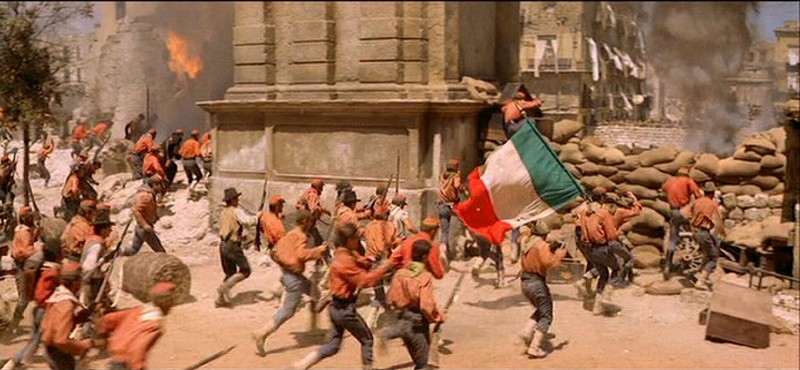
The Leopard is set around the activities of aging Prince Don Fabrizio Salina (Burt Lancaster) on the island of Sicily over a two year period. The Prince is an erudite scientific scholar, a man of logic who is prided around the island for his feats in the realm of astronomy. A commanding and intelligent patriarchal figure, the Prince's interior domestic life is opposite to his exterior regal status. The film's opening shots lead us to a grand country mansion located within the harsh Sicilian landscape: embodying the splendour and opulence the Prince manifests in his exterior life against the harsh terrain with its own political symbolism. Inside, the family are holding mass despite the cries of the servants who find a young soldier dead on their property. The revolution has hit home. Along with his priest, he decides to travel to a different home in order to protect it from the marauding soldiers of Garibaldi's republican Red Shirts who have landed in Sicily. The decision to bring along the priest is more a matter of protection, rather than spiritual advisement as throughout the film traditional institutional figures such as priests are showed great reverance and respect. While the rest of his family sob over the Prince's dangerous trip, he vents his disgust and anger to them. This early scene shows us a key facet to the Prince's personality in relationship to his family members.

He is a loner amongst them: an isolated figure who ignores his plain daughters and directionless son. He no longer engages in sexual activities with his wife Maria Stella (Rina Morrelli), but rather spends time with a lower class prostitute in the ghettos of Palermo. With his power and prestige, the Prince can even disregard the spiritual advice from the family's bumbling Catholic priest without much complaint. Whilst filling the air with blunt anti-clerical jokes and quips to his uptight clergyman, the two individuals whom the Prince is most direct and honest toward are his hunting partner Don Francisco Ciccio Tumeo (Serge Reggiani) and his politically agile nephew Tancredi (Alain Delon).

The first time we see Tancredi is in the reflection of a mirror while the Prince is shaving. In Tancredi, the Prince not only sees a younger version of himself, but the key to securing the family's future and prominent status in Sicilian society. His love for Tancredi is so strong that when his nephew rejects the Prince's shy and stubborn daughter Concetta (Lucilla Morlacchi) for a local middle-class Mayor's daughter Angelica (Claudia Cardinale), the Prince supports Tancredi against the wishes of his wife. Tancredi needs the financial security that the newly-bourgeois Mayor Don Calogero Sedara (Paolo Stoppa) can provide in exchange for the false sense of privileged influence that only the old aristocratic nobility can offer as compensation. Furthermore, Tancredi is an opportunistic and free-spending individual who unlike the prince acts on impulse rather than calculated logic. With little faith in the abilities of his own son, the Prince places his trust, adoration and reputation in Tancredi who has joined Garibaldi's anti-aristocratic Republican Red Shirts under the pretense that "If we want things to stay as they are, things will have to change."

A key feature of The Leopard is in Mario Serandrei's smooth editing which allows the film to flow at a brisk pace and allows for the seemless transistions between the intimate and the operatic. Like the Prince's favoured astronomical sciences, Visconti's film utilizes a cyclical notion of history. Characters, words, actions and events are re-simulated in subtle disguises to address the changing nature of Italian society and the Prince's domestic life. This is notably seen through the actions of Tancredi, particularly when he is shown acquainting with the ever-changing Italian military, as they quickly move from being Garibaldi's impulsive anti-royalist guerilla forces to regimented pro-royalist anti-terror squads. The infusion of democratic ideals onto the Sicilian political landscape with a plebiscite regarding the annexation of Sicily to the Italian mainland is another key matter in demonstrating the modifications of class relationships and the influx of corrupt political schemes including bribery, rigged elections and the acquistion of tracts of land through backhand tactics.

[Spoilers in the the next two paragraphs]

The Leopard may be an Italian film, but it is a Sicilian epic. The island's harsh topography, inclimate geography and impoverished status is used to great effect throughout Visconti's intelligent epic. The loss of an independent Sicilian political identity is a key element to the picture, which is mostly felt on the shoulders of Lancaster's Prince. Despite his initial happiness with political unification as a means of securing his own future, the Prince becomes increasingly dismayed at the underhand approach and dirty tactics displayed by the local bourgeoisie, the military and the federal Italian politicians. The film can be viewed as one of two parts: the first in which Italian annexation is seen as a route to secure prosperity through Tancredi and the second in which the Prince realizes the utter failure of such an approach that has done little to protect his prominent status. As with other films in the period, The Leopard is equally a film about the conflicts between the old and the new. On a political level, this can be seen in the Prince's arguments with the bourgeoisie; on a domestic level it is through his fleeting faith in an increasingly bawdy and comtemptuous Tancredi and his realization of the defiencies of his own youthful progeny.

The film's celebrated ballroom sequence- beautifully shot by Giuseppe Rotunno- demonstrates the Prince's melancholic summarization of his choices were the generations of cross-breeding between select families and cousins has not resulted in a purified and noble class, but rather a slovenly and ignoble group of idle children who are either overtly wayward in their direction or stubbornly refuse to have any such as his own daughter Concetta who refuses the overtures of a Milanese Count (Terence Hill) due to her distaste for the urban north and her dwelling upon a lost love. Here the politically young rebuke the ideas of their elders without apology or reservations; while the youthful children dance and giggle only for their parents to attempt securing partnerships to save their fading status. Thus it is only through a last waltz with his beloved nephew's fiancee Angelica that the Prince realizes his own failures and triumphs: finding solace in angelic beauty.

Throughout the film Visconti rarely uses close-ups; preferring instead to utilize medium and long-shots to enhance the interior mood of the character against the architecture: a method utilized by both Antonioni in L'Avventura and Olmi in I, Fidanzati. The ballroom sequence is one of several sequences that uses the motif of multiple doorways being opened at once noting the opportunites and pathways for the characters to choose. Visconti's method, whether in elegant salons or dim alleys, to allow characters to fade out of view is another remarkable visual symbol designed to show the impermenant status of mortality and livelihood.

Unlike American epics of the period, Visconti allows Rotunno's camera to blend into the crowd as almost a third-party observer: gazing upon the characters in question from eye-level as by-passers naturally walk in-front of their field of view. The stunning cinematogrpahy ranges from the impressionistic influenced exterior imagery which evokes the cruel majestic status of nature, to the Baroque interior sequences which are ornately decorated, lavishly costumed and exqusitely detailed. The rich cinematography provides a deeper layering of the character's thoughts and feelings: aiding in the film's visual psychology.

Despite belonging to an ancient Italian aristocratic family himself, Visconti was an intellectual Marxist who preferred on paper the idea of egalitarianism. Thus, the director has a personal equation to the film's themes of a vanishing class, as well as the Prince's own struggle with balancing democracy and the retaining of his former privileged status. Visconti's use of locations and ability to allow characters, images and feelings to engage in a transition between detachment and intimacy is a rare feat in a historical epic. Nina Rota's score adds the atmospheric notions of melancholy and prestige in its richness. In one of his best roles Lancaster is strong and powerful as the tempermental, yet unenduring noble figure who labours to balance authority and change. Delon is magnificent as the Prince's spontaneous playboy nephew adding a degree of envy and ill-boding motivation to the character. Yet, the real star here is Cardinale: a gorgeous ball of steaming sex, who perfectly fits into the naive aura of her character as an individual who brightens weary hearts and stops the activities in the room with a single movement.

The Leopard is a brisk, scholarly and gorgeous historical epic. Shot with decadent care, the film manages to encompass the chameleon-like changes in tone set in motion by the events of the Risorgmento in mid-19th century Sicily. With a splendid cast, Visconti captures a moment in time that whilst predating the political changes of the late Sixties feels to be an ominent forecaster of the failure of such revolutionary ideas. The setting of Risorgmeneto Italy was utilized by Visconti in earlier pictures such as Senso and therefore it would have been interesting to see how similar Visconti would have made this film in 1968, rather than 1963. Such is its universal classicism and inquisitive political approach, it is unlikely he would have changed a single beautiful thing.
-------------------------------------------------------------------------------------
* I would advise anybody who wishes to see The Leopard, but has no background in Modern European history to watch the fifteen minute historical context special feature on the second disc about the Risorgmento on the Criterion DVD prior to watching the film. It does not give away any spoilers and is a valuable aid for those without any knowledge of that period.

** The Leopard is available through Criterion

Copyright 2006 8 ½ Cinematheque.

Labels: , , ,

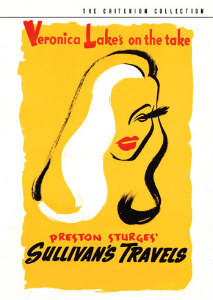
1942: Sullivan's Travels

Sullivan's Travels (1942, Sturges) 7/10


John Sullivan (Joel McCrea) is your classic versatile Hollywood director: reliable, profitable and respectful. After shooting such "classics" as Ants in Your Plants of 1939 and Hey, Hey in the Hayloft, Sullivan has decided to move into the cinematic domain of Capra: creating social justice pictures to aid those in troubled times. Sullivan is the type of artist, which Andrew Sarris would expect and which Leni Riefenstahl would be bemused over: a Sarrisian auteur figure willing to imbue his own personal stamp on his projects and utilize his stature to raise political and social questions; unlike the self-proclaimed apolitical Riefenstahl who claims that art and politics act within their own separate spheres.

Preston Sturges' 1941 film Sullivan's Travels begins with a rip-roaring fight atop a train on a stormy night, which would not be unfamiliar in the work of Lang or Hitchcock. The two men continue to battle before falling off the train and into the river below as "The End" surfaces from the icy water. It's all metaphorically political in Sullivan's mind. It's capitalism versus communism in a futile brawl atop one of the Industrial Revolution's signature pieces. Yet, to the studio it is trouble. Serious pictures do not sell in mainstream America and could later cause trouble: a fact in retrospect to which Sturges was extremely perceptive given the trouble social justice pictures brought about for figures such as Dmytryk and Trumbo a decade later. But Sullivan is their star director and thus he decides to utilize his clout within the studio system to make the great American social picture to be entitled Oh, Brother Where Art Thou? Naturally, the studio are unamused and would prefer Sullivan to create a less-personal project in the form of Ants in Your Plants of 1941 instead.

Sullivan is convinced that through the power of images, he can change modern society for the better. He is a true idealist, the type who later on would have been called in front of HUAC and probably blacklisted. He undertakes a research project designed to find out the type of material he should utilize in Oh, Brother Where Art Thou? Thus, against the warnings of the studio and his assistants, he disguises himself as a tramp (a socially inclined reference to Chaplin's oeuvre) and traverses the American landscape in search of the hapless and the hopeless impoverished wastrels who have been abandoned by their nation. Yet, there is something oddly ironic about his journey. No matter how hard he tries to leave the confines of Hollywood, it never leaves him.

He is followed by an RV of press agents, chefs and reporters attempting to utilize his story as the greatest PR coup in history. When he does attempt to escape via hitchhiking, he always ends up back in LA. He meets an unnamed female simply known as "The Girl"- played brilliantly by the astoundingly gorgeous Veronica Lake:a poor studio's version of Lauren Bacall. She offers to aid Sullivan in his travels; yet she, like Sullivan, is bothered by their meager conditions and their inability to find viable source material. When they do encounter their future subjects and material they are aghast at the plight and conditions, which will later create Sullivan's sympathetic masterpiece. Trouble arises and Sullivan himself ends in the position of those whom he wishes to create a film about. Without his assistants and his money, Sullivan is just another man resigned to an inescapable fate.

Sturges' film is a sophisticated masterwork of satire: a superly directed and touching road film with a splendid cast and a personalized message on the state of American cinema. He follows the credits with a personal homage to clowns and to comedy and ends the film with a group of prisoners forgetting their troubles through laughter. Throughout the film, Sturges parodies the type of films Sullivan wants to emulate: films by Capra and Chaplin and works such as I Am A Fugitive on a Chain Gang, Grapes of Wrath and The Prisoner of Shark Island. There is even a scene in which Sullivan is watching a serious film in a rural theatre were very few members of the audience are actually concentrating on the film at hand. His message is clear. Although social justice films have their place, it is the belief of Sturges that comedy has a greater importance in the lives of individuals: that through comedy they can escape their internal and external problems and enjoy the silliness of life.

In order to demonstrate his thesis, Sturges utilizes almost every brand of comedy during the period including a sped-up slapstick car chase; sight-gags in paintings, Hollywood in-jokes and witty social critiques. His casting of honest everyman Joel McCrea perfectly extenuates Sullivan's desire to disappear into the masses and become the credulous face in the crowd. Yet, his approach belies that fact: pulling up in an expensive car to hitch a ride on a freight train; or using clothes and props from the studio to make himself appear more authentically downtrodden. The result is Hollywood's version of a bum. When Sullivan and "The Girl" encounter reality they are stunned by the horror of it, yet are pleased by the kindness of strangers such as the poor and isolated coffee shop owner who gives them food for nothing.


Thus, these stripped down, almost neorealist segments in the film are Sturges' own nod to the futility of Hollywood attempting to create a document of poverty through their expensive wardrobes, sets and art direction. Sullivan's own ability to escape Hollywood figuratively and mentally is a further example of this element. These assured and sensitive attempts at replicating such conditions onscreen throughout Sullivan's Travels provides further credence to Sturges' promotion of a supplementary relationship between comedy and social drama in Hollywood: which does not necessarily require that seriousness on screen be given more responsibility and acclaim than comedy, but rather that each form is recognized for its beneficial effects on the populace.

* Sullivan's Travels is released separately in a deluxe edition by Criterion and is included in a basic edition in Universal's Preston Sturges: The Filmmaker Collection

Copyright 2006 8 ½ Cinematheque.

Labels: , , ,

1939: Young Mr. Lincoln

Young Mr. Lincoln (1939, Ford) 8/10

The cinema of John Ford is often the cinema of American mythography. Despite his Irish Catholic roots, there is perhaps no other director who has repeatedly attempted to capture the historical American essence on celluloid as much or as well as John Ford. Young Mr. Lincoln is a minor masterpiece of Ford's idyllic poems to American populist folk history and its sense of character. While Ford is best known for his Monument Valley westerns such as Stagecoach and The Searchers, Ford's filmography displays a variety of important (yet today often overlooked) historical (Young Mr. Lincoln/Prisoner of Shark Island/Drums Along the Mohawk) and contemporary (Last Hurrah/Grapes of Wrath) attempts to define the American spirit.

Young Mr. Lincoln is one of Ford's earliest forays into this historiographical era, which produced early highlight The Prisoner of Shark Island documenting the miscarriage of justice when Dr. Samuel Mudd (Warren Baxter) was incarcerated to the Shark Island penal colony for his supposed involvement in the Lincoln assassination: Curtiz' The Sea Hawk taken from Sabatini's book is a much more famous and frivolous example of a figure wrongly accused, which takes on a much more epic and lively form. Young Mr. Lincoln made three years after The Prisoner of Shark Island also examines democracy, justice, liberty and other American values during the fragmented pre-Civil War period. Much like his Drums Along the Mohawk made the same year (1939 also saw Ford direct Stagecoach) as Young Mr. Lincoln, Ford attempts to find the historiographical roots of Americana.


Young Mr. Lincoln is not a historical accurate account of the life and times of Abraham Lincoln, nor is it meant to be. Rather it is an examination of ideals and community built around the romanticized actions of Lincoln, who is considered to be one of the great American champions of these cultural standards. It is crucial for modern audiences to understand the historical period under which Ford's film was created in which the world was yet again on the verge of war and extremist ideals at either of the spectrum reigned unchecked. Thus, Ford's film becomes a gentle patriotic reminder to American audiences about the importance of maintaining an American identity and history in a turbulent era of revolution and totalitarianism. Critics such as Karl Williams have often referred to the picture as a "hagiographical" account of Lincoln's formative years rather than a complete biography: a film designed to swell the myths surrounding the cult of Lincoln giving the "Great Emancipator" an almost God-like status: made more pertinent by Fonda's assertions that the role was akin to playing Jesus. Yet, such critical voices tend to forget the timeframe under which the film was created, as well as the conditions under which films were made during the period. Any attempt to create a multi-faceted film about Lincoln's life would appear as blasphemous to censors and audiences alike. Allowing the spread of populism during such an ominous period outweighed the need for historical checks and balances.

Although a staunch social conservative, the ideals Ford stresses in the picture belong to classic liberalism: rejecting big government in favour of increased civil and economic liberties. These liberalist tendencies fit within the classic American perception of how a democratic society should operate. It is this ideological preference which has resulted in Ford's filmography being often misinterpreted and misunderstood. Whereas openly racist pictures such as Griffith's Birth of a Nation, although integral to any understanding of cinematic history at a technical level, continue to garner acclaim; Ford continues to be relegated based on his awkward and antiquated attempts at addressing racial or social issues: in a period which repeatedly failed to explore them publically and despite the social continuance of the populist ideals he explored. Thus typical Ford comedies such as Donovan's Reef have become neglected, as have Ford's more expansive attempts at addressing racism and sexism such as Fort Apache, Cheyenne Autumn, Sergeant Rutledge and Seven Women. Even The Searchers-today often the most lauded Ford film- strives to examine the source of racism, despite its rather hackneyed and hasty embrace between racist Ethan Edwards and his niece.


Young Mr. Lincoln is not a Ford picture designed to address these social problems, instead it focuses on the society that would establish and preserve the validity of such ethical choices until the Civil Rights movement in the late Sixties. An often barely recognizable and brilliant Henry Fonda transforms Lincoln from a mythical figure to a humble and hard-working lad who rides a mule because he cannot afford a stately horse. Ford's Lincoln is an idealist and a champion of American liberty, truth, education and justice. He aids a pioneer family in return for a collection of law books (Blackstone's Commentaries), which the illiterate clan have no use for and reads them in fascinated solitude by a river to decipher their spirit and definitions. The often repeated image of the river is part of Ford's sophisticated lens and becomes an important symbol for change, progress and the future.Throughout the film, Ford (as in many of his other films) examines the spirit and values of the American community through the participation in town festivals, sports, games, contests and parades. Here notions of fairness, tradition and vitality become sewed into Ford's American historical fabric.

Yet, the social workings of the film's first half give way to a more political and legal commentary on American society.The film's centerpiece trial continues Ford's mythographical look at Lincoln. The trial itself was not based on any case tried by Lincoln, but rather on a trial witnessed by screenwriter Lamar Trotti. Yet, it is the film's key moment, which creates the greatest insights into the characteristics of the Fordian Lincoln. The community fondness toward lynching the Clay brothers (suspects to a murder during a town festival) is akin to that in Fritz Lang's first American film, the superb anti-lynching drama Fury made three years prior and demonstrates Ford's desire to stress patriotic American democratic values: access to a fair trial, equal justice and liberty to the innocent.

The communal fury over the prospects of a trial and the denied calls for the suspects to be lynched demonstrates Ford's reassertion of democratic justice over vigilante justice in a time when Fascist thuggery and Orwellian pre-emptive trials were prevalent in Germany, Italy and Stalinist Russia. Lincoln's active participation in the trial and his effect on the community reinforce American values in a society, which is in danger of losing them to fear, blind justice, political coercion and irrational judgments. The thunderous cloud which represents the oncoming storm of the Civil War simultaneously stresses the future storm far away from American soil in Europe; yet also the possible danger lurking in the hinterlands of a corruption of American values, which can be avoided through following the disciplined example of Abraham Lincoln and his correlation to American ethical, social and moral codes.

* Young Mr Lincoln is available through Criterion

Copyright 2006 8 ½ Cinematheque.

Labels: , ,

1942: The Children Are Watching Us

The Children Are Watching Us (1942, de Sica) 8/10


The Children Are Watching Us was Vittorio De Sica's fifth film as a director, but more importantly it was a proto-neorealist melodrama, which laid the domestic groundwork for future neorealist classics such as Bicycle Thieves and Rome, Open City. Whereas neorealism deconstructed ideas about class and poverty through a Christian-Marxist lens, The Children are Watching Us still retains the sympathetic emotion-laden cinematic language and sentimental overtones of Fascist period Italian cinema, as well as the utilization of studio sets and actors. Yet, even though the film is situated around a crime of passion, the "crime" itself is not a state offence, but a moral and spiritual one.

Filmed in 1942, but only released in 1944 after Mussolini was defeated, the story taken from neorealist screenwriter Cesare Zavanetti's script tells the tale of young Prico (Luciano de Ambrosis): a Roman infant who awakes one morning to see that his bourgeois mother Nina (Isa Pola) has left town in the night with her on-and-off lover Roberto (Adriano Rimoldi) . Prico's father Andrea (Emilio Cigoli) a prosperous businessman is driven into a state of shock. Unable to parent his own son, he attempts to briefly whisk him away to his relatives in order to figure out the boy's future.

The child becomes an unwanted gift: a parcel re-directed from door to door in an attempt to find a suitable guardian. Nobody wants to assist the father or his son, rather they openly blame the child and his mother for the situation at hand. His aunt is unwilling to take him as it infers with her work and own romantic life; his grandmother leaves the boy malnourished and scorns his childlike behaviour as it interrupts her peaceful retirement; while his cousin Paolina allows him to run away in order for her to secretly rendezvous with a local barber.


In doing so Prico witnesses an unfiltered view of the world. De Sica makes a key artistic choice by making Prico the vehicle by which the social and domestic horrors of the world are decoded. Throughout the film, De Sica allows the boy's eyes to strip away all the pure moral fantasies of marriage, childhood and domesticity as propagandized by Mussolini's regime. Through it we see Prico repeatedly pushed away to interact alone in corners, while the adults gossip; allowing him to listen to uncensored adult material about recent sexual escapades, forbidden lovers and material interests.

Yet, Prico is not as complacent or unknowing an observer as the adult world appears to believe he is. Rather, he allows the information to seep into his heart: creating his own complex internal destruction and sadness: which notably springs to life in a feverish train ride reminiscent of the tornado scene in the Wizard of Oz. In an attempt to keep the boy docile, his mother and other relatives bribe him with empty promises of gifts, trips and affection in order for him to lock away their secret sexual trysts and nightly love affairs. He sees the destruction of his family unit: the melancholy hopelessness of his father and the unabashed adultery of his mother. In an especially powerful scene, the young boy witnesses his mother being attacked by her lover; only to later on in the film view the same couple continue their love affair at a middle-class holiday resort, while Prico's father is called back to Rome on business. Prico's response is stunning as he flees the resort and attempts to board a train back to Rome to be with his father. This scene culminates with the boy almost being hit by a speeding locomotive only to be chased away in tears by an unsympathetic railway attendant.

At times the film is as shocking today is it was over forty years ago. It's power is found in the fostering and the dissolving of individual relationships between the boy and his parents. Although Prico is at times too cute and angelic; Renzo Rossellini's score is repeatedly overly sweeping; and de Sica utilizes far too many tearful close-ups, this is an immensely powerful and wonderful film. The script and the film's more understated scenes carry the picture and surprisingly give it is greatest emotional impact. The restrained melodrama of the scene in which Prico's father attempts to learn about his wife's escapades utilizes close-ups in a touching and effective manner. Yet, nothing can prepare the audience for the film's devastating finale, which one must find difficult to comprehend how audiences in 1944 received the film's finale.

The Children are Watching Us is as pertinent now as it was sixty years ago. Although it contains some intensive emotional conditioning, the film never wavers from its attempt to demonstrate the worldliness of the child. The film's title recognizes that and warns adults to maintain a level of respect and dignity within the presence of children. De Sica's film attempts to show that while children may not understand the material spoken by adults, they can comprehend the consequences, which will envelope their little universe. As with De Sica's later Bicycle Thieves, the picture promotes the importance of strong moral examples and the creation of a relationship between parent and child that is not based upon material goods and vacant promises, but on a spiritual kinship fostered by an active interest in the child's life and in the world s/he is developed within.

* The Children Are Watching Us is available through Criterion

Copyright 2006 8 ½ Cinematheque.

Labels: , ,