Reviews and criticism of classic and contemporary films

Thursday, April 19, 2007

1951: His Kind Of Woman

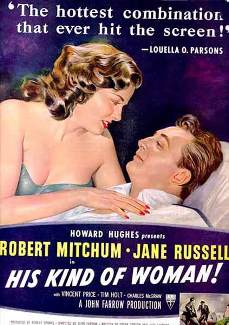
His Kind Of Woman (1951, Farrow) 5/10
"Whenever I have nothing to do and I can't think, I always iron my money (Dan Milner)
What d'ya do when you are broke? (Lenore Brent)
When I'm broke, I press my pants (Dan Milner)

Throughout her two decade career, controversy seemed to follow Jane Russell. Not for risqué behaviour, but rather as documented in Martin Scorsese's The Aviator, the protruding extent of her cleavage. Unlike other similar popular sex symbols of the period, Russell's off-screen life was not filled with scandalous behaviour or psychological difficulties that blighted the private lives of Lana Turner or Rita Hayworth.

Signed to a seven-year contract with Howard Hughes in the early Forties, Russell's career infamously became linked to Hughes' attempts to demonstrate her physical attributes, rather than her acting talents. Yet, in films such as Howard Hawks' Gentleman Prefer Blondes, Russell proved adept at playing wisecracking, strong women unafraid to insert their views or stamp their authority upon a situation.

While her later career was fraught with a slew of forgettable films and flops such as Nicholas Ray's Hot Blood and Norman Taurog's The Fuzzy Pink Nightgown, her mid-period, particularly alongside imposing actor Robert Mitchum in a pair of oddball Noirs- 1952's Josef von Sternberg film Macao and John Farrow's 1951 His Kind Of Woman- demonstrated her ample skills.

In 1951, Howard Hughes earmarked His Kind Of Woman to be a showcase for Russell. An eccentric romantic-adventure-comedy draped in the chiroscuro clothing of Noir, His Kind Of Woman is a sprawling mess: as entertaining as it is infuriating. Set in Mexico, the picture involves Dan Milner (Robert Mitchum) as a down and out professional gambler, who is offered $50,000 by a group of his underworld colleagues to await orders. Along the way, Milner meets Lenore Brent (Jane Russell), a socialite-cum- chanteuse who is flying down with Milner to Morro's Island.

Despite its beginnings in typical urban Noir settings such as cramped apartments, dining cars, cavernous mansions and Mexican bars, the film jettisons to the un-Noir-like Frank Lloyd Wright inspired Art Deco surroundings of Morro's Island: a resort for wealthy eccentrics including ham actor Mark Cardigan (Vincent Price), a chess-obssesed writer in Martin Krafft (John Mylong) and a gambling insurance salesman named Winton (Jim Backus).

While others lap up the sun and the alcohol, the teetotal Milner finds out the true nature of his mission from Lusk (Tim Holt): a federal agent tracking the mysterious involvement of several of the hotel's guests in an attempt to bring exiled gangster Nick Ferraro (Raymond Burr) back into the United States.

His Kind Of A Woman is a misleading title. Despite the steamy air of mystery which follows her, Russell's Brent is not a typical Noir femme fatale. Her intentions are always benevolent and never concealed. Her reason for swooning with the nouveau riche is simply to solidify the trans-national relationship between her and longtime lover Cardigan. She never feels any ill will toward Milner, but rather goes out of her way to protect him: supplying him with weapons, securing assistance and so forth. Her passion for Milner stems out of Cardigan's disregard for her emotional platitudes in favour of hunting; unlike Milner whose veiled remarks and body language suggest the possibility of a relationship.

It is this interplay of characters which signifies the film's opening hour. The plot leisurely adapts to the tropical surroundings in the first half of HIs Kind Of Woman. There is little that genuinely thrills in His Kind Of Woman as the film's first hour is more of a laid back meditation on identity and personality. We learn about the existential nature of the characters themselves and why they are here? And who are they with? Yet, little of the film's plot reveals itself in these sequences beyond a few verbal skirmishes between an investigative Mitchum and the resort's heavy Thompson (Charles McGraw).

The film thus strongly infers a typical Noir theme of identity throughout. Mitchum's character knows little of why he is at the resort, but is desperate to consolidate a reason for his colleagues' hefty investment. Despite her acclaimed riches, Lenore Brent is not exactly the woman she appears to be, as a guitar player in the resort's band attempts to inquire into her veiled past. Ferraro's approach to identity is even more diabolical, as he wishes to take Milner's physical identity through the type of bizarre plastic surgery which Georges Franju would later make famous in his poetic horror film Eyes Without A Face.

Furthermore, nobody in His Kind Of Woman seems willing to self-analyze their personal crises. Rather they need the form connections with others in order to solve their discrepancies. This can be seen in the young couple, who are gambling away their life savings. After Milner intervenes at the silent wish of the young bride, the couple regain their finances. Cardigan is equally perplexing. While Lenore believes he has been divorced for several months, the actor's wife like something out of Fellini's 8½ stumbles back into his domain, whilst he is on vacation. Cardigan's reflexive and quizzical behaviour begins to find a purpose in his attempt to save Milner from Thompson and Ferraro.

As noted earlier, gambling is also a prevalent theme. Milner retorts that he only engages in games were the outcome has already been decided; yet he is known to have been repeatedly unlucky across Southwestern California: hence his desperate acceptance of the enigmatic $50,000. The theme of games and gambling extends to Krafft's solitary chess matches, Winton's aggressive tactics against a hapless newlywed and Mitchum's surreal insertion of a leather shoe into the winner's pot at a game of poker.

Cardigan's lust for hunting and fishing further expands the theme, yet it also takes on a symbolic turn in Russell's animalistic pursual of Price's bumbling actor and his attempt to turn a duel with McGraw's Thompson into masculine sport. Yet, women are excluded from this realm in which notions of male mental skill and intelligence are demonstrated. The film's female characters are more obsessed with money. Their intellectual acumen is used to preserve their financial state such as the young bride stopping her husband and both Lenore Brent and Helen Cardigan desperate to seek out Mark Cardigan.

Yet, the sultry, slowly cooked atmosphere of the film's first half gives way to jarring slapstick humour and acts of brutal sadism. Whereas the film's first half showcased the brilliant modes of sophisticated sex comedy Russell and Mitchum were capable of together, the film's latter half is devoted to an unsettling blend of devious violence and farce. The latter is filtered through Price's Shakespeare-spouting Cardigan and was expanded at the behest of producer Howard Hughes who adored Price and the Cardigan character. This queasy potpourri of humour which plays upon racial stereotypes and sight gags is more akin to Frank Capra's Arsenic and Old Lace than to Mitchum's great Noirs such as Out Of The Past.

Combined with the vicious nature of Raymond Burr's Ferraro, the film's last hour unbalances an already uneven film. The film's latter third was completely re-shot by director Richard Fleischer ( The Narrow Margin; Compulsion) at Hughes' behest and sits uneasily alongside the lazy, slow-building tension built by Farrow. Running at least half an hour too long, the film's final half stretches out Mitchum's torture scenes and Price's boggled rescue past their limit. These scenes extend notions of masculinity earlier explored through gaming in the film. Despite her persona as a tough brunette, Russell spends almost the last hour of the film locked in a closet. The only other available female character in Mrs. Helen Cardigan (Marjorie Reynolds) remains true to her feminine leanings and stays at home.

Cinematographer Alfred J. Wild applies his earlier tutelage under Gregg Toland in producing a low-angle shot, ceiling-filled maze of images that compliments both the film's somewhat Noirish leanings and its scope as a romantic-adventure. The scenes in which we first meet Russell in a Mexican cantina should be noted for the extreme lack of height in comparison to the voluptuous ceilings of scenes in a Hollywood mansion. Wild's cinematography along with the excellent, snappy banter between Mitchum and Russell are some of the few highlights to this aloof entry in Hollywood history. Although the film was surprisingly a hit, today it is often better known for Vincent Price's offbeat performance which defines the film's latter half. Yet, within the sex-dripped dialogue espoused by Russell and Mitchum, one can imagine how delicious the film could have been without studio interference.

* His Kind Of Woman is available through Warner Home Video in their Film Noir Collection V3 boxset

Copyright 2007 8½ Cinematheque

Labels: , , ,

Monday, April 16, 2007

1952: The Narrow Margin

The Narrow Margin (Fleischer, 1952) 8/10

"What kind of a dish?" (Forbes)
"A sixty cent special: cheap, flashy, strictly poison under the gravy" (Brown on Mrs. Neall)

In the annals of B-movie history, there is often a debate among critics and scholars as to what is the greatest low-budget production of Hollywood's Golden era. Generally, two films come up within this discourse. The first is Edgar G. Ullmer's 1946 film Detour; the second is Richard Fleischer's incomparable 1952 masterstroke The Narrow Margin.

Like Detour, Fleischer's film operates in the hard-boiled cynical world of Film Noir; but while Ullmer's film was financed by forgotten Poverty Row studio PMC, Fleischer had the benefit at working at RKO: a studio which, albeit was no longer the dynamic force it had been two decades earlier, was still among Hollywood's classic brand.

While film critics and cultists have often placed Detour on an unfounded critical plateau, The Narrow Margin often gets lost in the critical mix. Yet with its taut, economical pace, razor sharp dialogue and coiled narrative, the film is an exemplary showcase of how to construct a "B" picture. The high esteem for The Narrow Margin both then and now, can be seen in its 1952 Academy Award nomination for Best Story and its later unsuccessful 1990 remake with Gene Hackman in the starring role.

Set almost entirely on a train, The Narrow Margin begins at Chicago's Union Station were L.A. detective Walter Brown (Charles McGraw) and his partner Gus Forbes (Don Beddoe) arrive to collect Mrs. Neall (Marie Windsor) a saucy widowed gangster's moll. Brown's job is to protect Mrs. Neall en route to Los Angeles were she is to testify before a grand jury. Almost immediately, the vitrolic relationship between Brown and Neall is born; after the cigar-chomping Forbes is mercilessly gunned down as the pair attempt to secretly whisk Neall out of town.

However to Brown's good fortune, the fleeing assassin fails to catch a glimpse of Mrs Neall descending the staircase. After scampering onboard a train, Brown begins a game of cat and mouse with a string of mysterious men all out to silence Neall before she reaches California: including a bulging obese man named Jennings (Paul Maxey), a wiry moustached hired-hand (David Clarke) and a small-time businessman named Yost (Peter Brocco). Each uses different methods ranging from intimidation to bribery in order to ensnare Neall into their oily palms; but despite his gritty stare Brown does not bite, as he affirms his duty to protect the venemous Mrs. Neall, as well a group of innocent passengers who unknowingly become a part of this case of hidden identity.

One of the late entries into the classic Noir period, The Narrow Margin is a smart, nimble thriller which snarls through its 71 minute running time. Notable for its use of handheld cameras, Fleischer's film is a claustrophobic exploration of themes of identity, duty and corporate crime. One can find traces of its brooding malevolence in later films such as Peter Yates' Bullitt, Alfred Hitchcock's North By Northwest and John Boorman's Point Blank. Yet what separates Fleischer's film from the former two in particular is the intense atmosphere of seething contempt-similar to that found in Fritz Lang's The Big Heat from the same year.

Featuring "the King and Queen of the B's" in Charles McGraw and Marie Windsor respectively, Fleischer utilizes their sneering and conniving personas to great effect. McGraw's Brown predates the type of bitter cops which would be seen in films such as Dirty Harry. There is not much really likeable about Brown in his brooding, caustic approach to social interaction and life in general.

But underneath his hard exterior, there is a man who feels anguish about the death of his partner and the effect it will have on others. The smoky-voiced Brown may not be able to relate or confer with others on a human platform, but this arguably due to his nature as a bitter and underpaid law enforcement officer. Brown's approach to ethical procedure is acidic, but his response to duty and preserving the safety of others is altruistic and paramount.

The selflessness of Brown's work is magnified by the ambigious notion of Neall's identity. Locked in Forbes' cabin, Neall remains hidden to the crooks and criminals who are lusting for her blood outside. But since the hitmen are unaware of what Neall looks like, this becomes a problematic situation for Brown. The detective's repeated interactions with a likeable blonde woman named Mrs. Sinclair begins to arouse suspiscion that perhaps she is the mysterious Neall: extending Brown's need to protect multiple passengers.

The enigmatic nature of identity also amplifies the suspense of Fleischer's film. Since the assassins are unaware of Neall's whereabouts and Brown is unable to discern who is and isn't a possible threat, Fleischer's film aggressively plays with the concept of identity. Everyone in The Narrow Margin from the hefty man who continually blocks the corridors to the conductor is a possible suspect.

Snaking through corridors, George E. Diskant's expressionist and abrasive camera captures the claustrophobic intensity of The Narrow Margin's closed quarters, which intensifies Brown's need to remain alert at all times: as characters disappear and reappear into frame at the blink of an eye. Furthermore, Fleischer maximizes the nature of train travel by making every possible layover and stop a dangerous situation. The repeated taps on doors and the need to remain silent, also heighten the film's suspense and the weariness of McGraw's volatile sub-Kirk Douglas persona.

Like Boorman's Point Blank almost fifteen years later, The Narrow Margin explores the sophistication of modern crime. The organization which is keen to silence Mrs. Neall is headed by Brocco's Yost-incidentally also the name of a similarly ambigious character in Boorman's film- who offers Brown $30,000 in return for Neall's head. The mild-mannered Yost is not a typical criminal.

Balding and short, Yost is employed as a equipment salesmen in Chicago and refuses to carry a gun as he abhors them Yost talks to Brown about Neall in the language of modern business. He refers to his employer as a respected company and sees any compromise the pair can arrange as a viable business deal. In Yost, Fleischer thus demonstrates the multi-faceted nature of modern crime: as organizations working under respectable pretences and preferring to use diplomacy first and force second in order to achieve their means.

Cheaply crafted, yet aesthetically sharp Richard Fleischer's 1952 film The Narrow Margin is a dark biting thriller which fleshes out its intensions almost immediately. Using rapid-fire editing and ingenious sound design, Fleischer's film is able to turn small gems out of silent glances between characters and almost meaningless effects such as the sound of Neall's scratchy nail file turning into a pacy train wheel. Although Fleischer was to go on to creating illustrious A-pictures such as 20,000 Leagues Under The Sea and The Vikings, he rarely ever came close to capturing the raw fury, excitement and intensity contained in this ultimate "Killer B."

* The Narrow Margin is available on Warner Home Video in their Film Noir Collection V2 boxset

Other Richard Fleischer Films Reviewed:
Compulsion (1959) 6/10

Copyright 2007 8½ Cinematheque

Labels: , , ,

Tuesday, March 20, 2007

1948: He Walked By Night

He Walked By Night (Anthony Mann, 1948) 8/10


Alongside Agnes Moorehead, Richard Basehart is often cited as one of the greatest American actors never to be have made it to superstar status. With his icy disposition and classical training, the intelligent and dignified Basehart was perhaps too good for Hollywood. In his European period, Basehart was sought after by John Huston for the part of Ishmael in Moby Dick, by HUAC blacklistee Joseph Losey in Finger of Guilt and by an emerging Federico Fellini in both Il Bidone and most famously as The Fool in La Strada.

Yet in Hollywood, Basehart’s career bounced around town: garnering roles in war films such as Anton Litvak’s Decision Before Dawn and Samuel Fuller’s Fixed Bayonets, the odd Jean Negulesco epic (Titanic) and a pair of early Anthony Mann films, Reign of Terror and He Walked By Night. The latter film featured Basehart in a star-making performance as a quiet, sociopath electronics expert: signalling the emergence of one of Hollywood’s most understated talents, yet also defining Basehart’s career as an actor adept at playing psychological roles.

Davis Morgan (Richard Basehart) is a taciturn figure. In his cramped second-floor apartment Morgan spends his days with his dog; only leaving to sell his latest electronic invention to Paul Reeves (Whit Bissel) at his laboratory and rental outlet. Or at least that is what Reeves believes. Unbeknownst to him Morgan is a scrupulous thief wanted for the murder of a cop during a botched night-raid on an electronics store.

Silently financed by Joe Breen (the head of the Production Code's Hays Office) and inspired the true story of WWII veteran Erwin Walker, He Walked By Night is a gripping low-budget account of the police’s attempt to track down Morgan. Signed by Alfred Werker, but directed by an uncredited Anthony Mann, the film represents the post-war shift in American Noir from the corrupt individuals of the early 1940’s to the semi-documentary police procedurals of the late Forties through to the early Fifties. While Noir focuses on the darkness within human nature, the police procedural is a sub-Noir field that examines the methodology and approaches used by the state to protect ordinary citizens from impropriety. Despite its Noirish lighting and cinematography, one could argue that He Walked By Night falls under the banner of the “procedural” for its emphasis on the interlocking mechanics of crime, crime-fighting and deterrence.

As a police procedural, He Walked By Night establishes the institution of the police department as one representing values of progress, security and community co-operation. Although there are outbursts of tension in He Walked By Night from police officials, they are not equated with the private malfeasance with figures found in textbook Noir films. The semi-documentary approach utilised in this film is thus crucial in emphasising this difference. The audience are shown the instruments of deterrence and the tools utilised in the war against crime (radios, face recognition equipment and so forth) in order to show the cutting-edge nature of contemporary police work.

Yet, at the same time we are also shown the abuse of these techniques in Morgan’s meticulous approach to thwarting the law. Hidden in his garage are police radios, various license plates, false identification cards and cleaning equipment, while stored in the network of sewers under the streets of Los Angeles are more weapons and supplies to aid his cause. Morgan’s resourcefulness and utility is stressed in the film as a rarity: the product of specialised training and a threat to society. Morgan’s shifting modus operandi and proficiency in multiple fields of crime stress the further problematic nature of combating his strategies. Yet as the film proposes intra-department networking along with modern technology and public assistance can readily defeat threats to the well-being of ordinary citizens.

At the forefront of this movement was director Anthony Mann. Although better known today for his contextually violent and visually inspiring westerns, Mann is an often forgotten figure in the development of the police procedural. Before his iconic series of westerns with James Stewart, Mann was a director of romantic-comedies who shifted into the crime genre: filming a slew of Noirs such as Railroaded, Raw Deal and T-Men, as well as 1949’s trans-national police procedural Border Incident. Thus, by the time an uncredited Mann directed He Walked By Night, he had already collected a wealth of knowledge regarding the genre’s visual and moral codes, as well as building working relationships with several crew members such as cameraman John Alton who would be influential in the appearance of Mann’s later “police procedural” films.

Alton shoots the film in stunning fashion: blending Noir’s penchant for peculiar angles, Venetian blinds, wet pavements, sharp contrasting light and shadows. Using Mann’s ability to capture the fullness of space, He Walked By Night becomes a rare Noir-influenced picture which does not always rely on cramped quarters to maximise the sensation of the protagonist caught in a grandiose trap. The scene in which Morgan secretly visits Reeves' office with its cathedral ceilings and large doors is especially revealing: emphasising the physical space for Morgan to manoeuvre, yet demonstrating his inability to do so. Alton’s use of deep focus photography is particularly stunning in the film’s final chase through the Los Angeles sewer system: further exercising the falseness of space, while predating a similar sequence in Carol Reed’s The Third Man.

Mann’s film precedes later attempts at this concept such as Akira Kurosawa’s High and Low in showing the detailed dexterity of a master criminal. With its remarkable lead-performance from Richard Basehart, fantastic cinematography by John Alton and fluid direction by Anthony Mann, He Walked By Night overcomes the limitations of its thin script and maturates into an enthralling account of individual genius versus public cooperation.

* He Walked By Night is released through MGM Home Video

Other Anthony Mann Films Reviewed:
Man Of The West (1958) 7/10

Copyright 2007 8½ Cinematheque

Labels: , , ,

Saturday, March 17, 2007

1951: Ace in the Hole

Ace in the Hole (Wilder, 1951) 10/10


“Bad news sells best. ‘Cause good news is no news” (Charles “Chuck” Tatum)

"Fuck them all! It is the best picture I ever made" (Billy Wilder)

In 2003, New York Times reporter Jayson Blair was forced to resign from his esteemed American employer after he was caught fabricating evidence about the Beltway sniper shootings. Blair’s breach of journalistic principle smeared the New York Times’ reputation for accuracy: briefly inducing a public debate about media practices and the distortion of the truth for profit. Ironically the same publication fifty years earlier denounced Viennese director Billy Wilder for the creation of what Times film critic Bosley Crowther called a “preposterous” character: an immoral and opportunistic journalist who misleads the nation with his reporting of a mining accident in rural New Mexico.

In a brilliantly savage and astringent lead performance, Kirk Douglas stars as Charles “Chuck” Tatum, an ace reporter whose intoxicating behaviour has led to his dismissal from every major news publication from New York to Chicago. Arriving in a broken down convertible in Albuquerque, New Mexico, Tatum offers his services to editor Jacob Q. Boot (Porter Hall) for a fifth of his New York salary. Boot agrees on the condition that the openly alcoholic and reckless Tatum maintains his sobriety and adheres to the paper's chief policy: ”Tell The Truth.”

Believing in his own hype, Tatum expects his newly acquired Alburquerque position to last no more than a few weeks; before being once more snapped up by a large Eastern paper. One year later however, the increasingly agitated Tatum is still attached to his desk in a sweaty New Mexico office. Desperate for his break, Tatum begrudingly accepts his latest assignment: a report on an annual rattlesnake hunt in the baking desert. Along the way, he and the paper’s junior photographer Herbie (Bob Arthur) stop at a local gas station were the windswept monotony of the summer is broken by a wailing police siren heading toward a Native American cliff dwelling.

Following the police car, Tatum learns that the gas station’s propertier Leo Minosa (Richard Benedict) is trapped in a collapsed cave in a failed attempt to steal some burial pots. Climbing into the sacred cave in order to interview and photograph the local entrepeneur, Tatum sees that Leo’s legs are trapped under a mass of debris: rendering his escape from the mountain impossible without a rescue squad. Sensing his good fortune, Tatum builds a story around a Native American curse, a trapped war hero and Lorraine (Jan Sterling) his grieving wife.

According to the engineers who arrived on the scene however, the removal of Leo from the crevice is little more than a sixteen hour operation involving the butressing of the failing walls. Dismayed at this fact and dreaming of glory and financial gain, Tatum works in tandem with a corrupt sherriff (Ray Teal) and a servile former truck driver-turned-contractor to use an alternate drilling method, which will take days rather than hours to complete. Luckily, for Tatum, Leo’s cynical Baltimore-born wife equally wants her husband to remain trapped in the cave. Bored and trapped in their diminutive outpost, Lorraine tells Tatum of her hunger to head East and her desire to quench her sexual thirst for him.

Slightly intrigued by her sexual advances, Tatum quickly realizes that Lorraine’s planned desertion of Leo will hurt the appeal of his articles. With his stories producing a media frenzy, the remote outpost is quickly beseiged by tourists who fill the coffers of Leo and his parents small store and subsequently fund Lorraine’s temporary loyalty to her husband. Yet, as more vacationers enter the Minosa property, the quiet and somber desolation is replaced with vivaciousness. Sightseers begin paying a fee to visit the area, while the S&M Entertainment Company erects a carnival and a train service shuttles in more visitors; as the area turns into a media circus driven by profit and greed, rather than the desire to save a dying man.

Ace In The Hole is arguably the most caustic and cynical film ever to come out of the studio system. Wilder took his idea from a real life cave-in, which Douglas mentions in the film. In 1925, cave explorer Floyd Collins was trapped in a Kentucky mine for eighteen days. Before Collins’ death- almost three weeks after his intial entry into the mine- his story was told by a local reporter, who eventually won the Pulitzer Prize for his riveting accounts. Collins’ fateful foray was even fictionalized into a best-selling novel “The Cave” by “All The Kings Men” author Robert Penn Warren. Yet, as writer, producer and director, Wilder- unlike other Hollywood producers- was less interested in the human interest story, but the possibilities of the explotation of a human interest story. Fresh off his acclaimed Sunset Boulevard, Wilder was ready to continue with his interest in the more sadistic and immoral elements of human nature: greed, lust, betrayal and murder.

But in an era when critics held great sway and audiences expected even the most sinister of protagonists to acquire a degree of moral growth, Ace in the Hole was a bitter pill to swallow. Critics of the period derided Wilder’s treatment of their profession; while audiences were unable to accept the personal motives of one of cinema’s most repellant protagonists in Douglas’ Charles Tatum, nor the masses jocund lust for such a depressing story of turning tragedy into entertainment. Yet in an era when the private destructive streaks of fallen pop stars and minor celebrities become tabloid fodder and gossip channel filler, one can see that Wilder’s film was merely not in bad taste as his critics concluded, but simply far ahead of its time.

Flawlessly acted and directed, Ace in the Hole is a scathing, yet brutally honest delight: a gritty alternative to present-day Hollywood in which yesteryear's forum of images and ideas has now been replaced by a visually and contextually vacuous contingent of moribund plots and critical dormancy . Lauded at the Venice Film Festival and popular throughout Europe, the picture was Wilder’s first critical and commercial flop, which reduced his standing at Paramount as the film lost money despite a name change (Big Carnival) and radical attempts to briefly release the film on television. Whether, the screen was silver or small, audiences turned away in numbers: shunning Kirk Douglas’ star power and Wilder’s acidic vision.

Contrary to popular belief, Wilder’s sardonic approach to life was not a rarity in 1951. In the 1940’s Preston Sturges had created a bitter portfolio of films such as Sullivan’s Travels and Unfaithfully Yours; Orson Welles had directed two particularly abrasive films in 1942’s The Magnificent Ambersons and 1948’s The Lady From Shanghai, while Welles himself had appeared as the charming, yet immoral Harry Lime in Carol Reed’s 1949 film The Third Man. Chaplin’s Monsieur Verdoux and Hitchcock’s Rope both featured sinister characters comparable to Welles’ Lime. In Mark Robson's 1949 film Champion Kirk Douglas played a brutal pugalist, the Academy Award for Best Picture in 1950 was won by Joseph L. Mankiewicz’s biting All About Eve and even Stanley Donen and Gene Kelly’s Singin’ In the Rain is a masterpiece of alkaline perceptions and bittersweet sentiments.

And of course in 1950, Wilder himself had written and directed Sunset Boulevard: a film which bears striking similarities to Ace in the Hole. Both films featuring failed writers down on their luck who arrive at their respective unlikely destinations via a malfunctioning convertible. Each character attempts to use this improbable situation to get their careers back on track. For Gillis’ his job re-writing Norma Desmond’s infantile script is meant to provide him with the resources to pay off his creditors and perhaps through his job moonlighting at Paramount on a screenplay, he can revive his career. For Tatum, his job in Albuquerque is simply an attempt to revive his reputation and start anew back East.

However for both immoral protagonists, they are unable to escape this situation. Each becomes tied down to the financial and material gains extracted from their jobs, as well as the unwanted guilt which comes with it. Joe Gillis realizes he has a “long term contract, with no options” as Norma’s ghostwriter-cum-gigolo who is distraught by his attempts to leave her side; Tatum knows that his career rests on Leo’s fate, which produces sparse and pithy outbursts of emotional responsibility. Additionally, both mortally expire at the hands of the unwanted women who they have used for financial gain in return for sexual favours.

More so than Sunset Boulevard, Ace in the Hole also delves into the cult of celebrity and the perversity of human entertainment. Thanks to Tatum’s “way with words,” a small community springs up in the Mojave wasteland around the Minosa family trading post. On their way to a lakeside cottage, the grounds' first batch of visitors inform Tatum and Lorraine that they are simply passing through and wish to visit the cliffs for thirty minutes since the experience will be educational for their small children. Yet almost a week later, the family are still there: collecting Indian souvenirs, riding the Ferris Wheel and trying to promote the father’s insurance company.

The community spirit fostered in this event is as suitabilyconnected to the concept of celebrity as Tatum’s desire to maintain Leo’s struggle. By embarking on a journey to Escadero, the participants can claim their kinship with Leo, while failing to understand or appreciate his struggle. At the film’s finale, when travellers begin to cry their false tears represent a loss of the entertainment associated with this circus, rather than any pity for Leo. His plight is the catalyst for their journey, but not their reason for remaining longer than half an hour in an infertile area

It is in this barren state, that codes of morality disintegrate. Trapped and alone, Leo worries for “grieving” wife Lorraine. Yet, Lorraine is unmoved by Leo’s situation and only remains at her in-laws home in order to reap the financial benefits of the media circus and woo Tatum, as he spends boozy hours bartering contracts for his exclusive story. In Lorraine’s restaurant, the corrupt local sheriff brokers a partnership with Tatum for favourable sentiments in his articles: informing Tatum that the region’s only contractor owes his position to the sheriff’s baseless tactics. Meanwhile, as the media-hungry crowds outside begin to swell, Leo’s Hispanic parents and the local Native American tribe hold vigils and ceremonies for Leo. These attempts of goodness however are chastized by the racist and inept officers, as well as Lorraine who objects to Tatum’s insistence of going to a vigil/photo-op as “kneeling bags my nylons.” Thus, Wilder’s film becomes a critique of Western morality: prophetically showing a culture which kneels at the altar of celebrity and feeds off the rotting carcass of the human spirit for little more than fifteen minutes of fame.

One of the best American films from the 1950's

* Ace in the Hole is currently unavailable on DVD. Although Criterion is rumoured to be releasing a R1 edition in late 2007.

Copyright 2007 8½ Cinematheque

Labels: , , ,

Saturday, March 25, 2006

1938: La bete humaine


La bete humaine (1938, Renoir) 8/10

In Grand Illusion and Boudu Saved From Drowning, French master Jean Renoir explored the tensions of class in modern society. In his 1938 proto-Noir La bete humaine, Renoir delves into the anthropological rather than the sociological.

From the film's opening shot, we know there is something different to this Renoir film than some of his earlier classics such as Grand Illusion and Boudu Saved From Drowning. As the credits end we are introduced to the blazing furnace of a speeding locomotive, which directly introduces us to ideas of danger and "playing with fire." Our first shot of legendary French actor Jean Gabin is not of a handsome and slick charming man, but a soot-filled and dirty face. The matinee charm of Pepe Le Moko is erased in an instant. In a few brief opening shots Renoir is able to demonstrate there is something unsettling, violent and dangerous about the film and the characters within it.

The film adapted from Emile Zola's novel tells the story of Jacques Lantier, a working-class engineer who becomes unknowingly involved in a sordid world of murder, crime and adultery. Forced by a broken axle to stop-over in the industrial city of Le Harve, Gabin visits his godmother at her quaint railside cottage. Her introductory remarks unsettle our notions of Gabin's character as ordinary. He suffers from outbursts of violence: a disease caused by generations of alcoholism and bad blood, which have seeped into his genes. We are witnesses to this shortly after when he unconciously strangles a potential lover ironically by the railroad.

Onboard a train back to Le Harve, he encounters Severine (Simone Simon) and her husband Robaud (Fernand Ledoux), the local stationmaster in Le Harve. The Robauds internal relationship is enshrouded in secrecy. They are an odd couple: the stout and aging grizzly stationmaster and the beautiful young femme fatale. As their secret lives lose their potent ability to masquerade, their relationship in its language and form alters. Robaud's emotional lust for vengence kicks in and he commits the heinous crime of murder upon Severine's "godfather". It is an interesting parallel to Lantier's godparent: she reveals secrets, while Severine's conceals them.

Lantier does not witness the crime, but witnesses the couple in the tight corridor around the time of the murder. He knows the couple are acting guiltily through Severine's eyes, but has fallen for her charms. The pair begin a torrid and intimate affair, which is based on Severine's desire to accumulate more and to control Lantier's actions. He tries to resist, yet her sexual charms are too alluring: resulting in consequential disaster for everybody involved.

Throughout the film, Renoir creates a moody, foreboding atmosphere that was highly influential in the establishment of the American Film Noir movement a few years later. Expressionistic lighting plays a crucial part in creating this atmosphere and is extremely effective in representing the sense of entrapment the characters begin to feel. This is primarly done by having the image of the window pane reflect on the walls when specific characters are in the shot. At times it almost appears to mirror the bars of a jail cell as do the pillars in the ball room dancing sequence. Gabin plays himself into Simone Simon's trap and cannot escape, thus resulting in her influence over him.

As with other elements in the film, Simone Simon is definitely a proto-Noir Femme Fatale figure repeatedly emasculating those she has a relationship with. She is a pathological liar who uses her sex to force men to do evil tasks at her bidding. When they are unable to do, they are seen as cowardly and effeminate. Note the scene in which Gabin tries to kill her husband Robaud with a metaphorically phallic lead pipe on the trainyard. When he is unable to do so due to his sympathy for Robaud's depression, he becomes impotent and unwanted by Simon who quickly finds a new lover to do her dirty work. Sex is Simon's instrument of power and we see her use it when her and Gabin copulate in the trainyard shed during a rain storm, which notes their tempetuous affair. Additionally, it is important to recognize that when Gabin is unable to kill Robaud, there are puddles on the ground, noting a symbolic end to any sort of fruitful relationship.

The train is also an important (and highly phallic) symbol in the film. Gabin gets most of his pleasure riding on the train, as he is in control. Yet, the first problem Gabin encounters is when the axle on his train breaks. An axle can control many things including steering and braking. It is due to the mechanical failure that he becomes involved in the seedy dealings of Robaud and Simon's Severine. Thus an uncontrolable fate guides his destiny from this point onwards. The train also represents violence and danger. Note the scene in which a young woman gently sails on a boat on a placid river, only to have nature disturbed by the fury of the locomotive. Train noises and sounds can be heard throughout the film at key points, which remind viewers of the danger and violence to come. Additionally, the colour black is also featured prominently, none so more strikingly then when Severine reveals her secret to Gabin (who already knows) when she is dressed all in black in a costume that could be considered funeral, or perhaps the start of a peverse marriage with her veil.

As with other Renoir films of the period class plays an integral part to the actions of the characters. The class status of Robaud is never fully presented and perhaps he could be considered bourgeoisie, but Severine certainly acts as though she is with her rampant materialism. The comment Robaud makes that 'nobody will suspect him and Severine of committing any crime' seems to point in the direction that he was at least considered a member of the bourgeoisie. Nevertheless, Severine seems to use working-class men such as Gabin's Lantier to do her bidding and the character of Cabuche (played by Renoir) is another working-class fellow who is treated indignantly and with suspiscion because of his class status.

Despite its iconic status being assured there are some glaring frailties in the film. Firstly, the soundtrack is at times so overly sappy and melodramatic, you would think you were watching a Hollywood romantic epic. Additionally, one of the first shots of Severine holding a kitten, while in retrospect ironic considering Simone Simon would later appear in Cat People, is lit in a fashion that isn't sensual, but rather viriginal and romantic. There are other moments throughout the film, which point to this and perhaps Renoir was experimenting with trying to find a focus for the film.The second complaint is the entire idea of Gabin's illness.

This was a period when eugenics was a prevalent idea, but there is never any reason given for his sudden attacks, or how they can be controlled other than generations of alcoholics producing bad genes being the source. The character of his godmother addresses some of the problems, but she brings up the subject in an off-putting way, which is designed to startle the audience, yet is never really fully realized. In creating the film Renoir omitted much of the melodrama of Zola's novel. With this in mind, Renoir could have easily done away with this element as well, which may have perhaps enhanced the picture had he changed Gabin's illness to perhaps an underlying rage from an unhappy childhood, which is brought about by specific actions.Although the film is great, this idea of why Gabin becomes the "human beast" is neither rounded or completely utilized in an appropriate manner.

It appears to me that Wiene's The Cabinet of Dr. Caligari seems to be an influence here and perhaps Simone Simon is the Caligari figure with Gabin as the somnabulist Cesare who goes in a trance-like state. But even that explanation cannot decipher why Gabin chokes an earlier romantic interest in the film's opening half hour. It is the only truly haphazard element of the film and takes away from the grandness and brilliance of the rest of the film's 96 minutes.

Still, the picture is one of Renoir's best and one of the best and most influential of the period. Along with Carne's Port of Shadows, the film was instrumental in creating the atmosphere and mood necessary for Film Noir's success. This is not a major masterpiece in the same manner as Grand Illusion simply because of Renoir's inability to harness the potential of Zola's human beast element, which is essentially the crux of the film. Other than that element, the picture is superb with great performances from Gabin and Simon and is highly recommended as a minor masterpiece in the Renoir canon.

La bete humaine is available through Criterion.

Copyright 2006 8 ½ Cinematheque.

Labels: , , , , ,

Tuesday, March 21, 2006

1950: Sunset Boulevard


Sunset Boulevard (Wilder, 1950) 10/10

Before Billy Wilder’s 1950 masterpiece Sunset Boulevard there had been very few “backstage” critiques of Hollywood and film culture. William Wellman’s 1937 A Star is Born along with Buster Keaton’s 1928 slapstick comedy The Cameraman are some of the more acknowledged pieces prior to this period, which utilized Hollywood as its backdrop. Yet, unlike the latter two films, Sunset Boulevard represented a more scathing and fastidious position toward Hollywood, particularly in the divide between the Old Hollywood of the silent era and the New Hollywood of the sound era. The effect of Wilder’s film was clearly evident in the immediate creation of other “Hollywood backstage” films such as :Vincente Minelli’s 1952 film The Bad and the Beautiful; Joseph L. Mankiewicz’s 1954 film The Barefoot Contessa; Robert Aldrich’s 1955 picture The Big Knife; George Cukor’s 1954 remake of A Star is Born and Stanley Donen-Gene Kelly’s 1952 musical Singin’ in the Rain, which further ridiculed Hollywood’s silent era in a less spiteful manner.

Sunset Boulevard is the fullest and most dynamic example of Billy Wilder’s career filled acidic cruelty and satirical spite. Along with John Huston, Wilder was a director chided by influential American critic Andrew Sarris for his overarching cynicism. Yet, an examination of Sarris influential and exceptional American “auteur bible” The American Cinema: Directors and Directions, 1929-1968. demonstrates his distaste for directors whose work holds a defeatist or pessimistic outlook. In his classification of “who is and is not an auteur”, Sarris unconsciously endorses a cinematic language that requires and hones a redeeming factor in which the central characters can be cleansed of their sins and start anew. Such characteristics are prevalent in the work of Fritz Lang, which despite his distrustful attitude toward authority, always maintains a Christian element of salvation and repentance.[1]

Sunset Boulevard however is a rare Production Code era film that has no fuzzy ending or elements of remorse amongst its principal characters. Rather it is an astringent and downbeat critique of the antithetical forces of Old and New Hollywood. In the process, no-one is spared any mercy, whether they are lowly opportunist Joe Gillis (William Holden) or eminent director Cecil B. DeMille (playing himself). In the process, Wilder creates a film that embraces a multi-genre approach: the satiric and slapstick forms of comedy; psychological and monster horror characteristics; melodramatic dramas; and the mad criminals of crime capers. Minus the western and the musical, the dominant genres of the silent period are all here, while the World War II era progeny of Film Noir is added in the utilization of its themes, concepts and lighting.

The film begins with the camera peeling back from the gutter: a helpful element of foreshadowing representative of the film’s principal characters. The first is Joe Gillis (William Holden): a B-movie screenwriter from Ohio who is being hunted by the Repo Men for back payments on his sporty convertible. The second is Norma Desmond (Gloria Swanson): a legend of the silent screen desperate to return to the spotlight and fulfill the wishes of “millions” who demand her return to the silver screen. The third is Max (Erich von Stroheim), Norma’s sad and conniving butler with a dark past. Each is at a low in their careers: stuck in a metaphorical gutter, which they hope by combining their forces with others, they can aid the resurrection of their individual careers.

After a shot reminiscent of a Warner Brothers gangster flick with an array of police cars hurdling down Sunset Blvd, we are introduced to Joe Gillis: drowned and floating in the pool of an enormous Hollywood mansion built by one of those “crazy people in the crazy twenties.”
The “crazy” individual in question is Norma Desmond, who first meets Joe in his flight from the Repo Men. A blown tire has fatefully driven him onto her estate. She thinks he is a mortician for her pet monkey; he recognizes her as a forgotten silent film star.

In their sparring chit-chat, Desmond hears that Gillis is a screenwriter and would like his assistance in assembling her lifelong work: a film about Salome, the daughter of Herod Philip who received John the Baptist’s head on a plate. Naturally, Desmond plans to star as Salome, despite being more than thirty years too old for the part, and hopes to obtain Cecil B. DeMille as director. In his head, Gillis concocts a plan to swindle Desmond out of money in order to pay off his debts and return to Ohio.

Yet, unbeknownst to Gillis, he is the one who is being used. As Max will reveal later in the film, Norma Desmond uses men for her own sexual gratification. Her materialism and vanity is apparent in the grandiose opulence of her home and her line of Norma Desmond photographs. Significantly, the only films shown at her home are Norma Desmond silent pictures. She is a figure distinctly from the silent era. Her actions and movements are wildly over-the-top in stark contrast to Joe Gillis’ New Hollywood subtleness. With its wheezing organ and cavernous walls the home is reminiscent of a Universal Horror film: a fact made even more prescient in Norma Desmond’s claw-like fingers and expressive make-up. Her home has become her own world: a representation of herself, which has become a safe-zone from a period that has abandoned her. Here, Chaplin is replicated, Valentino is reminisced and “The Waxworks” featuring silent stars such as Buster Keaton and Hal Warner play cards: it has become a shrine to the silent era and an abode for the dead and the forgotten.

When Gillis steps into this world, he turns it upside down. His virility and youthful energy are increasingly utilized less for screenwriting and more as a plaything for Norma. The effect is typified in a New Years celebration in which despite a sophisticated dinner and expensive orchestra, the only guests are Gillis and Norma Desmond. Yet, Wilder’s cruelty is often in the latter half of the film replaced by sympathy. Despite her narcissistic demeanour, Norma can be at times warm and appealing toward Joe Gillis. She buys him gifts, pays his bills and cultures him. Materially she offers Joe anything he wants, yet she cannot offer him the type of relationship he desires. The source of Norma’s fan letters is revealed in Max’s intricate plot to continue her stardom and prevent her from further suicidal “bouts of melancholy”: a blow made even more crushing when Norma is invited back to Paramount Studios not to make Salome with DeMille as she believes, but rather to borrow her antique car for an upcoming period piece. Even DeMille is not spared in this heart-breaking scene in which for fifteen minutes Norma regains her stardom, as he equally appears foolish and out of touch with the modern era.

Wilder does provide Gillis with an outlet to break free from Norma in the form of a script writing job with Betty Schaefer (Nancy Olson). Yet, Gillis’ adulterous adventure with Betty turns out to be ruinous. It is also significantly one of the rare moments when the characters do exert moments of guilt and regret; yet it is only as a minute response to their own selfish greed. Ideas of fate and chance are abound in Sunset Boulevard. And its fate that Holden’s character reluctantly accepts not as a Hollywood scriptwriter, but as Norma Desmond’s solitary member of what “On Sunset Boulevard” author Ed Sikov refers to on the Paramount DVD commentary as ‘a male harem: a bordello of one.’

Sex was a taboo subject in 1950, yet Sunset Boulevard is dripping with ideas of sex throughout its 110 minute running time. The theme of power is a crucial element to Sunset Boulevard. Here power is manifested into the ability to control one’s sexuality. In the case of Joe Gillis he is unable to do so and thus is as much an emasculated servant as Max, without the uniform. Norma’s forceful clout as a star and material power allow her to obtain anything she wants, including Joe Gillis. After abandoning Norma’s genuine romantic advances at the New Years Party, he clearly ends his chances at having a relationship built on love and cooperation. His return after Norma’s suicide demonstrates his own capitulation. Although guilt holds some sway in his decision, Gillis’ lust for money draws him back to Norma Desmond, which results in Gillis prostituting himself even further.

Wilder gives the film an additional element of spite in his utilization of realistic locations such as Paramount Studios, figures and semi-autobiographical elements, most notably in the tense relationship between von Stroheim and Swanson, which was a touchy subject in itself considering their failed project Queen Kelly (the silent film shown in the picture at the suggestion of von Stroheim) effectively ended von Stroheim's career behind the camera.
Another director may have not tried to push his actors to the edge in a story with such personal undertones, yet Wilder’s ability to do so results in a subservient tension between the pair throughout the film. Yet, this tension not only represents the conflict between von Stroheim and Swanson, but also the conflict between the characters of the decayed and exaggerated mannerisms of Old Hollywood and the ungrateful, yet realistic tones of New Hollywood. The end-product is some of the most dynamic performances and cinema ever put to celluloid.

[1] See Fury or Metropolis for such examples

* Sunset Boulevard is available through Paramount Home Video

Copyright 2006 8 ½ Cinematheque.

Labels: , , , ,