Reviews and criticism of classic and contemporary films

Saturday, September 06, 2008

1939: The Women

The Women (Cukor, 1939) 6/10
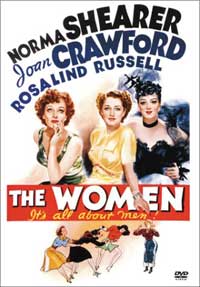
The one-sheet tagline for George Cukor's 1939 film The Women declared 'It's all about men!" Yet, throughout the course of Cukor's 133 minute melodrama, there is not a single masculine presence visible. Furthermore, despite having an entirely female cast featuring some of the biggest stars of the period, it is the topic of men that dominates the proceedings through hearsay, third-party gossip and the rare off-screen appearance.

Before Sex and the City monopolized the superficial plight of the modern Manhattan socialite, there was The Women. Released by MGM in 1939 and shot by famed ‘women’s director’ George Cukor, The Women is an archetypal example of MGM's high production values during the 1930's. Taken from a play by Clare Booth Luce, the film centers on a group of catty and shallow high-society women who are as eager to backstab one another, as they are to indulge in sherry-filled fashion shows and afternoon tea parties.

The crux of the film details the collapse of Mary Haines' (Norma Shearer) marriage to Stephen Haines, the latter having absconded his marital vows to embark on an illicit affair with snarling working-class perfume saleswoman Crystal Allen (Joan Crawford). Unbeknownst to Mary, this information has been spread without her knowledge throughout her Park Avenue social circuit by her garrulous cousin Sylvia (Rosalind Russell). After crushingly hearing the news via a talkative manicurist, Mary leaves Stephen and heads to a ranch in Reno, where along with other divorcees she must decided whether her pride is more important than her marriage.

Adapted by pioneering female screenwriters Anita Loos and Jane Murfin, The Women is mostly a callous and throughly bitchy affair. Despite its projections of aristocratic sophistication, The Women features waves of snappy dialogue drenched in sexual innuendo and vitriolic assaults quite unbecoming for MGM's output during the period. Besides its physical exclusion of the male sex, The Women is also particularly interesting for its conceptualization of "the modern woman."

Mary Haines certainly considers herself to be a progressive character and avoids the recommendations of her mother to act obliviously toward Stephen's indiscretions. Nevertheless, Mary's supposed liberal mindset is rarely applied with conviction throughout the film: resulting in a rather regressive portrayal of womanhood. Although characters exist from each class bracket in Cukor's film, it is the upper-class figures who are garnered the majority of the film's attention. Subsequently, a skewed upper-class definition of contemporary femininity emerges that today appears volatile, negative and rooted in stereotypes.

The women in The Women are primarily portrayed as solely interested in gossip, money, fashion and physical fitness, the latter purely for sexual purposes. Scarcely any of the women are employed and even fewer are educated at a tertiary level. Any progressive attempts toward gender solidarity are also non-existent in the film. The rigidity of class relations takes precedence in their lives, as evidenced when Sylvia appears to take greater offense to Stephen having an affair with Crawford's Crystal for the clerk's social rank, rather than the act itself.

With little personal socio-economic freedom separate from their husbands, yet an abundance of leisure time, the film's characters tend to take an unhealthy interest in their friends' private lives. Their leisure time is not devoted to a pursuit of the liberal arts, but rather engaging in the art of liberally pursuing each other's dirt, secrets, lies and scandals. For several of the characters in The Women, pleasure appears to be obtained more so from the anguish of others, rather than personal development.

Consequently, the examination of feminine identity and gender-related struggles in The Women intrinsically follows a singular track. Maternalism is given preference over careerism, as Cukor's film tends to laud Shearer's doting mother. The latter's progressive 'feminism' is aggressively gnawed away by the film's insistent unspoken idea that dependence and loyalty is greater than independence and pride. Often the film tends to characterize women as petty, hysterical, chatty, irrational and primal: no more so than the film's zoological-themed opening credits delineating a corresponding animal for each character.

In casting the film in its initial moments as an animalistic menagerie, the film underscores the rare outlets for power available to its protagonists. In the concrete jungles of Manhattan, survival is obtained through uncouth alliances and marital usurpation. In trying to manipulate their surroundings or re-invent themselves, several characters in the The Women attempt to address the imbalance of power between the genders and the fetishized and sexualized commodification of their sex.

Nevertheless, feminine power in Cukor's film is a device limited to the female community which adheres to its own racial, class and socio-political prejudices. With limited options for personal socio-economic growth, the male animal becomes vital for the women in the film. The failure to transcend the autonomy of their gendered environment results in characters like Mary Haines capitulating to the status quo: as her defiant resistance to her husband's immoral actions relinquishes toward a passive acceptance of her position.

In spite of Cukor's reputation as a 'women's director,' the adherence to patriarchal and conservative values is at the cornerstone of The Women. It is this advancement of male domination which perhaps sits most uncomfortably in Cukor's purportedly 'feminist' film. One certainly has to wonder had the film been made deeper into the Second World War, when women performed a greater role on the homefront, would Cukor's film have retained the same glowing appraisal of male dominance.

Recently remade by Murphy Brown creator Diane English, The Women still retains its classic status, despite its increasingly waning critical stature. Although some critics have posited Cukor's film as a comedy or a satire, the film places far too much in the melodramatic plight of its central heroine to conform into any strict comedic classification. The performances range in divergent standards with Shearer's overwrought cuckold aging poorly, whilst Crawford's conniving temptress maturing into a fine flavour. Nevertheless it is in the snappy, fork-tongued dialogue of Loos and Murfin's script that The Women briefly exceeds the overcooked melodramatics of Cukor's direction in an otherwise clichéd and dated ensemble film

*The Women is released by Warner Home Video and is available in their Joan Crawford Collection Vol. 1

Copyright 2008 8½ Cinematheque

Labels: , ,

Sunday, August 17, 2008

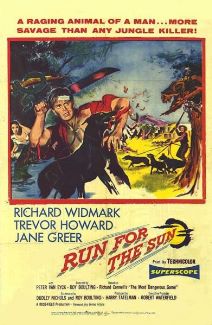
1956: Run For The Sun

Run For The Sun (Roy Boulting, 1956) 5/10

Anthologized in 1924, Richard Connell's short story The Most Dangerous Game has been the source material for countless films. Elements of Connell's work can be found in such diverse material as Cornell Wilde's The Naked Prey (1966) to 1977's Bond film Octopussy. Its premise is simple: man, the hunter, also becomes the hunted.

Inspired by the big-game hunting safaris enjoyed by affluent European and American travellers in the late 19th century, Connell inverted the scenario by twisting the rules of the game. Rather than having man hunting wild beasts in exotic locales, Connell wrapped his original story around the plight of a shipwrecked man, who becomes hunted by a savage and sinister Cossack.

In doing so, Connell created a work that twisted the colonial paradigm of the era, infusing it with the unfettered savagery and bleak humanity, Connell and his peers witnessed during the First World War. Hollywood first picked up on Connell's story in 1932 with its first official adaptation by Irving Pichel and Ernest Schoedsack for RKO. Thirteen years later at the end of the Second World War, RKO released a remake helmed by Robert Wise at RKO entitled Game of Death. Poorly received, Wise's work altered the hunter's background from a Cossack to a exiled Nazi. It is this strand that the second official remake of the story, 1956's Run For The Sun, undertakes as its focal point.

Released in 1956 by MGM, Run For The Sun was the lone American film made by British director Roy Boulting. Set in Mexico, the film centers on Mike Latimer (Richard Widmark), a reclusive Hemingway-esque writer living an anonymous existence in the fishing village of San Marcos. His short-lived exile is soon interrupted by tabloid journalist Katy (Jane Greer). Claiming to be a tourist stranded in the village waiting for friends, Katy strikes up a relationship with Mike, who is oblivious to both her profession and purpose. After prodding and probing him for answers about his failed relationships and inconsistent output, she takes his offer of a flight in his private plane back to Mexico City.

Swerving off-course, the plane crashes into the dense Mexican jungle. Far from civilization, the pair are relieved to find a group of European settlers, Browne a British plantation owner (Trevor Howard) and van Anders a Dutch archeologist (Peter van Eyck), operating a small farm in the thick forested region. Despite the gracious hospitality afforded to them, the pair are soon perturbed by the antics of their hosts. Rifts emerge due to the web of clandestine pasts and concealed identities in the tropical heat. Mike, in particular, begins to suspect the origins and war-time practices of the plantation proprietors; conversely Katy's less nefarious designs also come to the forefront. Fearing for their safety, the couple quickly mend their differences, as they head east toward the beach: racing for the sun in the name of survival.

Heavy on action, Run For The Sun is a brisk B picture on an A-budget. Obstinately a film about closeted personal histories, Run For The Sun is a visually flavourful romp; a Saturday matinee classic that probably would have easily entertained many a twelve year old boy in 1956. Secretive pasts swirl at the forefront of the film's exotic settings. The revelation of the characters respective backgrounds throughout the film, brings a sense of uneasiness to each individual. This restlessness emerges because has much to lose in the process of disclosure.

The unearthing of Mike's reclusive home disrupts the alcoholic, self-pity he has drowned in, since the failures of his last book and his last relationship. In leaving its destructive, but comfortable climes, Mike puts himself in a position to be emotionally hurt once again. By having her professional credentials revealed to the intensely private Mike, Katy knows she will likely lose not only Mike's trust, but also their blossoming relationship. Certainly the pair of Browne and van Anders have the most to lose in this ordeal. By having their treacherous Nazi origins unmasked, the duo open themselves up to lose everything: their money, their obscurity and possibly their lives.

In response to this threat, Browne and van Anders engage in hunting the American couple for sport: an act that typifies the physical and psychological cruelty Browne and van Anders represent and regularly enact on the local indigenous tribes. Yet, the manner through which director Roy Boulting explores their dilemma is primarily muted. For much of its ninety-nine minute running-time, Run For The Sun feels shorn of character development and insight.

At the expense of narrative, action is placed at a premium: yielding a nimble production that darts along, but fails to maximize its own potential. As a result, much of the film's suspense is blunted, as speed takes preference. Characters suss out each other's intentions far too easily. For example, the manner through which Boulting and screenwriter Dudley Nichols explore the wartime relationship between Widmark's Mike and Trevor Howard's Browne is particularly underwhelming. Greer's descent from independent career woman to middling damsel in distress is also astonishingly poor in lieu of the materials' potential.

Nevertheless in spite of its flaws, Run For The Sun is an entertaining, if not particularly memorable film. While Widmark plays his role by the numbers, Trevor Howard delivers a scintillatingly sinister effort as the Nietzsche espousing "hunter" Browne. Yet, perhaps the film's greatest star is cinematographer Joseph LaShelle, whose cinematography is the film's greatest reward, adding a humid frenzy to the classy MGM production values.

* Run For The Sun is available on R2 DVD through Optimum Home Video

Copyright 2008 8½ Cinematheque

Labels: , ,

Thursday, August 14, 2008

1942: Mrs. Miniver

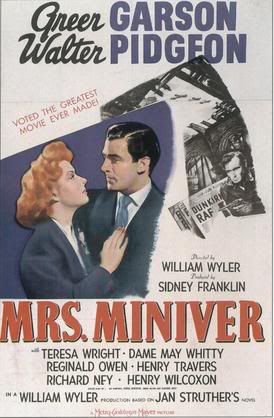
Mrs. Miniver (Wyler, 1942) 6/10

"This is the People's War. It is our war. We are the fighters. Fight it then. Fight it with all that is in us and may God defend the Right" (Vicar)

During the Second World War, American cinema played a crucial wartime role. At the front, motion pictures were used to entertain the troops; at home, films became important tools in providing information, influencing public debate and assuaging the masses. Perhaps no other film of this era did more to affect the general public than William Wyler's 1942 classic Mrs. Miniver.

Heralded by British Prime Minister Winston Churchill as being "more important to the war than the combined work of six divisions," Mrs. Miniver was both a monumental commercial and critical success: a polished archetype of 1940's MGM high drama that raked in over five million dollars and collected the Academy Award for Best Picture. Adapted from the short stories of English novelist Jan Struther, Wyler's inspirational melodrama focused on the war-time struggles of the film's titular "middle-class" heroine Kay Miniver played by Greer Garson.

Set during the first two years of the war, the film examines the changes affecting the Miniver household and their rural southwest England community. Prior to the war, the Minivers are portrayed as a typical, hard-working English "middle-class" family. The family patriarch Clem (Walter Pidgeon) is a successful architect, whilst their eldest son Vincent (Richard Ney) attends Oxford. Whenever the couple are not spending their "little money" on extravagant purchases behind each other's back, they are raising their two younger children: one of whom takes piano lessons, the other who is perpetually holding a kitten.

The onset of the war however threatens to destroy this bucolic splendor within the Miniver household. Whilst the conflict hampers Vincent's impulsive romantic pursuits of Carol (Teresa Wright), the socially conscious granddaughter of the town's lone aristocrat Lady Beldon (Dame May Whitty), it also deeply changes the community and its rigid class identities. This is most sharply evident in the conflict between the haughty Lady Beldon and Mr. Ballad (Henry Travers), the town's working-class stationmaster.

For over three decades Lady Beldon has won the grand prize at an annual flower show hosted on her property. When the meek Mr. Travers decides to enter his own rose into the competition, his audacious act is seen by Lady Beldon as a swipe against her rank in the community: threatening to jeopardize her status. Furthermore his decision to name the flower after Mrs.Miniver, rather than a lady of the gentry causes a stir throughout the town. These ideas soon become relics of the past. Within a matter of weeks, the war's arrival brings with it a minimization of class boundaries. The caste-like walls, previously unchecked only in the town's local pub, are torn down in the name of sacrifice and communal spirit.

The attempt to project the dissolution of class lines in Britain was one of the key driving forces in the film's production. At the behest of the American Office of War Information, MGM were asked to create a film that not only stressed the importance of communal togetherness during the war, but also projected a new image of Britain to American audiences detached from traditional Hollywood conceptions of Britain as a stuffy, anachronistic society. Wyler's film was meant to create a more democratic idea of Britain that could allow American audiences to sympathize with the plight of the British.

In its presentation, the film's contemplation of the British class system is severely flawed. In MGM's glamorized depiction of British "bourgeois" life, the Miniver family manages to maintain a spacious house located on the banks of the Thames equipped with a motorboat, two live-in servants and a luxury automobile. The Minivers and their fellow townspeople are deemed to be ordinary, everyday figures through this logic; despite the fact they- The Minivers- are clearly more privileged than their middle-class background suggests.

The village's working-class are easily identifiable through their colloquial accents and speech, yet are routinely characterized as almost childlike citizens who look up to the more adult and responsible bourgeois and aristocratic members of the community. There is little mention of the economic strife and class-orientated politics that affected Britain at the time. Rather this is a sanitized and wholly idealized image of Britain that continued to feed into popular, weatherworn images of people enjoying cups of tea or a rousing pint of bitter at the quaint local pub. Mrs. Miniver's Britain is a conservative one of stiff upper-lips and upper-crusts.

Nevertheless, by projecting an image of quotidian activities and individuals, Wyler's film managed to transcend international cultural boundaries. The film became important because it stressed the ideas of sacrifice, duty, solidarity and harmony. In this way it is easy to see both why U.S. President Franklin D. Roosevelt asked for the film to be rush-released and why the film itself became so popular. In an era when propaganda and jingoistic war films tended to focus on the battle front, Mrs. Miniver turned its lens toward the rarely analyzed home front. There despite their economic superficialities, the Miniver's struggles and strife became easily identifiable and therefore offered comfort and empathy to millions of viewers. The film's brilliant and rousing final speech delivered by the local Priest (Henry Wilcoxon) is a magnificent piece of inspirational screenwriting.

The film also provided a blueprint for how the citizen soldier should operate during war time. Although the film fails to address the true historical realities, which would have likely have seen both Clem and Kay Miniver holding voluntary positions to assist local war-time organizations, it does offer a moral layout of how they should act socially and politically. In Mrs. Miniver, dissension on the home front is non-existent. Everyone unquestionably acts without exception. Non-conformity or fear is invisible. Not only does everyone in Wyler's film participate in the war effort to the best of their abilities- forfeiting relationships and economic progress in the process,-but they further defy the war's horror by continuing to engage in regular activities. Thus, the film became an important political tool in providing an example of good conduct and citizenship for viewers, as well as emotional support and encouragement for millions of viewers.

Since its initial release in 1942, Wyler's film has lessened in stature. Its idealized view of British society appears dated and weather-worn. The film's soapy melodramatic narrative that once appeared honest and realistic, today appears long, contrived and ponderously slow. The film's glossy patriotism that once aroused and inspired audiences in particular feels naive and calculated. For the majority of Mrs. Miniver, the film's leading performances including Greer Garson's Oscar-winning effort as the title character loom as synthetic archetypes of cool, calm and collected citizenship.

With her expansive eyes and unflappable serenity, Garson's Miniver rarely comes across as genuine. As a result, the film's infamous scene in which Mrs. Miniver single-handedly combats the Nazi threat appears especially ludicrous. Walter Pidgeon's portrayal as Clem is stiff and nondescript. Despite appearing in several films together, Garson and Pidgeon lack any believable chemistry in Wyler's film. The only genuine romantic chemistry in the film awkwardly belongs to Garson and Richard Ney, who woodenly plays her garrulous son Vincent. Ironically, the pair dated during filming and were later married. Only Teresa Wright, as the fresh-faced Carol, Henry Wilcoxon as the motivational cleric and Henry Travers as the shy flower enthusiast seem to have injected any genuine spark and humanity into their performances.

Despite its slick, outmoded approach, there are still moments when Mrs. Miniver's polished artifice still manages to kindle something more than sentiment. Joseph Ruttenberg's cinematography, particularly in the film's climatic coda in the village church is especially rewarding. Packaging the film around a series of set-pieces, Wyler managed to extract some of the film's best performances during these segments. Scenes including those during an air raid and the film's finale added an element of authenticity and intrigue often absent in the film's fabricated projections.

Nevertheless, through its images and essence Mrs. Miniver became an important and immensely popular film, which spawned a far-less successful sequel, 1950's The Miniver Story. Four years after directing Mrs. Miniver, Wyler would helm a far more authentic and less idealistic conceptulization of the home front with his 1946 Academy Award winning film The Best Years of Our Lives.

* Mrs Miniver is available on DVD through Warner Home Video

Other William Wyler films reviewed:
The Letter (1940) 7/10

Copyright 2008 8½ Cinematheque

Labels: , ,

Thursday, July 31, 2008

1964: The Night of the Iguana

The Night of the Iguana (Huston, 1964) 9/10

The last major entry in the cycle of Tennessee Williams' adaptations that permeated Hollywood from 1950 to 1966, The Night of the Iguana is a rich, sensual experience: a tropical fever dream of a film filled with crippling anxieties, devilish rogues and bittersweet redemption. Directed by famed Hollywood auteur John Huston, The Night of the Iguana is one of the finest translations of Williams' work on celluloid: a film that produced an iconic performance from Richard Burton and turned Puerto Vallarta from a remote village barracked by mountainous jungle into a bustling tourist destination.

Shot in stunningly sharp monochrome by Luis Buñuel cinematographer Gabriel Figueroa, The Night of the Iguana centers on the moral and spiritual trials of the Reverend T. Lawrence Shannon (Richard Burton). Locked out of his Episcopalian Church for indulging his immoral appetites, the former Minister now spends his time working as a tour guide escorting tourists on religious pilgrimages, rather than guiding a flock of parishioners. Yet, even south of the border, his errant ways and bothersome habits continue to clutch at his soul.

His response to the lusty whims of a promiscuous minor named Charlotte (Sue Lyons) in particular cause a stir amongst the busload of middle-aged female Baptist school teachers. Despite his best efforts, Shannon is unable to abscond from her rash erotic impulses. Accused by Charlotte's infuriated chaperon Miss Fellowes (Grayson Hall) of seducing the teenager in his bedroom, the desperate Shannon cracks under the strain and diverts the tour from their base at a modern hotel in Puerto Vallarta to another locale, the Costa Verde Hotel: a folksy hilltop establishment on the outskirts of town owned by his highly sexualized, proto-hippie friend Maxine (Ava Gardner).

Yearning to stop Miss Fellowes from contacting the tour company in Texas, Shannon mistakenly hopes that he and Maxine can win over the tour's patrons at Costa Verde in order to spare him his measly job. Nevertheless, Shannon's predilections for the flesh and alcohol continue to haunt him in the cool mountain air. Soon "at the end of his rope," Shannon descends into madness and physical anguish: culminating in breakdown during a frenzied stormy night with only the assistance of his friend Maxine, the soothing words of traveling painter Hannah Jelkes (Deborah Kerr) and the poetry of her ailing eight-year old grandfather Nonno (Cyril Delevanti).

The Night of the Iguana is an intense portrait of human destruction. Bordering on a nervous breakdown, Burton's Shannon is a figure drowning in his anguished mistakes. Unable to truly connect with others for help, Shannon is a figure caught up in his own dissolution. As shown visually throughout the film, this strain takes on an almost torturously biblical route. In one memorable scene, a barefoot Shannon walks across broken shards of glass in order to resist the tempting Charlotte as taunts and teases him with her lusty flirtatiousness. Convinced the weight of God's fury is upon him, Shannon even tries to strangle himself with a gold crucifix, he procured from a pawnshop.

Yet, despite his weaknesses and failings, Shannon is still an intensely proud individual. After Miss Fellowes engages in a fact-finding mission in order to taint his credibility, Shannon rebukes her claims that he was defrocked with conviction and intensity. In response, Shannon expresses his tormented relationship with God at the source of his professional woes; highlighted by his unwillingness to view God as a childish and petulant figurehead. In his frank discussions with Hannah Jelkes, Shannon strives to correlate a genuine spiritual association with Him. This connection is partially frayed by the inability of others to understand Shannon's moral faux-pas as the strain of enforced perfection on a broken individual.

The women in The Night of the Iguana play an important part in Shannon's misery and search for purpose. Like her earlier and more infamous role as the title character in Stanley Kubrick's adaptation of Vladimir Nabokov's Lolita, Sue Lyons plays a teenager who tempts an older man. But unlike the lecherous Humbert Humbert in Lolita, Shannon earnestly wants to suppress his feelings. Lyons plays her role in The Night of the Iguana as a series of quick emotional outbursts; flitting from one frothy viewpoint to the next as each constituted an aspect of eternity.

Her chaperon, Miss Fellowes is an all together different creature. Unlike, the flirtatious Charlotte, Miss Fellowes is stiff and distant. Portrayed in the film as a closeted lesbian, her vocational need to protect Charlotte seems both connected to her highly moralistic character, but also her own interests in the girl. Her sharp tongued attacks are not only leveled at Shannon, but to his highly-sexed friend Maxine, who also poses a threat to the social character she aspires to represent.

Bouncy, yet bearing an undercurrent of contempt, Maxine is a highly independent woman. Sexually liberated even before the death of her husband Fred, Maxine is characterized by her earthy and carnal characteristics. Despite the censorship of the era, it quickly becomes apparent that Maxine regularly engages in a multitude of sexual activities with her two young Mexican cabana boys. Aging, yet still beautiful, Maxine feels alive and wanted through them. Yet, in spite of their presence, Maxine still desires Shannon, who has continually rebuffed her advances out of respect for Fred. Nevertheless, Maxine offers Shannon a sense of home and permanency that his troubled life is crucially lacking.

The final woman who offers Shannon comfort is the gentle painter Hannah Jelkes. Unlike Charlotte and Maxine, Hannah is a highly asexual creature. Contemplative and assured, she resists Shannon's advances because she believes in love for it what offers beyond its physical capacities. Traveling with her aging grandfather, the pair offer their art as payment for their lodgings and food. Unlike the proud Shannon, Hannah feels no shame for her destitution, because she is not bound to a world of materialism and money. Rather, she is complete in the world around her and thus tries to make Shannon understand his shortcomings and flaws.

The principal metaphor in the film emerges from their plainspoken conversations. Like the Iguana, Maxine's cabana boys have tied to a post in order to fatten up to eat, Shannon too has a noose around his neck. The weight of his religious commitments and his moral principles is too great a weight for his tortured soul to bear alone. Thus, Huston's film becomes a homage to companionship, to art and to ethereal beauty. The film's principal characters are each astutely acted. With his booming voice and theatrical disposition, Burton is perfect as the plagued priest. Ava Gardner is equally remarkable against-type as the primal Maxine, while Deborah Kerr adds a saintliness and calming resonance to the picture.

Featuring a series of superb performances and gorgeous on-location cinematography, John Huston's adaptation of The Night of the Iguana is a criminally overlooked and undervalued entry into his filmography and the filmic Tennessee Williams' canon. Unlike other "prestige pictures" of its day, The Night of the Iguana does not appear dated and bloated; in large part due to Gabriel Figueroa's cinematography and Huston's emphasis on capturing the emotional pitfalls and sensual primacy of Williams' work set to an exotic background.

At times a stunning achievement.

* The Night of the Iguana is released on DVD by Warner Home Video and is available in their excellent Tennessee Williams Film Collection box set

Other John Huston Films Reviewed:
Across The Pacific (1942) 3/10
The Unforgiven (1960) 7/10

Copyright 2008 8½ Cinematheque

Labels: , ,

Tuesday, July 29, 2008

1958: Cat On A Hot Tin Roof

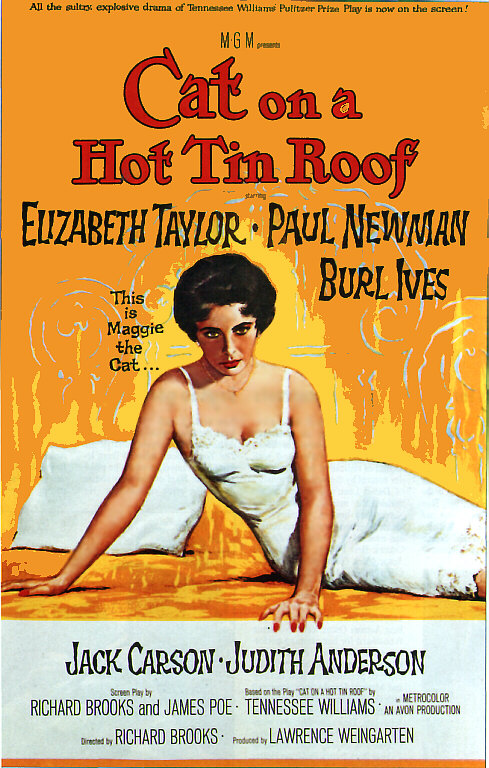
Cat On A Hot Tin Roof (Richard Brooks, 1958) 7/10

"Big Daddy...What is it that makes him so big? His big heart? His big belly? Or his big money? (Brick Pollitt)

The theatre of Tennessee Williams is one of liars and failures, conniving creatures and tortured customers. Perhaps no other work in his oeuvre better represented and quantified these diverse characteristics than Williams' 1955 Pulitzer Prize winning play Cat On A Hot Tin Roof: a tawdry story built around the falsehoods of its characters and the complex socio-cultural environment they operate within.

Set in southern Mississippi, Cat On A Hot Tin Roof focuses on the destructive crises affecting the affluent Pollitt family and their divulgence over a tumultuous weekend. The film specifically centers on the fractious relationship between former athlete Brick Pollitt (Paul Newman) and his alluring wife Maggie (Elizabeth Taylor). Escaping a lifetime of poverty through marriage to the youngest member of the Pollitt clan, Maggie is perturbed by their failing marriage. Sexless and fraught with altercations, the couple's relationship reaches a nadir when they travel to Brick's family plantation to celebrate the birthday of his father known as Big Daddy (Burl Ives).

Rather than a celebratory event, Big Daddy's birthday quickly unravels into a specter of violence, drunkenness and collusion. Partially stemming from the rumour that Big Daddy is possibly dying of colon cancer, the party sours from a festival of life into a gala of connivance. Leading this scheming are Brick's solicitor brother Gooper (Jack Carson) and his acquisitive wife Mae (Madeleine Sherwood). Spawning five hellish brats, Gooper and Mae are eager to secure Big Daddy's illustrious fortune through any means possible; even through coercing Gooper's emotionally unstable mother Big Mama (Judith Anderson) into signing a series of contracts to ensure their ownership of Big Daddy's properties.

Holed up in his room with a broken ankle, the alcoholic Brick stews about the culture of lies, the family have structured itself upon. Guilt-ridden by the death of his "best friend" Skipper and distrustful toward materialism, Brick spirals into an inebriated stupor that threatens to tear apart not only his childless marriage to Maggie, but also his status in the Pollitt household.

Throughout Cat On A Hot Tin Roof, the theme of mendacity emerges as a key idea. Structuring their lives on false images and dreams, the Pollitt family sees the undoing of their individual acts of subterfuge during Big Daddy's birthday celebrations. During a stormy weekend, family members such as Brick and Big Daddy begin to see the unravelling of these lies through an earnest attempt to reconcile truth into their relationships. Big Daddy's curmudgeonly approach to others reveals a volatile desire to truly express his repressed contempt toward his wife, his ill-behaved grandchildren and Brick's wallowing into an alcohol-induced world of self-pity.

In contrast to his family's boisterous patriarch, Brick prefers to drown his resentment in liquor. His inability to express his pain and sorrow pushes him further away from his estranged wife and isolated family. Brick's anger is both recent and long-term. He virulently detests his father's idealization of love through the form of material transactions, but Brick also despises both his wife and himself for their role in Skipper's suicide. While Brick rancorously objects to his family's culture of lies, he neglects his own aggressive and frequent participation in this realm.

Brick and Skipper's past friendship is presented throughout Cat On A Hot Tin Roof in ambiguous terms, yet their is an underlying sense their relationship probably held homosexual qualities. As the recipient of a homosexual advance or perhaps a repressed homosexual himself, Brick vigorously attempts to deny the true extent of his emotionally intense bond to Skipper. In doing so, he creates voluminous fissures in his marriage to Maggie and isolates his feelings from others with disastrous consequences.

The distancing effects brought on by the repression of these feelings is smartly addressed by director Richard Brooks throughout much of Cat On A Hot Tin Roof. Frequently, Brooks places characters in stark opposition to one another, often shooting characters talking to one another faced in opposite directions. This particularly works well in several of the film's key speeches involving the emotionally cold Brick. Notably, much of the play's homosexual content was muted by the censors at the time. In spite of the enforced revisions, Brooks manages to admirably maintain the sense of equivocal uncertainty fermenting in Brick's soul.

Originally earmarked for the openly gay director George Cukor, the film was instead given to Richard Brooks after Cukor turned the film down. While Cukor would have more likely given the film a greater visual eloquence, the more action-orientated Brooks offered the film a biting, steamy flavour that ultimately won over critics and audiences. The film's success aided not only the careers of Elizabeth Taylor and Paul Newman, but also Richard Brooks who would later go onto adapt another Tennessee Williams' play (Sweet Bird of Youth) also starring Newman and Madeleine Sherwood.

Brooding and snarling, Newman carved a niche for himself as a serious actor capable of skillfully playing the arrogant/angry young man: an archetype he would frequently revisit throughout the early stages of his career in films such as The Hustler, Hud, Sweet Bird of Youth and The Young Philadelphians. Despite losing her then third husband Mike Todd in a fiery plane crash during filming, Elizabeth Taylor continued working and produced one of the most sultry and dynamic performances of her career. Yet, the film's true show stopper was neither Newman or Taylor, but Burl Ives who reprised his Broadway role as the cranky larger-than-life patriarch Big Daddy. Played with cantankerous verve, Ives' performance provides the film's strong moral core, as well as the centre of much of its anger and sorrow.

Director Richard Brooks' Cat On A Hot Tin Roof remains one of the most enduring cinematic adaptations of Williams' work. Constructed with a moody mis-en-scene, Brooks gave Cat On A Hot Tin Roof the type of scorching, sultry atmosphere that has defined Williams work for audiences and critics alike. Unlike his second Williams' adaptation Sweet Bird of Youth, Brooks' first attempt at translating the Southern playwright was not as fatally destabilized by the censorship of the era. Rather, the film's tedious pacing is its only truly detrimental attribute; a factor that is nevertheless ultimately redeemed by its acute performances and evocative visual ornamentation.

* Cat On A Hot Tin Roof is released on DVD by Warner Home Video and is available in their excellent Tennessee Williams Film Collection box set

Other Richard Brooks films reviewed:
Sweet Bird of Youth (1962) 6/10

Copyright 2008 8½ Cinematheque

Labels: , ,

Sunday, July 27, 2008

1962: Sweet Bird of Youth

Sweet Bird of Youth (Richard Brooks, 1962) 6/10

"Provocative Adult Entertainment." In 1962, Richard Brooks' second cinematic Tennessee Williams adaptation Sweet Bird of Youth truly embodied the three words emblazoned in the middle of its orange hued poster. Today, the topics discussed in Sweet Bird of Youth would appear tame to a modern audience, despite their immoral nature.

Yet in 1962, Williams' play was so risqué that when Brooks transferred Sweet Bird of Youth onto celluloid, he was unable to incorporate several topics found in Williams' play such as venereal disease and castration into the shooting script. The removal of these aspects may have changed the overall effect of the film in its conclusion; yet even without their inclusion into the film's final cut, Brooks' film still featured several taboo elements: some so controversial their existence was merely hinted at indirectly during the film.

Reprising his role on Broadway, the film stars Paul Newman as Chance Wayne: a young Floridian man desperate for success, but undeniably naive in his actions. Madly in love with Heavenly (Shirley Knight), the daughter of tyrannical Southern politician. Boss Finley (Ed Begley), Chance is informed by her father that he must acquire riches and fame in order to secure her hand in marriage. Leaving his job as a busboy at a Gulf Coast country club, Chance heads for the bright lights of New York and Hollywood to find his fortune in order to retrieve Heavenly from her father's potent grip.

Unbeknownst to Chance, his glorious vision is a fatefully flawed apparition. After years struggling to break into Hollywood as an actor, Chance has achieved little in the way of wealth or fame. The only notoriety he has accrued is through being an objectified instrument of pleasure for the wives of millionaires, the debutantes of "the horsey set" and lonely eccentrics. One such eccentric is fallen star Alexandra del Lago (Geraldine Page). Once one of Hollywood's greatest names, del Lago's latest notable escapades have less to do with her on-screen performances, but through her off-screen exodus from the preview of her latest film. Copiously addicted to drugs, alcohol and sex, Alexandra has become an agoraphobic wastrel desperate to nullify her public rejection, yet still living up to her reputation as a diva.

Believing he has found the key to his future success, Chance takes the emotionally unstable Alexandra with him to St. Cloud during a sunny Easter weekend. The religious nature of the weekend should offer all its participants a chance from redemption, cleanliness and resurrection. Nevertheless, the presence of sin and evil is well-noted. Despite confessing a sensitivity to Alexandra's plight, Chance desires to use her to fulfill his self-inflated ambitions whether it be through tender words or blackmail. Blinded by his need to impress Heavenly's father, Chance has failed to recognize the nature of his surroundings, whilst chasing his "phony dream." Nevertheless, reality and his past actions soon return to haunt him, as the follies of his ambitions and his failures become achingly clear.

At its core Sweet Bird of Youth is a film about failed dreams. Several of the film's principal characters engage in the creation of overly ambitious dreams, whose success is struck a fatal blow due to the constraints of reality. Whilst, initially inspired by Heavenly's plight, Chance's dreams morph into inflated, self-centered projects that have little chance to succeed. Lacking any genuine acting talent, Chance's only skills and attributes are purely corporeal and sexual. His in-roads into Hollywood have been through the exploitation of his youth not to sell films, but for jaded aging women to purchase youth through relationships with him. Yet, youth is a fleeting commodity and Chance in his imaginative gullibility notably fails to realize its true nature. His plans are bold and engaging, but are reliant on unlikely breaks that divert him from the original purpose of his project.

Youth is also a commodity traded by Boss Finley. Utilizing his hot-headed son (Rip Torn), Finley has amassed a small army of neo-fascistic thugs to terrorize his enemies. Despite, his Christian populist rhetoric, Finley has also used Heavenly's sexuality to secure powerful contracts, only to- as with Chance- exile these men from his state once they no longer have any socio-political value to him. In Sweet Bird of Youth Boss Finley's aggressive machismo and misogyny contrasts neatly with Chance's flaccid approach to Heavenly, whom he promises to abscond, but repeatedly fails to confront.

The theme of failure also abounds in Sweet Bird of Youth. Like the Rev. T. Lawrence Shannon in Williams' The Night of the Iguana, Chance struggles to understand his errors and seek an alternative path: instead he recreantly looks to exploit weaknesses in others (i.e. Alexandra del Lago) to writhe out of a problematic situation of his own doing. The downfall of her career has also left Alexandra del Lago in a situation, were unwilling to commit to rebuilding her reputation, the actresses sinks into a world of debauchery and sin. Yet, rather than attempting to amend these flaws directly, several characters in Sweet Bird of Youth use duplicitous means to either forget via sex and drugs or correct through violence, blackmail and fear-mongering.

Released by MGM in 1962, Sweet Bird of Youthwas a popular and critical success, which aided in cementing Paul Newman as a genuine Hollywood star. In the forty-six years since its initial release, Sweet Bird of Youth has dated in parts of its overcooked southern melodrama. Brooks' method of cutting to flashbacks is particularly poor: appearing more at home in a 1940's comedy with its swirling dissolves and similar devices. Slowly paced in parts Sweet Bird of Youth is slightly too baggy, often engaging in sub-plots that divert from the true essence of the film. Additionally, the removal of certain plot elements involving Chance and Heavenly's relationship from the play due to censorship, leaves the film's finale in a discomforting position that fails to recognize the emotional complexity of their past.

Nevertheless, Sweet Bird of Youth does feature some excellent performances in this morally acidic film. Newman is commendable as aspiring actor-cum-gigolo Chance Wayne. Geraldine Page's swings back and forth on a tumultuous emotionally pendulum as Alexandra del Lago and produces one of the film's highlights. Ed Begley's work as the nefarious Boss Finley won him an Academy Award, whilst Madeline Sherwood offers an electric performance as Finley's favourite prostitute, who becomes victim of an act of misogynistic violence that rivals Lee Marvin's coffee pot in The Big Heat and James Cagney's grapefruit in The Public Enemy

Controversial and corrosive, Sweet Bird of Youth is an enjoyable, but often turgid entry in the cycle of Tennessee Williams films Hollywood produced during the Fifties and Sixties. Despite a strong cast and edgy subject matter, Sweet Bird of Youth probably failed to fulfill its full potential on film. Certainly censorship was a critical factor, but also Brooks' direction, whilst at times laudable lacked the ability to translate Williams' intense emotionalism into the type of fruitful vehicle of pity, depravity and quasi-religious redemption Sweet Bird of Youth could and should have been.

* Sweet Bird of Youth is released on DVD by Warner Home Video and is available in their excellent Tennessee Williams Film Collection box set

Other Richard Brooks films reviewed:
Cat On A Hot Tin Roof (1958) 7/10

Copyright 2008 8½ Cinematheque

Labels: , ,

Wednesday, July 23, 2008

1960: The Unforgiven

The Unforgiven (Huston, 1960) 7/10

John Huston's 1960 Western The Unforgiven was a film fraught with tragedy and dissolution both on and off-screen. Featuring a strong, reputable cast including Burt Lancaster, Audie Murphy, Lillian Gish and Audrey Hepburn in her only entry in the genre, The Unforgiven had the ingredients to be a box-office success, the film's lead star and co-producer Lancaster desired. Nevertheless from its inception, The Unforgiven was a work painted in shades of lament.

In the mid-Fifties and early Sixties, the Western had morphed into an important artistic vehicle for socio-political debate, particularly in the realm of race. The question of historical and present-day racism was subsequently addressed in film's such as John Ford's The Searchers, Anthony Mann's Cimarron and Don Siegel's Elvis Presley vehicle The Flaming Star.

For Huston, this project was also earmarked as a challenging allegorical piece designed to reflect America's contemporary racial disharmony. Instead, the film was disowned by its creator and its principal performers; the sorrowful filled victim of what Huston would later term as a "celestial vengeance."

By the time filming had completed, three crew members had perished in a plane crash and two miscarriages had been suffered. Additionally, Hepburn had seriously injured her back after falling from a horse, Audie Murphy had almost drowned on a nearby lake and Huston had been the victim of a knife attack. The myriad of delays coupled with the hefty wages of the star-filled cast prompted the termination of Lancaster's production company HHL. Failing to find an audience, the film was a commercial failure. Removed almost forty years from its initial release, The Unforgiven stands out as an interesting, overlooked and misunderstood film affected by the constraints of its time and the confrontation between art and commerce.

Located amongst the swirling sandy brush and the limbs of desiccated trees, the baked-mud walls of the Zachary ranch have demonstrated a tenuous permanency. Eking out a modest subsistence for years, the family fortunes finally appear to be on the upswing. Ersatz family patriarch Ben (Burt Lancaster) has returned from Wichita equipped with not only dreams of expanding their shared cattle business, but also with a modicum of western civilization: a small piano gifted through the muscular first-born's ability to win a bet through his strength.

Nevertheless social disaster soon strikes, as once dormant ghosts from the past return in the form of a one-eyed horseman (Joseph Wiseman) named Abe Kelsey. Spouting religious verse, blanketed in dust and baked into madness by the searing heat, Kelsey's mumbled ramblings appear to be little more than the words of a madman. In spite of Kelsey's mental fragility and susceptibility, his provocative mumblings about the racial origins of Ben's adopted sister Rachel (Audrey Hepburn) stir raw, primal emotions amongst the Zachary men, including Ben and his racist brother Cash (Audie Murphy).

As the Zachary boys try in desperation to track down Abe Kelsey, the influence of his ramblings permeates through the community. In an inversion of Ford's The Searchers, a local Kiowa tribe beseech the Zachary's to return the now adult Rachel to her people. Their methodology is one of peace and honour; even if their approach slants toward bartering for Rachel through the trading of horses, as if she were a mere commodity.

Concurrent with the Kiowa's requests, the Zachary's closet friends and trading partners also call for Rachel's reversion to the Kiowa in order to protect their own product: the threat of communal and entrepreneurial exile the high price for any corresponding inaction. Ben refuses to capitulate to either demands, even if by the film's finale, his reasoning is more incestuous than noble.

Supremely shot by Franz Planer, The Unforgiven is an often messy, yet interesting Western. Using the past as a distancing device, Huston aimed for The Unforgiven to be an outlet to explore racial conflict in 1960's America. But through a combination of off-screen mishaps and on-screen slovenliness, The Unforgiven never really fulfilled its potential. Based on a story by The Searchers author Alan LeMay, The Unforgiven similarly tries to address many of the racial and social concerns put forth in Ford's adaptation of the former. Unlike Ford's film, Huston's work fails to fully embrace these concepts, primarily due to the off-screen friction between Huston and the film's producer(s) and star.

Whereas Ford's protagonist Ethan Edwards is shown as an insensitive demonizing figure unable to adapt to the textured complexities of modern America, Huston's Ben Zachary is an atypical strapping hero by the film's final moments. Despite an early reverence for the peaceful Kiowa, there is little in the melodramatic story that serves to fully acknowledge the indigenous characters as multi-faceted beings. Bizarrely for a film devoted to an anti-racist message, the prolonged destruction of the Kiowa outside the Zachary household subtly depicts the Native Americans merely as superstitious, child-like creatures. In contrast, Lancaster's Zachary is portrayed in a positive manner as a family man desperate to protect his own interests; in spite of his incestuous desires for his half sister and his orders to shoot to kill upon an amicable party of Kiowa diplomats.

While Huston intended for The Unforgiven as an essay on racism, the overall effect is insipidly muted. This primarily stems from the muddled angles toward a serious examination of the topic throughout the film. The exigency held by Rachel in the film's final sequences is a particularly noticeable product of this problem: leaving the character involved in a twisted decision between nature or nurture. Ultimately, her choice is predicated through violence, rather than love as she decides between her biological and adoptive families: a facet that leaves Huston's flawed treatise cold and barren upon reaching its coda.

For contemporary audiences, The Unforgiven may work better as an examination of the tracts sociological racism built with the "pioneer spirit:" attributes plainly imbued by the callous Cash Zachary and subtly demonstrated by much of the community's xenophobic populace. Despite its notable contextual plot flaws and the miscasting of Hepburn, The Unforgiven is a peculiar and often compelling melodramatic Western. Featuring a brutish, against-type performance by Audie Murphy, a resilient Lillian Gish and an imposing Burt Lancaster, The Unforgiven is a misguidedly fissured film: an often captivating family melodrama that subsequently fails to dismantle the mythology of the West it yearns to correct.

* The Unforgiven is available on DVD through MGM Home Video

Other John Huston Films Reviewed:
Across The Pacific (1942) 3/10
Night of the Iguana (1964) 9/10

Copyright 2008 8½ Cinematheque

Labels: , ,

Tuesday, January 29, 2008

1964: Kiss Me, Stupid

Kiss Me, Stupid (Wilder, 1964) 9/10

With his renowned variety show, Dino (Dean Martin) is the star of the Las Vegas strip. He croons, he jests, he acts, he sings. He is a complete entertainer and an attractive draw for both sexes. The bright lights of Vegas however cannot mask Dino's blazing Hollywood aspirations. Placing his Sands' revue on hiatus, Dino absconds from the legions of beauties wanting "one for the road," hops in his Italian convertible and roars away to Hollywood for a profitable season of film shoots and television specials.

Along the desolate desert highway, Dino detours through the craggy hovel of Climax, Nevada. In this lifeless hamlet, two local struggling tunesmiths-paranoid piano teacher (Ray Walston) and sloven gas attendant Barney (Cliff Osmond)-sabotage the lounge lizard's sleek ride in order to peddle their infantile romantic ditties such as I'm A Poached Egg and I'm Taking Mom To The Junior Prom, Cos' She's A Better Twister Than My Sister. Adrift from the glitz of Las Vegas' bounty of casinos and his endless cache of booze and birds, the sleazy Dino salivates for some interim "action" to temper his cravings. Prowling for sex, Dino's arouses Orville's marital fears that his attractive wife Zelda (Felicia Farr) will soon be added to the crooner's bevvy of conquests.

Released in 1964 as the Production Code's moral leash began to slack, Kiss Me, Stupid acquired notoriety for its risque humour and moral ambiguities. Although tame by contemporary standards, Wilder's film, alongside Elia Kazan's Babydoll, was bestowed with a rare "condemned" rating by the Catholic League of Decency. Reviewers were scathing in their distate for Wilder's vulgar humour, theatre owners refused to run the film and audiences shunned United Artist's tacit release on its artsy Lopert imprint.

Viewed almost forty-five years after its brief original run, Kiss Me, Stupid emerges as a forward-thinking picture; a classic farce ahead of its time and its audience. British poet Philip Larkin may have chimed sexual intercourse began in 1963,but by 1964 it was openly visible. Unlike, the "safe" sex comedies of Doris Day and Rock Hudson, Wilder's film does not linger around the bedroom door,but rather breaks the door down. The repetoire of double-entendres at Wilder and co-writer I.A.L. Diamond's disposal are not disguised in coded layers; they operate with liberated abandon.

Sexual witticisms drench Wilder and Diamond's script in a manner akin to the innuendo adorned flavourings of Moliere and Shakespeare. Like the latter's Comedy of Errors,Kiss Me, Stupid hinges upon mistaken identities, infidelity and bawdy sexual humour to enliven the film's discourse on love, sex, greed and marriage. Furthermore, Wilder's film exploits Dean Martin's offscreen persona to create a credible early example of a celebrity engaging in cinematic self-parody.

In a role originally intended for Peter Sellers, Walston plays Orville Spooner; a nervy, suspicious eccentric whose wife Zelda is deemed the most beautiful woman in town. After five years of marriage, the wiry and disheveled Spooner still remains stunned that Zelda accepted his marriage proposal. Therefore, Orville treats Zelda's every word and decision with mistrust; fearing she will leave their penurious and rural homestead. The arrival of the sex-hungry and leering Dino emboldens Orville's selfish practices.

Isolated in a backwater desert community, Orville lusts for wealth, primarily as a security mechanism to ensure Zelda remains his. These chauvinistic and greedy attitudes shape Orville's conception of marriage. His worries about being able to provide for Zelda are informed by the material culture Dino represents, rather than the romantic notions his loving wife adheres toward; whilst his controlling nature strengthens his unconscious desire to be a strict patriarchal figure. Therefore, Dino is viewed as an antithetical figure representative of the carefree glamourous playboys viewed in other films of the period such as Fellini's La Dolce Vita.

Orville's response to local prostitute Polly the Pistol (Kim Novak)- whom he and Barney hire to placate Dino's urges-is interesting in that whilst the local piano teacher preaches devotion to his wife, he increasingly appears attracted to the doting, flu-rattled Polly, whose failed ambitions and eagerness to please appear better suited to Orville's clingy personality and brittle self-confidence.

Written by Wilder and his frequent collaborator I.A.L Diamond, Kiss Me Stupid is a raw, layered farce. Concocted as a comedy of errors, Wilder's film is a sharply tuned comedy of errors; cooly constructed around Orville's personality flaws which fate him to the collapse of his selfish web of deceitful ideas and plans. In using black and white cinematography, rather than colour, Wilder enhances the picture: capturing the drained, monotone environment highlighted by an unimaginative and dreary populace who spend their evenings crowded around the colour televisions in a local hardware store.

Walston's solid performance captures his character's hyperactive desperation and frenzied ways. Dean Martin simply adopts a cool demeanor in a role that requires the singer-cum-actor to simply be himself: allowing Wilder's stinging humour to poke fun at Martin and the Rat Pack's popular image. Yet, the genuine star of the film is possibly Kim Novak, who demonstrates a breadth and diversity often lacking in colder efforts such as the character of Madeline in Hitchcock's Vertigo.

Almost half a century from its initial release, Kiss Me Stupid appears not as a moral corrupting force, but as a wonderfully biting examination of modern values and ideas with regard to love, sex and marriage. Like in other Wilder films such as Sunset Boulevard, Ace in the Hole and One, Two, Three, the famed director demonstrates the shallow material desires and internalized greed of humanity. In doing so, Wilder formulates an investigation into the emptiness and disparity of modernity; themes often found in the 1960's Italian cinema in the films of Visconti, Fellini and Antonioni. But unlike the latter directors, Wilder's film adopts a less serious outlook, preferring to exercise his message and his analysis through comedic terms. The result is an overlooked comic gem.

* Kiss Me Stupid is available through MGM Home Video and is released in their Billy Wilder Collection box set.

Copyright 2008 8½ Cinematheque

Labels: ,

Monday, January 28, 2008

1961: One, Two, Three

One, Two, Three (Wilder, 1961) 8/10

Coca-Cola is arguably the most recognized and culturally divisive American brand in the world. Originating in late 19th century Atlanta as a pseudo-medicinal beverage, Coca-Cola rapidly transformed itself into one of the world's most recognizable companies.

Over the past sixty years, Coca-Cola has become a political and cultural embodiment of Americana. In the aftermath of the Second World War, the company’s emphasis on mass advertising, pervasive consumption and global marketing acquired Coca-Cola the ire of post-World War II Europeans on both sides of the Iron Curtain.

As addressed in Richard F. Kuisel’s article “Coca-Cola and the Cold War: The French Face Americanization, 1948-1953,” Coca-Cola’s systemic growth in post-war Europe alarmed both communist and anti-communist forces. Coca-Cola became stylized in anti-American propaganda as a demagogue threatening the health of children and the economic survival of regional beverages. Lawsuits and legal discussions in Denmark, Switzerland and France attempted to stop the sale of the drink.

In Communist circles, the sweet-tasting drink soured the tastes of officials and intellectuals who viewed Coca-Cola as a capitalist elixir designed to turn Europe into a series of coca-coloniés. The term "Coca-Colonization" gained prominence amongst intellectual scholars in the Cold War to identify the spread of American cultural and economic practices abroad; attitudes held and expounded upon by Cold War era Coca-Cola executives.

Positioned during the Cold War as the ultimate commercial signifier of American culture and capitalism, Coca-Cola was subsequently the perfect economic institution to be employed by the legendary Billy Wilder in his superb 1961 Cold War farce One, Two, Three. Filmed in Berlin and Munich during the construction of The Berlin Wall, One, Two, Three is a rapid fire comedy eagerly praising and ridiculing America's cultural and economic expansion into Europe. The film stars James Cagney in his purported final role (he came out of retirement for 1981's Ragtime) as C.R MacNamara, a lifelong Coca-Cola executive, who has traversed the globe for the company: tapping uncharted markets and expanding the brand from the Andes to the Alps.

Stuck in Berlin, MacNamara sees an audacious opportunity to sell Coca-Cola in the Eastern Bloc nixed by his patriotic boss in Atlanta. Desperate to garner greater influence in the company, MacNamara reluctantly accepts Hazeltine's (Howard St. John) request for MacNamara to look after his teenage daughter Scarlett (Pamela Tiffin) when her whirlwind tour of Europe hits Berlin. Scarlett's arrival exacerbates the fractures in MacNamara's marriage to his undersexed loyal wife (Arlene Francis) and his affair with his lurid German secretary Ingeborg (Lilo Pulver). Furthermore, MacNamara's plans for his long-awaited promotion are put on hiatus, as Hazeltine's southern daughter reveals herself to be a sexually promiscuous, intellectual simpleton, who secretly elopes with an ideologically wooden East German Communist youth.

Released after the successes of Some Like It Hot and The Apartment, One, Two, Three was a brief return to the more caustic channels Wilder had previously explored in dramatic masterpieces such as Ace in the Hole and Sunset Boulevard. One, Two, Three operates a hyperactive comedic critique of both capitalist and communist cultures with plenty of Wilder's trademark snarl, but without the acidic bite. Sadly, the film was not a great box-office success.

Contrary to recent critical studies of One, Two, Three that have argued the film was a critical disaster, it should noted that upon the film's release Wilder received mostly positive reviews from major publications such as Time, The New Yorker and the New York Times. Most of the negative feedback customarily associated with One, Two, Three primarily came from later sources such as Andrew Sarris, Pauline Kael and the staff at Cahiers du Cinema

Their critiques have mostly focused on the perceived "vulgarity" and tastelessness of Wilder's humour. According to Wilder biographer Maurice Zolotow much of Kael's criticisms stemmed from Wilder's exploitation of unsavory characters and situations for comedic purposes. Yet, it is through his boundary pushing witticisms that Wilder demonstrated humanity's self-serving attitudes and practices. Like Kubrick's Dr. Strangelove three years later, Wilder's film attempts to show the absurdity of Cold War politics, yet in Wilder's case it is through quotidian individuals. In One, Two, Threeboth systems, regardless of their ideological leanings,feature arrogant figures desperate to advance through their respective system through bullying, conniving and favours.

The character of MacNamara is a playful interpretation of the "Ugly American." MacNamara's main desire is to increase company profits and sales, which in turn will increase his own greed and opulence. His tactics are aggressive and disregard the sanctity of foreign cultures. MacNamara even goes so far to proclaim he wishes to ensure each German has a Coke to drown down his Knackwurst. MacNamara's cultural insensitivity is only rivaled by the ignorant buffoonary of Soviet officials, who share MacNamara's fondness for sex, materialism and personal gain.

The casting of Cagney in particular is extremely interesting. Cagney's character is certainly a self-reflexive tribute to his image and iconography in the gangster genre. Noted for his career-shaping roles playing a gangster and a hoodlum, Cagney's portrayal of MacNamara is an extension of his earlier gangster entrepeneurs, who try to expand their market and protect their interests via whatever means necessary. One, Two, Three even features visual references to such gangster classics as The Public Enemy and Little Caesar. Naturally, unlike The Public Enemy's Tom Powers or White Heat's Cody Jarrett, violence is not a viable option. Instead MacNamara uses his cunning sensibilities to place Scarlett's lover Otto into the hands of the East German Secret Police, the Stasi. Violence is not a sensible business tactic, but as MacNamara continually notes neither is displeasing your employer.

In One, Two, Three, Wilder also investigates the labyrinthine and inefficient layers of Communist bureaucracy. He takes swipes at East Germany's informant culture and the lack of freedoms in the Eastern Bloc highlighted by MacNamara's commentary about East Germany's collection of unreturned Coca-Cola bottles in relation to the masses defecting to the West: black market Americana is in, whilst personal freedom is out along the nefarious Iron Curtain.

The director's sublime capabilities even allow a torture sequence involving repeated listening sessions of garish American pop music to retain a comedic touch. The wealth of cultural misunderstandings solidify the bursting humour of One, Two, Three. Even West Germans are not spared, as Wilder and co-writer I.A.L Diamond offer comedic jabs at the failures of social denazification and the rise of West German material culture. Ironically, the film gained a cult following in West Germany following its belated release in the 1980's.

Working within a brilliant, punch-line intensive script, One, Two, Three becomes more than a series of visual jokes and puns about cuckoo clocks, sex-starved wives and lingering Nazi habits through Wilder's manic direction. Even as One, Two, Three seemingly stalls in its final third, the film is further held together by Cagney's illuminating skills and his fervent energy; as MacNamara becomes a Henry Higgins to Otto Piffl's Eliza Doolittle: shaping Scarlett's lover from a stubborn communist into a stubborn capitalist through flashy clothes.

Yet in his denouement, Wilder skillfully denotes that material trivialities do not define one's character or content. One can simply not switch allegiances through consumerism. Rather, it is the spiritual and moral essence of individuals that determines and shapes their practices and perspectives. Only through an understanding of these terms, do characters such as Piffl and MacNamara realize the true Cold War is not between their souls, but within their own frosty hearts.

An underrated farcical gem.

* One, Two, Three is released through MGM Home Video and is available in their Billy Wilder Collection box set

Copyright 2008 8½ Cinematheque

Labels: ,

Thursday, August 02, 2007

1976: Network

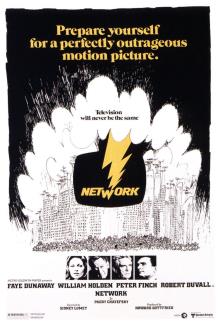
Network (Lumet, 1976) 6/10

"I'm mad as hell and I'm not going to take it anymore!" Howard Beale

Screenwriter Paddy Chayefsky might not be American cinema's greatest satirist, but he is arguably its most well known. Despite starting as a creator of "kitchen sink" type dramas such as his award-winning Marty, Chayefsky quickly re-invented himself as a caustic cultural observer in the latter portion of the 1950's through the 1960's. Works ranging from Paint Your Wagon to the underrated duo of The Americanization of Emily and The Goddess, which brought him modest critical success.

Chayefsky's grandest acclaim came as a result of 1976's multiple Academy Award winning media satire Network directed by Sidney Lumet and featuring an all-star cast featuring Robert Duvall, Faye Dunaway, William Holden and Peter Finch. The film examines the downfall of fictional television network UBS. Repeatedly last in the ratings, the network desperately yearns to reach an audience. Noticing the debts incurred by UBS' News Division, network head Frank Hackett (Robert Duvall) yearns to merge the division into regular programming to garner greater ratings and revenues.

Yet, News Division head Max Schumacher (William Holden) resists such as manuever and is subsequently told that his erratic and depressed Howard Beale (Peter Finch) will be subsequently fired due to poor ratings. Crushed, the alcoholic Beale decides to commit suicide on the airwaves. Instead of pulling a trigger, Beale indulges in an oft-kilter tirade that expresses the frustration of the American public.

This inspires ambitious programming executive Dana Christensen (Faye Dunaway) to re-fashion the network around Beale and his spectre of appeasing the angry American viewer. Subsequently, Beale re-invents himself as a populist "mad prophet of the airwaves" encapsulating his frustration with his loss of personal and social indepedence by proclaiming "I'm mad as hell and I'm not going to take it anymore!" and hosting a gaudy show in which everyday news is dressed up as entertainment.

Directed by Sidney Lumet, Network is the child of its screenwriter Paddy Chayefsky rather than its accomplished director. Often amusing, prophetic and boisterous, Chayefsky's talkative script about the corrupting nature of power, influence and media is one of American cinema's most revered. Pre-dating contemporary tabloid media, Chayefsky envisions a world in which demogogary and quarterly earnings are revered and honesty is downplayed.

Despite the film's topical freshness, the script is often filled with misogynistic opinions toward career women and self-righteous, cantankerous views about the history of television and the rise of youth culture. Although, the biting satire features skilled efforts by Faye Dunaway, Robert Duvall and William Holden, as well as an incredulous, over-the-top performance by Peter Finch as the maniacal Beale, Lumet's direction feels at times slick and stuffy.

Chayefsky's imprint is evident throughout Network, a film bristling with unbounded topical extremities and indulgent doses of vitrol. It is this film that Chayefsky's hallowed reputation rests upon. And for the most part, Network prophetically foreshadows a world of profit margins taking precedence over quality, accuracy and honesty. With multi-national conglomerates like Gulf + Western purchasing film studios during the Seventies, the screenwriter did not need to gaze far in order to seek out artistic inspiration. Yet, what is revelatory about Chayefsky's screenplay and Network in general is the manner in which the line between information and entertainment becomes blurred.

In Network, television once the new fangled usurper of cinematic audiences is no longer viewed as simply a cost-free distraction, but as a decayed vehicle that is symptomatic of a larger cultural and social devolution. Once profit takes precedence over art, both the artist and the audience become corrupted. Messages and opinions are dictated not by didactic intentions, but by dollars and cents funded by third-party revenues.

The corporate-cultural hegemony operating behind the scenes creates a platform designed to maximize the commercial potential of television at the expense of the brittle souls of the artist and the individual. Duvall's slick businessman is repeatedly reminded by the stream of former CBS News employees working in UBS' News Division that the news corps are expected to lose money. News is designed to inform the viewer, rather than enthrall.

Historically, these networks have maintained a journalistic independence designed to provide the fullest and most complete assertion of local, regional, national and global events. Yet, the new generation spearheaded by Duvall and Dunaway are unwilling to accept such a notion. In their minds, television is an entertainment medium and therefore a profit is expected to be extracted from this venue. Subsequently, the mode of news becomes perverted and stripped of all credibility in the name of advertising dollars.

This produces an environment allowing for the dessication of television. Ideologues, crackpots and the psychologically impaired become neo-messiahs for the masses: spouting hyperbolic social observations that the network passes off as entertainment. But to the audiences, the rants of psychics and cracked celebrities are taken not as mindless leisure, but and as honest assessments of society. Here, Chayefsky's script at its core demonstrates the rise of "infotainment" and crass, one-dimensional political punditry.

Whilst as anchor for the UBS Evening News, Howard Beale had one of the lowest viewer ratings in the country; resulting in his firing from the network. But as the revamped host of his carnivalesque news variety show, Beale becomes the hottest ticket in the country. Insulting the intelligence of his audience, Beale appeals for American citizens to educate themselves through reading literature, engaging in the democratic process and ironically turning off their television sets. Instead, audiences lap up his floor-crashing histronics and oral theatrics, rather than his message of individuality, social justice and civic interests.

With its church-like set design, Beale becomes the pastor of a nationally televised pulpit featuring a variety of acts more suitable for a circus than a news program. Here, he acquires the power and influence lacking in his previous position through an instable persona. In comparison, his cool mannered mentor Max Schumacher engages in an unsuccessful affair with Diane Christensen in order to try to reclaim part of the identity and power he once held.

While Holden's Max Schumacher appeals to his friend and his fellow UBS executives to protect the mentally instable Beale, the network ignores his pleas. As long as Howard Beale brings in dollars, the network cares less about Beale the person and more about Beale the commodity. When Beale's viewership declines, he simply produces more outlandish statements and ideas to rein in his audience. Thus, Beale's individuality, political opinions and intelligence is only respected as long as it results in a healthy financial return. Yet, when Beale's ravings tread too closely to UBS' business interests, the head of the network (Ned Beatty) orders him to change his stance. The world is no longer about nations, but business.

By infringing on the network and the nation's financial morality, Beale's opinions expose the duplicitious hypocrisy of the network's co-option of controversial political ideas. While Beale freely espouses his disgust toward the current democratic process and Diana Christensen attempts to use countercultural chic for her new show "The Mao Tse-Tung Hour," the network cannot allow discourse that strays into its paradigm. When Beale switches his argument to examining the dehumanization of society, he quickly loses viewers. Audiences previously engrossed by his antics that were endorsed and exploited by UBS are no longer interested in hearing about the same depressing, real-life material that once was the staple of the news: demonstrating their unwillingness to accept life's hardships in order to retreat to safely packaged formulaic programming and outrageous opinions.

* Network is available on DVD through Warner Home Video

Copyright 2007 8½ Cinematheque

Labels: , ,

Saturday, June 09, 2007

1972: Junior Bonner

Junior Bonner (1972, Peckinpah) 6/10

"I'm working on my first million. You're still working on 8 seconds" (Curley Bonner)

Prescott, Arizona is dying. Once enveloped in its classic western traditions and iconography, this small rural outpost is slipping into modernity. Railroad stations once linking the town to the outside world are passed over by freight traffic; the desert ranches that once filled the outskirts of town are now torn down to make way for the development of mobile homes. Stripped of its identity, the community and its vitality are vanishing into the sands of time.

It is the Fourth of July weekend and the community is gearing up for its annual rodeo, the centerpiece of its "Frontier Days." High school marching bands and ornate fllotillas compete for space amongst antique cars, stray dogs and lost causes on the town's sloped main street. Yet, this cause for celebration is muted for aging, nomadic rider Junior Bonner (Steve McQueen). Returning to his home town, Bonner is attempting to mend his pride and his family.

Utilizing Sam Peckinpah's familiar thematic interests in masculinity, aging and the extinction of the West, Junior Bonner demonstrates the director's ability to engage in topics that particularly illuminate his protagonists' desire for a final attempt at fulfilling their potential. In the case of Junior Bonner, Peckinpah creates a dichotomy between father and son, as each try to re-establish their masculine pride and soothe old wounds.

The spectre of the past haunts Junior Bonner. Skillfully demonstrated in a series of black and white flashbacks, Junior Bonner is chased by the painful memories of a spasmodic fall during a recent contest. Wounded by a ferocious bull owned by wily rancher Buck Roan (Ben Johnson), Bonner finds pain in more than his taped broken ribs. His ego is equally wounded. To eradicate his mental and physical anguish, Bonner bribes Roan to ensure that he and only he will be selected to ride Roan's cattle in the bull riding portion of the local competition.

Splitting the prize money fifty-fifty with Roan means little to Junior Bonner. Unlike his devious brother Curley (Joe Don Baker), money is not the world to Junior Bonner. His attitudes are a dying breed: belonging to a world in which self-respect and familial selflessness is more important than materialism. Antithetical to this are Curley's selfish attitudes. Taking advantage of his father's alcoholism and financial disarray, Curley purchases his father's 600 acre ranch for half of its $30,000 value. Bulldozing it to the ground, Curley plans to use the land for quick personal financial gain:building a giant mobile home park amongst the quarries of stone, gravel and bric-a-brac.

Curley speaks in the rhetoric of a unifier. He talks of consolidating the family, providing Junior with a job and his mother with domestic security. Yet, his actions are derisory: the stuff of a showman. Unlike his father or brother, his brand of entertainment is self-serving. Peckinpah cunningly illustrates this by demonstrating the divergent public reactions to the establishment of the rodeo and Curley's mobile home park.

Other than a few curious children, there is hardly anybody in town who appears excited over the erection of this annual event. Their eager eyes have instead moved over to Curley's mobile home park. Adorned in a carnivalesque atmosphere, Curley's park is feted by vast crowds, who are inquisitive of his modern contraptions and lured by free hot dogs and hard candies. Thus, Curley's dream of harmonizing his family are contrary to his actions. Rather than aid his father, he sends him packing onto the street. His equally myopic wife disapproves of her children going to the rodeo, despite the fact it offers an opportunity for the family to gather for one last time.

Following in his father's footsteps, Junior is a small-time celebrity on the rodeo circuit, who like his father Ace (Robert Preston) is seeing the extinction of his kind. Now descending into alcoholism, Ace is a forgotten figure in his own hometown. Separated from his wife Elvira (Ida Lupino), Ace dreams of emigrating to Australia to engage in another vacuous get-rich-quick scheme. Elvira on the other hand has resorted to renting out her small house to boarders, while Curley plans to sell the home and whisk his mother away into one of his isolated metal units.

While Curley paves the way for the future by destroying his father's delipidated home for other families, he is unable to mend his own. An interesting facet of Peckinpah's film is that old wounds are not neatly healed by film's end. Elvira refuses to re-unite with her inconsiderate husband, Ace appears unwilling-despite his talk-to change into an emotionally mature men and Junior is not inclined towards settling into the rigid lifestyle his brother plans to offer him. Each appear to be going their separate ways as does Bonner's bland love interest Charmagne (Barbara Leigh) by film's end.

The west may be dying for Junior Bonner, but he still clings to its values. His happiness is not found in selling plots of land, but in wandering along desert highways and performing at equally retrograde venues. By focusing less on the rodeo itself and Bonner's desire for personal redemption, Peckinpah crafts a wonderfully small and intimate modern western not at odds with his visually flamboyant and expressive style. Utilizing a wide range of zoom shots, split-screens and slow-motion techniques, Peckinpah establishes a style that complements rather than alienates a setting that places an emphasis on time.

McQueen's low-key performance is suitably grand for the material. Like Ida Lupino, McQueen nurtures a performance rooted in earthiness enhanced by a twangy accent and a famliarity with rolled cigarettes. Ben Johnson grins admirably, while Robert Preston is astutely dank, dirty and jovial. Joe Don Baker tries a little too much to be a southern Richard Burton, while Barbara Leigh is forgettable and superfluous. Peckinpah creates a cryptically desolate paradigm: a distinctly American sub-culture knowingly on the verge of death.

While regional historical societies have preserved Prescott, Arizona and other outpost communities from complete extinction, the characters and settings astutely encapsulated in Junior Bonner belong to a bygone era. The dynamic of detachment between modernity and the past is wonderfully dissected throughout the film: grafting the push and pull between the frayed fences of the historic rodeo and the empty tactics of Curley's real estate showman. Fittingly, Peckinpah concludes the present is unwilling to find a purpose for these people and their ways: resulting in their additional fractured separations and subsequent diaspora further into the American cultural wilderness.

* Junior Bonner is available on MGM Home Video

Other Peckinpah Films Reviewed:
Pat Garrett and Billy The Kid (1973) 8/10

Copyright 2007 8½ Cinematheque

Labels: , ,

Wednesday, May 02, 2007

1967: The Graduate

The Graduate (Nichols, 1967) 6/10

"Are you here for an affair, sir?" (Hotel Clerk to Benjamin Braddock)

Forty years ago, the most popular summer release was not an effects-laden sequel about a super hero, but a social satire about an affair between a bumbling twenty-one year old college graduate and the wife of his father's business partner. Grossing $104 million (approximately $624 million when adjusted for inflation), The Graduate became the highest grossing film of 1967 and the fourth highest grossing film of the decade behind The Sound of Music, Dr. Zhivago and 101 Dalmatians.

In the film, recent college graduate Benjamin Braddock (Dustin Hoffman), returns home to California from his eastern school. Feted by his parents and "worried about his future," the alienated twenty-something seeks an outlet for his boredom through an affair with Mrs. Robinson (Anne Bancroft): the sultry, alcoholic wife of his father's business partner (Murray Hamilton). Things become complicated however when Mrs. Robinson's daughter Elaine (Katherine Ross) returns from Berkeley, only for Benjamin to fall in love with her.

Released three weeks after Arthur Penn's Bonnie and Clyde, The Graduate spawned a flurry of catchphrases, popularized the music of Simon and Garfunkel and turned struggling Method actor Dustin Hoffman into a star. Yet, it could have been all so different had Simon and Garfunkel sang "Mrs. Roosevelt" instead of "Mrs. Robinson," or if Warren Beatty or Robert Redford were cast ahead in the part of the nervy and uncomfortable Benjamin Braddock. In casting the diminutive Jewish Hoffman in the lead role, no longer was physical appearance or ethnicity requisite to become a box-office draw.

Along with Bonnie and Clyde, the film became a massive hit with discontented and alienated youth audiences in Vietnam-era America. In Benjamin Braddock, audiences found a figure that they could relate to: a very ordinary young man stifled by expectations, reputations and a hollow sense of what the future holds. Yet, despite the changes The Graduate brought about in terms of casting and soundtracking, one wonders what truly was revelatory about The Graduate?

Certainly, Braddock's constant breaks with the expectations of others, beginning with his affair with Mrs. Robinson and completed by his hinging of a five foot crucifix into a church door, represented a breach with established values and mores of the era. But, time has not been kind to The Graduate. The rebellious ethos that once aerated in its California climes, now fetors with the musty scent of conformity.

Spending most of his time in his childhood room or in his parents swimming pool, Benjamin Braddock, the antithesis of rebellion, somehow managed to become a generational hero. Granted his parents do not seem to understand him, but with his nervy twitches and sweaty-palmed disposition, Benjamin is less of a hero and more of a villain: a figure who simply never grew up. Throughout The Graduate, Benjamin has no friends, no ambitions, no countercultural affiliations and no direction; yet, he manages to become the smouldering object of desire for two women in the same household.

In Benjamin Braddock, there is a true rebel without a cause. The rebellion he engages in by spending his nights with Mrs. Robinson serves as an escape: filling in the hours between drinking in his parents pool and hearing his father (William Daniels) attempt to instill some motivation in his lacklustre son. By engaging in this affair, he breaks with the decorum of his parents middle class expectations, only to in the end comply with their wishes by courting Mrs. Robinson's bland daughter Elaine.

Today, Braddock represents the bourgeois consumer, rather than a model for class noncomformance. For his graduation, his affluent parents supply him with a new Alfa Romeo convertible, which Benjamin has no qualms about accepting: proceeding to frequently wheel around town in the manner of an imbecilic adolescent. Like a model consumer, Benjamin always wants what he cannot have. In Mrs. Robinson, he acquires a lonely, broken and exotic housewife. After having taught him "the birds and the bees," Benjamin proceeds to abandon her for the one thing she requests him not to want: her daughter.

Encouraged by his parents, Benjamin dates Elaine and eventually falls for her by proclaiming only she makes him feel "real." But, like with Mrs. Robinson, when Benjamin finally is with Elaine, neither he or she have anything meaningful to say. Perhaps, his only genuine acts of emotion come in his quest to track her down, but this desire is more self-serving than altruistic. In an era in which social harmony was preached, it is ironic that Benjamin's emotional greed and spirit of doing your own thing was applauded. In Benjamin, the "Me Generation" and the nepotistic, impulsive youth of today found their idol in a self-absorbed young man simply happy to live off his parents success.

Rather than a social satire, the film is more of a social tragedy: a forewarning of the collapse of an idealistic era. Nichols' uneven direction creates two completely different halves. The first is a fantastic blend of sex and screwball comedy in which bashful Benjamin acquires sexual knowledge through an attentive teacher. Through Benjamin's empty insistence on communicating with one another, the physical relationship bears its first problems. But is also in this sequence, that the movie begins to collapse into a stereotypical conclusion to a romantic comedy.

The rampant misogyny and self-centered cruelty associated with Benjamin bleeds through onto the celluloid. He mocks Mrs. Robinson for having conceived Elaine in the back of a Ford, callously critiques their relationship and insenstively approaches topics such as her marriage and her overtly distressing choice to quit art school. Once Elaine is mentioned into the story, the film loses its tight kinetic thrust as Benjamin almost immediately tells Elaine of the affair: not before taking her to a strip club on their first date.

Mrs. Robinson rejects any proposal of a relationship between Benjamin and Elaine because they are too well suited. Evidently, mother knows best as they are both colourless, apolitical idiots who operate on impulse, rather than cold calculation. All though she does not allude to it, perhaps in Benjamin, Mrs. Robinson simply sees another future corporate stooge: acquiring a job at a plastics company through social networking, rather than individual skill or distinctiveness. Through her sexual cunning and prowess, Mrs. Robinson endears to offer Benjamin something more exotic than a life less ordinary.

Yet through Buck Henry's script and Nichols' direction, her desire to restrict Elaine from Benjamin turns Mrs. Robinson from a kind and patient woman into a histronic villain by the film's end. Despite her alcohol-sapped creativity, Mrs. Robinson evidently supplies more youthful charm and seductive wit than her bland offspring and incomplete lover.

Played with sensitivity and restraint by Anne Bancroft (who was 39 at the time and only nine years older than Hoffman), Mrs. Robinson is one of the greatest female characters in American cinema history: a rare strong female character in film who persuasively tries to procure something; only for her to be naturally end up crushed and embittered. In her character lies the spirit of thousands of other repressed women of the era, who gave up their creative university-educated livelihoods to raise children in loveless marriages: garnering comfort from vices such as alcohol and only recapturing an element of youthful affection from an intimate relationship with a cowardly local bore.

In Benjamin Braddock, Hoffman imbues the character with his now trademark quirks: filling the role early on in the picture with authentic post-graduation ennui. Katherine Ross fares less better, although Buck Henry's script is unable to create her into a fully developed woman: allowing her sexual promiscuity to overstep her lack of personality and inability to intelligently analyze situations. Mike Nichols' Nouvelle Vague inspired direction has its moments, particularly in an array of interesting shots such as Mrs. Robinson reflected in a coffee table and the edits in which Benjamin neglects the middle-class reputations of his parents for his own pleasure.

Yet, the themes of middle class malaise and stagnation Nichols attempts to infuse into his film sorely lack the sarcastic sneer of Godard or Fellini, or the visual emptiness evoked by Antonioni or Bergman in similar films during the decade. Time has sealed the breaks with conformity Benjamin once represented and fashioned him as cinema's most unlikely countercultural hero. Unrepresentative and unaware of the political and social turmoil around him, Benjamin's sheltered life under his caring parents roof is to be envied, not scorned. His sense of alienation appears to be due to a lack of incentive to abandon the closeted world of his childhood and step out into something new. In Mrs. Robinson, Benjamin is offered a way out, but instead he rejects it for a life with Elaine already filled with uneasy silence and failed motivations. And thus while Benjamin's job in plastics awaits, here's to you Mrs. Robinson...

* The Graduate is available through MGM Home Video

Copyright 2007 8½ Cinematheque

Labels: ,

Friday, April 20, 2007

1959: The Mating Game

The Mating Game (George Marshall, 1959) 7/10

Today, British author H.E. Bates is a forgotten figure in popular literature. Through the Forties and Fifties, he was responsible for composing several popular works of fiction, many of which were later made into films such as 1954's Purple Plain starring Gregory Peck. Bates also wrote the screenplay to David Lean's 1955 film Summertime starring Katharine Hepburn. Perhaps, Bates' most endearing works however are his Darling Buds Of May novels.

Set in rural Southeast England, The Darling Buds Of May was adapted onto television in the early 90's and became a popular platform for the show's future Hollywood star Catherine Zeta-Jones. Yet, this television show was not the first time that these ribald novels by Bates had been adapted. In 1959, MGM took the core elements of Bates' novels, transplanted them to the rural United States and re-tooled the format for George Marshall's The Mating Game

Starring Debbie Reynolds and Tony Randall, The Mating Game is a delightfully breezy romantic comedy: a slice of pure hokum which compensates for the contrivances of its plot with its playful physical comedy and innuendo-laden dialogue. Set in rural Maryland, the film features Reynolds as Mariette Larkin, a sprightly tomboy whose father Pop Larkin (Paul Douglas) is engaged in trouble with his neigbour, Wendall Burnshaw (Philip Ober) a local land baron. When the collectivist Larkin borrows his über-capitalist neighbour's prize pig to stud his hog, Burnshaw utilizes his political clout in Washington to have the I.R.S. search through Larkin's tax records.

The problem is Larkin does not have any: a matter which disturbs young, uptight tax collector Lorenzo "Charlie" Charlton (Tony Randall). Through his research Lorenzo, an aspiring lawyer, discovers Larkin has never filed a single tax return. Assigned to uncover Larkin's financial status, the urbanite Lorenzo enters an unfamiliar world of Christian-Socialist principles were church, community and family-not money- are paramount.

The Mating Game is a curious hybrid of mild sex comedy and slapstick. With its lavish production values, convoluted plot and likeable romantic undercurrents, The Mating Game could have easily been adapted as a musical had it been produced half a decade earlier. It is interesting to compare Marshall's film with Charles Walter's 1950 musical Summer Stock in which a group of students overrun Judy Garland's farm. Both films feature strong female leads, but while Garland was an efficient businesswoman, Reynolds' character here is a sexualized teenage girl. Garland's Jane is masculinized by her adoption of traditional male roles as breadwinner and provider; Reynolds' Mariette is a tomboy who wrestles with older boys in a sexualized manner. While Mariette initially believes these physical interactions to be innocuous and playful, it is significant that later on in the film, these same interactions taken on a violent spirit akin to rape and physical abuse.

Their relationships with men are not purely romantic in their intentions. Both utilize men to secure the future of their property. In Summer Stock, Garland woos an incompetent and passive-aggressive son of a community head in Orville; in The Mating Game, Reynolds tries to seduce a de-sexualized government agent in Randall's Lorenzo in order to protect the century old family farm. But while Garland's Jane abandons Orville for true love, Mariette is smitten by Lorenzo. Yet, her intentions are never fully clear. Her parents desire her to be with Lorenzo as he can provide for her a future, which they, nor the rugged farmhands she fools around with cannot.

He is equipped with an academic mindset, which they cannot fully understand, but readily appreciate. It is interesting to note that while Lorenzo eventually becomes engrossed with Mariette, her reasons for searching for him in Baltimore are altruistic, rather than self-serving. Furthermore, we never do see Lorenzo and Mariette marry and given her family's penchant for stalling Lorenzo's work, perhaps her attempts at enticing him are to ensure a favourable decision through sentimentality and sexual bribery.

Th undercurrent of sex is scattered throughout The Mating Game: there is the "play-fighting" between Mariette and the other boys; the phallic log, Randall sits upon while Mariette pursues him; the suggestive dialogue between Pop and Ma Larkin and so forth. For the Larkins sexual behaviour is a normal and healthy activity, while for Lorenzo it is a shameful act. Two interesting scenes demonstrate the perplexing attitudes to sex shown throughout The Mating Game.

The first involves an intoxicated Lorenzo stripped and left to fall asleep on Mariette's bed. When he awakes the next morning, he finds that Mariette has snuck in a few hours before and is lying next time. Believing he has engaged in intercourse with her, he is shocked to find a local priest and police officer in the downstairs parlour waiting to see him. With his conservative ideas, Lorenzo believes the pair are there to marry he and Mariette. Yet, the true nature of their visit is to thank Pop Larkin for his donation of an electric organ. The confused federal agent however suggests that Mariette is sexually loose and he would never conform to that behaviour.

The second scenes which expands on the latter, involves Mariette lying atop Lorenzo in a hay stack. Unbeknowst to the two lovers, the local farmhands are standing above them. Before engaging in fisticuffs, one of the farmhands informs Lorenzo that is his turn to be atop Mariette. Earlier in the film, Mariette corrects her mother on the prounciation of the word "orgy," while later on we see Lorenzo smelling a handful of hay taken from the same stack.

Given her previous sexually aggressive behaviour and the insinuation that the barn is a secret sexual rendezvous point, it is possible to argue that Mariette engages in clandestine escapades in the barn with the queue of young men attending at her feet. Coupled with her pursuance of Lorenzo, sex is arguably part of "The Mating Game" which Mariette freely engages in. Unlike with the local boys her infatuation with Lorenzo seems more at her parent's whispered behest, rather than her own.

Her free spirited ways are antithetical to the structured and disciplined ethos to life prescribed by Lorenzo. While Lorenzo espouses rhetoric regarding public ownership and government interaction, his words are false and contrived. When Lorenzo claims that his government car is public property, he is stunned to have the Larkins ask to borrow it. Similarly, when Mariette wishes to see Lorenzo's boss at the I.R.S., he informs her that she will have to file a claim. The face-to-face interaction, Mariette is used to does not apply in Lorenzo's world of paperwork, social networking and detached relationships. The materialism of Lorenzo's urban mindset is foreign to the openness and cooperative networks the Larkins operate within.

Lorenzo's attempts to find taxable income for the Larkins is a task engaged in vain. Still utilizing a bartering culture dating back generations, the Larkins engage in a quasi-socialist trading community. When the family wants an item, they simply trade their livestock or material goods which no longer hold value to them. Their farm is profitless as they simple swap produce for usable materials rather than cash. When another agent informs the family that the government will pay them to not grow certain crops, they are outraged and believe such actions are criminal. While for Burnshaw property, social contacts in Washington and hard currency represent power and wealth, the Larkins most valuable asset is a small pond, their social network extends around the church and their financial holdings amount to under two hundred dollars.

The Mating Game works through its efficient adoption of the Larkin's dated social mores. Imbuing the picture with a communal spirit and a light comedic sensibility, George Marshall turns a rather stilted concept into a delightful romp. There is no time for swooning melodramatics here, as the vastly underrated Douglas, along with Reynolds and Randall provide a warm humourous diversion to the traffic and calculated tactics of modernity as William Roberts' script jaunts along. Unlike in Summer Stock released almost a decade prior, there is an earthiness here which adds an air of authenticity to the proceedings. Although the film's finale is engineered with a hollow sense of truth, Marshall maximizes the potential of a thin plot with comic sexual overtones, jovial bucolic surroundings and a rich colourful brand of folksy Cinemascope.

* The Mating Game is currently unavailable on DVD

Copyright 2007 8½ Cinematheque

Labels: ,