1972: Junior Bonner
Junior Bonner (1972, Peckinpah) 6/10
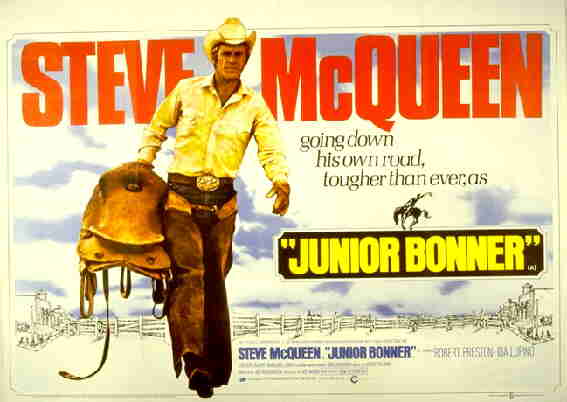 "I'm working on my first million. You're still working on 8 seconds" (Curley Bonner)
Prescott, Arizona is dying. Once enveloped in its classic western traditions and iconography, this small rural outpost is slipping into modernity. Railroad stations once linking the town to the outside world are passed over by freight traffic; the desert ranches that once filled the outskirts of town are now torn down to make way for the development of mobile homes. Stripped of its identity, the community and its vitality are vanishing into the sands of time.
It is the Fourth of July weekend and the community is gearing up for its annual rodeo, the centerpiece of its "Frontier Days." High school marching bands and ornate fllotillas compete for space amongst antique cars, stray dogs and lost causes on the town's sloped main street. Yet, this cause for celebration is muted for aging, nomadic rider Junior Bonner (Steve McQueen). Returning to his home town, Bonner is attempting to mend his pride and his family.
Utilizing Sam Peckinpah's familiar thematic interests in masculinity, aging and the extinction of the West, Junior Bonner demonstrates the director's ability to engage in topics that particularly illuminate his protagonists' desire for a final attempt at fulfilling their potential. In the case of Junior Bonner, Peckinpah creates a dichotomy between father and son, as each try to re-establish their masculine pride and soothe old wounds.
The spectre of the past haunts Junior Bonner. Skillfully demonstrated in a series of black and white flashbacks, Junior Bonner is chased by the painful memories of a spasmodic fall during a recent contest. Wounded by a ferocious bull owned by wily rancher Buck Roan (Ben Johnson), Bonner finds pain in more than his taped broken ribs. His ego is equally wounded. To eradicate his mental and physical anguish, Bonner bribes Roan to ensure that he and only he will be selected to ride Roan's cattle in the bull riding portion of the local competition.
Splitting the prize money fifty-fifty with Roan means little to Junior Bonner. Unlike his devious brother Curley (Joe Don Baker), money is not the world to Junior Bonner. His attitudes are a dying breed: belonging to a world in which self-respect and familial selflessness is more important than materialism. Antithetical to this are Curley's selfish attitudes. Taking advantage of his father's alcoholism and financial disarray, Curley purchases his father's 600 acre ranch for half of its $30,000 value. Bulldozing it to the ground, Curley plans to use the land for quick personal financial gain:building a giant mobile home park amongst the quarries of stone, gravel and bric-a-brac.
Curley speaks in the rhetoric of a unifier. He talks of consolidating the family, providing Junior with a job and his mother with domestic security. Yet, his actions are derisory: the stuff of a showman. Unlike his father or brother, his brand of entertainment is self-serving. Peckinpah cunningly illustrates this by demonstrating the divergent public reactions to the establishment of the rodeo and Curley's mobile home park.
Other than a few curious children, there is hardly anybody in town who appears excited over the erection of this annual event. Their eager eyes have instead moved over to Curley's mobile home park. Adorned in a carnivalesque atmosphere, Curley's park is feted by vast crowds, who are inquisitive of his modern contraptions and lured by free hot dogs and hard candies. Thus, Curley's dream of harmonizing his family are contrary to his actions. Rather than aid his father, he sends him packing onto the street. His equally myopic wife disapproves of her children going to the rodeo, despite the fact it offers an opportunity for the family to gather for one last time.
Following in his father's footsteps, Junior is a small-time celebrity on the rodeo circuit, who like his father Ace (Robert Preston) is seeing the extinction of his kind. Now descending into alcoholism, Ace is a forgotten figure in his own hometown. Separated from his wife Elvira (Ida Lupino), Ace dreams of emigrating to Australia to engage in another vacuous get-rich-quick scheme. Elvira on the other hand has resorted to renting out her small house to boarders, while Curley plans to sell the home and whisk his mother away into one of his isolated metal units.
While Curley paves the way for the future by destroying his father's delipidated home for other families, he is unable to mend his own. An interesting facet of Peckinpah's film is that old wounds are not neatly healed by film's end. Elvira refuses to re-unite with her inconsiderate husband, Ace appears unwilling-despite his talk-to change into an emotionally mature men and Junior is not inclined towards settling into the rigid lifestyle his brother plans to offer him. Each appear to be going their separate ways as does Bonner's bland love interest Charmagne (Barbara Leigh) by film's end.
The west may be dying for Junior Bonner, but he still clings to its values. His happiness is not found in selling plots of land, but in wandering along desert highways and performing at equally retrograde venues. By focusing less on the rodeo itself and Bonner's desire for personal redemption, Peckinpah crafts a wonderfully small and intimate modern western not at odds with his visually flamboyant and expressive style. Utilizing a wide range of zoom shots, split-screens and slow-motion techniques, Peckinpah establishes a style that complements rather than alienates a setting that places an emphasis on time.
McQueen's low-key performance is suitably grand for the material. Like Ida Lupino, McQueen nurtures a performance rooted in earthiness enhanced by a twangy accent and a famliarity with rolled cigarettes. Ben Johnson grins admirably, while Robert Preston is astutely dank, dirty and jovial. Joe Don Baker tries a little too much to be a southern Richard Burton, while Barbara Leigh is forgettable and superfluous. Peckinpah creates a cryptically desolate paradigm: a distinctly American sub-culture knowingly on the verge of death.
While regional historical societies have preserved Prescott, Arizona and other outpost communities from complete extinction, the characters and settings astutely encapsulated in Junior Bonner belong to a bygone era. The dynamic of detachment between modernity and the past is wonderfully dissected throughout the film: grafting the push and pull between the frayed fences of the historic rodeo and the empty tactics of Curley's real estate showman. Fittingly, Peckinpah concludes the present is unwilling to find a purpose for these people and their ways: resulting in their additional fractured separations and subsequent diaspora further into the American cultural wilderness.
* Junior Bonner is available on MGM Home Video
Other Peckinpah Films Reviewed:
Pat Garrett and Billy The Kid (1973) 8/10
Copyright 2007 8½ Cinematheque
posted by eight_and_a_half at 7:04 PM


