Reviews and criticism of classic and contemporary films

Thursday, July 31, 2008

1964: The Night of the Iguana

The Night of the Iguana (Huston, 1964) 9/10

The last major entry in the cycle of Tennessee Williams' adaptations that permeated Hollywood from 1950 to 1966, The Night of the Iguana is a rich, sensual experience: a tropical fever dream of a film filled with crippling anxieties, devilish rogues and bittersweet redemption. Directed by famed Hollywood auteur John Huston, The Night of the Iguana is one of the finest translations of Williams' work on celluloid: a film that produced an iconic performance from Richard Burton and turned Puerto Vallarta from a remote village barracked by mountainous jungle into a bustling tourist destination.

Shot in stunningly sharp monochrome by Luis Buñuel cinematographer Gabriel Figueroa, The Night of the Iguana centers on the moral and spiritual trials of the Reverend T. Lawrence Shannon (Richard Burton). Locked out of his Episcopalian Church for indulging his immoral appetites, the former Minister now spends his time working as a tour guide escorting tourists on religious pilgrimages, rather than guiding a flock of parishioners. Yet, even south of the border, his errant ways and bothersome habits continue to clutch at his soul.

His response to the lusty whims of a promiscuous minor named Charlotte (Sue Lyons) in particular cause a stir amongst the busload of middle-aged female Baptist school teachers. Despite his best efforts, Shannon is unable to abscond from her rash erotic impulses. Accused by Charlotte's infuriated chaperon Miss Fellowes (Grayson Hall) of seducing the teenager in his bedroom, the desperate Shannon cracks under the strain and diverts the tour from their base at a modern hotel in Puerto Vallarta to another locale, the Costa Verde Hotel: a folksy hilltop establishment on the outskirts of town owned by his highly sexualized, proto-hippie friend Maxine (Ava Gardner).

Yearning to stop Miss Fellowes from contacting the tour company in Texas, Shannon mistakenly hopes that he and Maxine can win over the tour's patrons at Costa Verde in order to spare him his measly job. Nevertheless, Shannon's predilections for the flesh and alcohol continue to haunt him in the cool mountain air. Soon "at the end of his rope," Shannon descends into madness and physical anguish: culminating in breakdown during a frenzied stormy night with only the assistance of his friend Maxine, the soothing words of traveling painter Hannah Jelkes (Deborah Kerr) and the poetry of her ailing eight-year old grandfather Nonno (Cyril Delevanti).

The Night of the Iguana is an intense portrait of human destruction. Bordering on a nervous breakdown, Burton's Shannon is a figure drowning in his anguished mistakes. Unable to truly connect with others for help, Shannon is a figure caught up in his own dissolution. As shown visually throughout the film, this strain takes on an almost torturously biblical route. In one memorable scene, a barefoot Shannon walks across broken shards of glass in order to resist the tempting Charlotte as taunts and teases him with her lusty flirtatiousness. Convinced the weight of God's fury is upon him, Shannon even tries to strangle himself with a gold crucifix, he procured from a pawnshop.

Yet, despite his weaknesses and failings, Shannon is still an intensely proud individual. After Miss Fellowes engages in a fact-finding mission in order to taint his credibility, Shannon rebukes her claims that he was defrocked with conviction and intensity. In response, Shannon expresses his tormented relationship with God at the source of his professional woes; highlighted by his unwillingness to view God as a childish and petulant figurehead. In his frank discussions with Hannah Jelkes, Shannon strives to correlate a genuine spiritual association with Him. This connection is partially frayed by the inability of others to understand Shannon's moral faux-pas as the strain of enforced perfection on a broken individual.

The women in The Night of the Iguana play an important part in Shannon's misery and search for purpose. Like her earlier and more infamous role as the title character in Stanley Kubrick's adaptation of Vladimir Nabokov's Lolita, Sue Lyons plays a teenager who tempts an older man. But unlike the lecherous Humbert Humbert in Lolita, Shannon earnestly wants to suppress his feelings. Lyons plays her role in The Night of the Iguana as a series of quick emotional outbursts; flitting from one frothy viewpoint to the next as each constituted an aspect of eternity.

Her chaperon, Miss Fellowes is an all together different creature. Unlike, the flirtatious Charlotte, Miss Fellowes is stiff and distant. Portrayed in the film as a closeted lesbian, her vocational need to protect Charlotte seems both connected to her highly moralistic character, but also her own interests in the girl. Her sharp tongued attacks are not only leveled at Shannon, but to his highly-sexed friend Maxine, who also poses a threat to the social character she aspires to represent.

Bouncy, yet bearing an undercurrent of contempt, Maxine is a highly independent woman. Sexually liberated even before the death of her husband Fred, Maxine is characterized by her earthy and carnal characteristics. Despite the censorship of the era, it quickly becomes apparent that Maxine regularly engages in a multitude of sexual activities with her two young Mexican cabana boys. Aging, yet still beautiful, Maxine feels alive and wanted through them. Yet, in spite of their presence, Maxine still desires Shannon, who has continually rebuffed her advances out of respect for Fred. Nevertheless, Maxine offers Shannon a sense of home and permanency that his troubled life is crucially lacking.

The final woman who offers Shannon comfort is the gentle painter Hannah Jelkes. Unlike Charlotte and Maxine, Hannah is a highly asexual creature. Contemplative and assured, she resists Shannon's advances because she believes in love for it what offers beyond its physical capacities. Traveling with her aging grandfather, the pair offer their art as payment for their lodgings and food. Unlike the proud Shannon, Hannah feels no shame for her destitution, because she is not bound to a world of materialism and money. Rather, she is complete in the world around her and thus tries to make Shannon understand his shortcomings and flaws.

The principal metaphor in the film emerges from their plainspoken conversations. Like the Iguana, Maxine's cabana boys have tied to a post in order to fatten up to eat, Shannon too has a noose around his neck. The weight of his religious commitments and his moral principles is too great a weight for his tortured soul to bear alone. Thus, Huston's film becomes a homage to companionship, to art and to ethereal beauty. The film's principal characters are each astutely acted. With his booming voice and theatrical disposition, Burton is perfect as the plagued priest. Ava Gardner is equally remarkable against-type as the primal Maxine, while Deborah Kerr adds a saintliness and calming resonance to the picture.

Featuring a series of superb performances and gorgeous on-location cinematography, John Huston's adaptation of The Night of the Iguana is a criminally overlooked and undervalued entry into his filmography and the filmic Tennessee Williams' canon. Unlike other "prestige pictures" of its day, The Night of the Iguana does not appear dated and bloated; in large part due to Gabriel Figueroa's cinematography and Huston's emphasis on capturing the emotional pitfalls and sensual primacy of Williams' work set to an exotic background.

At times a stunning achievement.

* The Night of the Iguana is released on DVD by Warner Home Video and is available in their excellent Tennessee Williams Film Collection box set

Other John Huston Films Reviewed:
Across The Pacific (1942) 3/10
The Unforgiven (1960) 7/10

Copyright 2008 8½ Cinematheque

Labels: , ,

Wednesday, July 23, 2008

1960: The Unforgiven

The Unforgiven (Huston, 1960) 7/10

John Huston's 1960 Western The Unforgiven was a film fraught with tragedy and dissolution both on and off-screen. Featuring a strong, reputable cast including Burt Lancaster, Audie Murphy, Lillian Gish and Audrey Hepburn in her only entry in the genre, The Unforgiven had the ingredients to be a box-office success, the film's lead star and co-producer Lancaster desired. Nevertheless from its inception, The Unforgiven was a work painted in shades of lament.

In the mid-Fifties and early Sixties, the Western had morphed into an important artistic vehicle for socio-political debate, particularly in the realm of race. The question of historical and present-day racism was subsequently addressed in film's such as John Ford's The Searchers, Anthony Mann's Cimarron and Don Siegel's Elvis Presley vehicle The Flaming Star.

For Huston, this project was also earmarked as a challenging allegorical piece designed to reflect America's contemporary racial disharmony. Instead, the film was disowned by its creator and its principal performers; the sorrowful filled victim of what Huston would later term as a "celestial vengeance."

By the time filming had completed, three crew members had perished in a plane crash and two miscarriages had been suffered. Additionally, Hepburn had seriously injured her back after falling from a horse, Audie Murphy had almost drowned on a nearby lake and Huston had been the victim of a knife attack. The myriad of delays coupled with the hefty wages of the star-filled cast prompted the termination of Lancaster's production company HHL. Failing to find an audience, the film was a commercial failure. Removed almost forty years from its initial release, The Unforgiven stands out as an interesting, overlooked and misunderstood film affected by the constraints of its time and the confrontation between art and commerce.

Located amongst the swirling sandy brush and the limbs of desiccated trees, the baked-mud walls of the Zachary ranch have demonstrated a tenuous permanency. Eking out a modest subsistence for years, the family fortunes finally appear to be on the upswing. Ersatz family patriarch Ben (Burt Lancaster) has returned from Wichita equipped with not only dreams of expanding their shared cattle business, but also with a modicum of western civilization: a small piano gifted through the muscular first-born's ability to win a bet through his strength.

Nevertheless social disaster soon strikes, as once dormant ghosts from the past return in the form of a one-eyed horseman (Joseph Wiseman) named Abe Kelsey. Spouting religious verse, blanketed in dust and baked into madness by the searing heat, Kelsey's mumbled ramblings appear to be little more than the words of a madman. In spite of Kelsey's mental fragility and susceptibility, his provocative mumblings about the racial origins of Ben's adopted sister Rachel (Audrey Hepburn) stir raw, primal emotions amongst the Zachary men, including Ben and his racist brother Cash (Audie Murphy).

As the Zachary boys try in desperation to track down Abe Kelsey, the influence of his ramblings permeates through the community. In an inversion of Ford's The Searchers, a local Kiowa tribe beseech the Zachary's to return the now adult Rachel to her people. Their methodology is one of peace and honour; even if their approach slants toward bartering for Rachel through the trading of horses, as if she were a mere commodity.

Concurrent with the Kiowa's requests, the Zachary's closet friends and trading partners also call for Rachel's reversion to the Kiowa in order to protect their own product: the threat of communal and entrepreneurial exile the high price for any corresponding inaction. Ben refuses to capitulate to either demands, even if by the film's finale, his reasoning is more incestuous than noble.

Supremely shot by Franz Planer, The Unforgiven is an often messy, yet interesting Western. Using the past as a distancing device, Huston aimed for The Unforgiven to be an outlet to explore racial conflict in 1960's America. But through a combination of off-screen mishaps and on-screen slovenliness, The Unforgiven never really fulfilled its potential. Based on a story by The Searchers author Alan LeMay, The Unforgiven similarly tries to address many of the racial and social concerns put forth in Ford's adaptation of the former. Unlike Ford's film, Huston's work fails to fully embrace these concepts, primarily due to the off-screen friction between Huston and the film's producer(s) and star.

Whereas Ford's protagonist Ethan Edwards is shown as an insensitive demonizing figure unable to adapt to the textured complexities of modern America, Huston's Ben Zachary is an atypical strapping hero by the film's final moments. Despite an early reverence for the peaceful Kiowa, there is little in the melodramatic story that serves to fully acknowledge the indigenous characters as multi-faceted beings. Bizarrely for a film devoted to an anti-racist message, the prolonged destruction of the Kiowa outside the Zachary household subtly depicts the Native Americans merely as superstitious, child-like creatures. In contrast, Lancaster's Zachary is portrayed in a positive manner as a family man desperate to protect his own interests; in spite of his incestuous desires for his half sister and his orders to shoot to kill upon an amicable party of Kiowa diplomats.

While Huston intended for The Unforgiven as an essay on racism, the overall effect is insipidly muted. This primarily stems from the muddled angles toward a serious examination of the topic throughout the film. The exigency held by Rachel in the film's final sequences is a particularly noticeable product of this problem: leaving the character involved in a twisted decision between nature or nurture. Ultimately, her choice is predicated through violence, rather than love as she decides between her biological and adoptive families: a facet that leaves Huston's flawed treatise cold and barren upon reaching its coda.

For contemporary audiences, The Unforgiven may work better as an examination of the tracts sociological racism built with the "pioneer spirit:" attributes plainly imbued by the callous Cash Zachary and subtly demonstrated by much of the community's xenophobic populace. Despite its notable contextual plot flaws and the miscasting of Hepburn, The Unforgiven is a peculiar and often compelling melodramatic Western. Featuring a brutish, against-type performance by Audie Murphy, a resilient Lillian Gish and an imposing Burt Lancaster, The Unforgiven is a misguidedly fissured film: an often captivating family melodrama that subsequently fails to dismantle the mythology of the West it yearns to correct.

* The Unforgiven is available on DVD through MGM Home Video

Other John Huston Films Reviewed:
Across The Pacific (1942) 3/10
Night of the Iguana (1964) 9/10

Copyright 2008 8½ Cinematheque

Labels: , ,

Tuesday, May 29, 2007

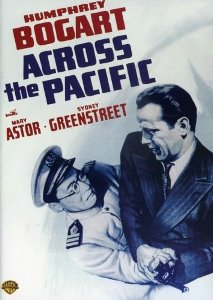
1942: Across The Pacific

Across The Pacific (Huston/Sherman, 1942) 3/10

By the early 1940's, audiences associated Warner Brothers with its trademark qualities of grit, toughness and bluntness. Stars such as James Cagney, Bette Davis and Humphrey Bogart detailed these embodiments with their flavourful, often brutal performances.

Another trademark of the studio in the early part of the decade was in its infatiguable attempts to recapture the magic of previous successes such as John Huston's 1941 Noir The Maltese Falcon and Michael Curtiz's 1942 wartime romance Casablanca.

Huston's 1942 film Across The Pacific tries to earnestly and cognizantly recall the brooding sensibilities, fraudulent personalities and deceptive humour of his début The Maltese Falcon. Reuniting three of the four prinicpal cast members (Humphrey Bogart, Mary Astor and Sydney Greenstreet) along with director John Huston, the studio desired to reclaim the accomplishments of the latter project, coupled with a wartime tint. They failed.

Ejected from the U.S. army for stealing money, Rick Leland (Humphrey Bogart) wanders north to Canada in order to exercise his skills.Yet, due to his earlier disgrace the Royal Canadian Forces in Halifax are unwilling to utilize his services either. Dejected, he stumbles into a travel agency, where he notices an attractive Canadian woman Alberta Marlow (Mary Astor) procuring a ticket on a Japanese steamship in order to return to Medicine Hat, Alberta via Vancouver.

Intrigued and lacking in domestic opportunities, Rick hopes to either find love or employment under Chiang Kai-shek's Chinese nationalist forces by the end of his voyage. On board, Rick meets few passengers. Among the few travellers, there is a British sociologist Dr. Lorenz (Sydney Greenstreet) returning to lecture in the Philippines with a curious infatuation with Japanese society and a talkative second generation Japanese-American, Joe Totsuiko (Victor Sen Yung) returning to his ancesteral homeland to work in his family's businesses.

Despite the potent casting, Huston's film is a mess: a jumble of genres, tones and atmospheric moods. Starting with Bogart's dismissal from his post in Panama, the director creates a sense of anticipation, awaiting Bogart's abilities to correct both his personal demons and the errors of the state. What ensues is a convoluted pastiche part action film, part Thin Man sleuth comedy. Bogart and Astor become less the tawdry, virulent couple shown in The Maltese Falcon as their characters become more inclined to replicate the bubbly hijinks equated with William Powell and Myrna Loy. Arguably, one should not assume Huston would desire to continue the personalities of his earlier film, yet the setting and tone of Across The Pacific is chiefly suited to such poisonous methods.

Despite its title, the film fails to even sail into the Pacific. Prior to filming, the studio opted to change the setting from pre-war Hawaii to the more isolated southern locale of Panama, yet keep the original title. Given the sentiments of Huston's film, it is easy to assume why. The director's emphasis on the forced humour between Astor and Bogart on the one hand, and the sinister relationship between Bogart and Greenstreet on the other, would be ill-fitted to a Hawaiian setting in 1941. The director's over-indulgence in the banter between the sexes, rather than one man's quest to protect his nation would certainly be at odds with the spectre of heroism and patriotism necessary within a film set on the politically sensitive shores of Hawaii.

For a wartime product, Huston's film is strangely more indebted to its queasy romantic-comedy storyline than the necessity to protect American soil. One of the film's most interesting facets is Bogart's muted patriotism. Utilizing a skilled plot twist after more than half an hour of sugary romance, Huston offers Bogart's character a sense of national duty. Yet, there is little pride that Bogart carries with his newfound occupation. Flag-waving and hyperbolic patriotism are almost non-existent throughout Across The Pacific. Cultural ignorance however remains at the forefront.

Racist attitudes via stereotypes and malignant cartoonish appropriations of Japanese culture permeate Across The Pacific. Almost all of the Japanese characters are short, male and stone-faced. Their emotionless expressions are evident in their stereotypical wire moustaches, thick Coke bottle glasses and heavily accented broken English. Joe Totsuiko is an exception in that he is garralous and overly friendly: a trait one assumes is related to his perceived Americanized upbringing. Yet, in the film's language and tone, these All-American traits are worn as a costume designed to mask the hidden malicious characteristics the film duly associates purely with Oriental characters and their admirers.

Greenstreet's rotund Lorenz is one of those followers. His cultured appreciation for haikus, judo and his fluency in Japanese is not a sign of worldly education, but as with other films of the era this signifies his deceptive baseness. In contrast, the film's North American characters are often hostile and suspicious of their Asian crew and fellow passengers. Both Astor and Bogart embarassingly claim the Japanese are purely homogenous in their facial features. Upon hearing a delicate haiku translated by Lorenz, Astor's character woefully responds in front of two Japanese men that she believes the Japanese do have "emotions like us."

Bogart's mistrust of Joe Totsuiko is evident in his avoidance and snappy rhetoric toward his fellow passenger. Upon arriving in Panama, it should be noted that Bogart's closest colleague on the thinly composed Central American country is an Asian hotel clerk named Sam. Furthermore, Bogart frequently works with Asian coworkers in Panama in order to expose a chilling secret about the ship's passengers and crew. Yet, Huston's film tends to tar all Japanese nationals and Japanese-American citizens with the same close-minded brush: assuming all are willing participants in the development of a war mongering Imperial Japan. Attitudes which resulted in the abbhorent seizure of thousands of citizens of Asian descent throughout the United States and Canada during this period.

Across The Pacific serves as an interesting mid-point between Bogart's work in The Maltese Falcon and Casablanca. Donning the similar trenchcoat and hat as in the former, Bogart's character in Across the Pacific adds a greater sense of romance to the proceedings. Furthermore, the backstory of a jilted American turned isolationist with a friend named Sam complies the characteristics of Bogart's character- also named Rick- in Curtiz's masterful film released the same year.

Yet, despite its slick performance by Sydney Greenstreet and Bogart's patented irascible lead, Across The Pacific drifts in a dull fashion along its filmic ocean. Astor's character is flat and uninspired, while Victor Sen Yung achieves a decent effort in another of his continually marginalized and stereotyped performances during the decade.

While Vincent Sherman took over the reins for the film's action-packed finale after Huston was called up for military service, the responsibility for this slow, turgid mess does not fall into his hands. This guilt falls squarely onto John Huston's palms in a picture that ultimately seems ill-suited to his propensity for demonstrating the heart of darkness, rather than fluffy romantic escapades and comedic timing.

* Across The Pacific is available in Warner Brothers' Humphrey Bogart Signature Collection Vol 2.

Other John Huston Films Reviewed:
The Unforgiven (1960) 7/10
The Night of the Iguana (1964) 9/10

Copyright 2007 8½ Cinematheque

Labels: , ,