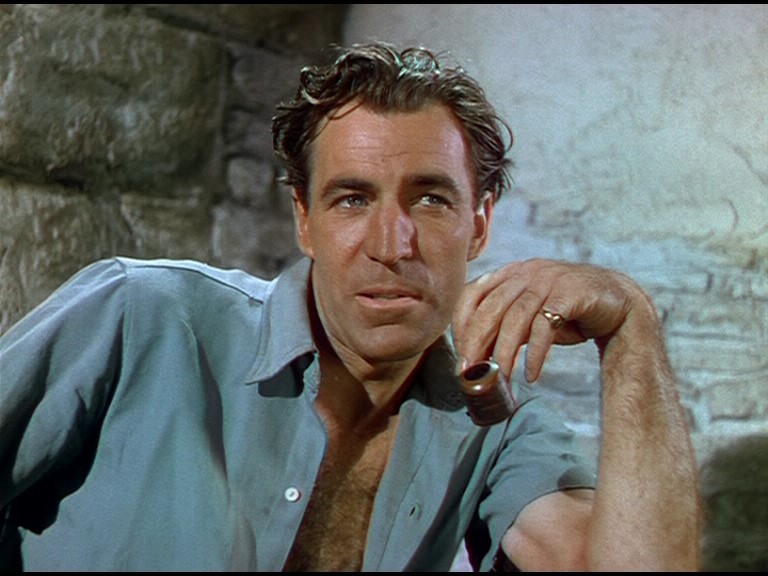
Reviews and criticism of classic and contemporary films

Wednesday, May 16, 2007

1946: A Matter Of Life And Death

A Matter of Life and Death (Powell and Pressburger, 1946) 8/10
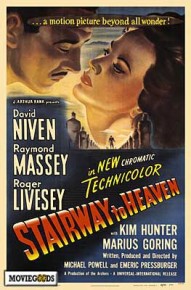
In their 1979 song "Heaven," New York quartet The Talking Heads cheekily summized that "Heaven, Heaven is a place, a place where nothing, nothing ever happens." Thirty-three years earlier in their film A Matter of Life and Death, the imaginative British duo of Michael Powell and Emeric Pressburger thought otherwise.

Flying across the English Channel in his damaged Lancaster Bomber, English pilot, poet and European historian Peter Carter (David Niven) realizes he is about to die. With his parachute destroyed and the rest of his crew either deceased or previously ejected, Carter eccentrically mutters his final words to June (Kim Hunter), an American radio operator stationed in England. As she weeps upon his hearing his words, Carter jumps into the icy waters below.

Arriving washed-up on a sandy shore manned by a naked boy herding goats, Carter assumes he is in heaven, only for the boy to remark that he is actually in England. Seeing June cycling across the beach, Peter runs to her and the pair begin to fall in love. But in Heaven, there is a problem. Conductor 71 (Powell and Pressburger regular Marius Goring) a French Revolutionary-cum-Angel was supposed to collect Carter upon his fall, but became bewilderingly lost in the thick wafts of English fog.

Appearing in a rose garden, Conductor 71 informs Peter of the rare mistake. Madly in love with June, the former pilot refuses to accept death and pleads for a trial to determine his fate; while June's friend Dr. Reeves (Powell and Pressburger alumni Roger Livesey) tries to diagnose Peter's plight through more scientific and rational terms.

Released in the United States as Stairway to Heaven, A Matter of Life and Death was concocted at the behest of the Ministry of Information. With Anglo-American relations straining after the war, the Ministry was keen to have a film that spoke of the "special friendship" the two nations have symbolically shared. Thus, Powell and Pressburger, who had created such notable wartime films as A Canterbury Tale and The 49th Parallel devised a story based upon a newspaper clipping of a pilot who had survived an escape from his downed plane sans parachute.

Ironically, the film product was criticized by reviewers and audiences of the time for being anti-British: a charge that was regularly utilized in reviews of Powell and Pressburger's wartime fare. Yet, what critics of the time mistook for lack of patriotism, today translates into a lack of jingoism. There are no images of the brave, heroic Briton. Instead, A Matter of Life and Death finds Powell and Pressburger pondering their familiar topical concerns about rationality, mental stability and exotic worlds.

Despite the film's emphasis on a world beyond, Heaven itself is often subjected to scrutiny. While the pair do not openly dismiss the existence of Heaven, they do call into question the omnipotent nature of Heaven. The afterlife in the film is imbued with Calvanist notions of predestination as a receptionist holds a list featuring the names and dates of each of the deceased. Conductor 71's mistake may have been the first in over a millenium, but his inability to find Peter hints at the possibility of Heaven as an imperfect world. Certainly there is a degree of truth to this delienation; after all Heaven's membership is compiled of flawed human beings.

Upon first entering Heaven, the receptionist notes that hierarchical barriers such as rank, sex and race are nullified here: all are equal. But as noted by Peter's trial, it is interesting to see how prejudice still exists in Powell and Pressburger's view of Heaven. The prosecutor in Peter's case is Abraham Farlan (Raymond Massey): the first American to be killed during the Revolutionary War. Farlan despises the British and composes a jury of individuals from supposedly similarly minded societies: colonial India, Boer War-era South Africa and early 20th century Ireland. Farlan's case is mostly constructed not from judicial arguments, but through cultural prejudices: arguing that a woman of "good American stock" would be culturally unable to love a whimsical Englishman.

Yet, the trial brings into question the rationality of the natural laws binding the two worlds. In Farlan's estimation, love is irrational and thus he is unable to support Carter's claim for a prolonged life. But, Carter and his attorney argue differently. Conductor 71's mistake allowed Carter to rationally fall in love with a woman, whom previously he would not have met under any other circumstances.

The existence of Heaven is established through the dichotomy between scientific rationalism and psychological irrationalism. The negating of time during his confrontations with Conductor 71 prevents individuals other than Carter in seeing these meetings occur. Due to Carter's previous history of head trauma, Dr. Reeves assumes that these visions could easily be hallucinations. Through surgery the doctor aims to correct this mental imbalance, while still involving his curiousity by inquiring to the nature of Carter's conversations with the Frenchman. Furthermore, Powell and Pressburger employ the same actor to play the Judge presiding over Carter's case and his brain surgeon.

Like other Powell and Pressburgers films like I Know Where I'm Going!, The Red Shoes, Tales of Hoffman and Black Narcissus, the notion of mental instability is progressed. In each of the latter films, this disproportion is the product of human emotions in a strange or foreign place. In I Know Where I'm Going! Wendy Hiller tries to marry a wealthy man on the Scottish island of Mull, but is surrounded by a group of colourful eccentrics, who along with Mother Nature persuade her to take an alternative route in life; both The Tales of Hoffman and The Red Shoes feature characters driven to the edge through romance in a foreign land; while Black Narcissus sees a group of nuns become fractured and instable in the Himalayas when their true sentiments and lusts are revealed.

The foreign nature of Heaven is related through Alfred Junge's modernist sets and Jack Cardiff's cinematography. Featuring open ampitheatres, white walls and an escalator, Heaven is a place detached from the warm colourful landscapes of Earth captured in Jack Cardiff's visuals. This is primarily acheived by Cardiff's utilization of both black and white and colour cinematography. Like in Victor Fleming's The Wizard of Oz, two colour techniques are utilized to distinguish two different worlds. Using harsh black and white to capture Heaven, the afterlife is filled with the type of cold and mechanical imagery later to be seen in 1950's Sci-Fi cinema; Earth on the otherhand is not as regimented and thus is filled with surreal imagery and hyperactive colour. Earth thus belongs to the cinematic spirit of Cocteau in its portrayal of the fantastic.

Featuring a strong cast including David Niven, Kim Hunter, Marius Goring and Roger Livesey, A Matter of Life and Death, A Matter Of Life and Death is one of the most interesting and complex British films of its ever. Utilizing fantastic sets by Alfred Junge and images by master cinematographer Jack Cardiff, Powell and Pressburger created one of the most memorable films of its era.

Although Hunter's performance is often annoying in its context as one of the duo's dependent female characters, her role is minimal. Additionally, the picture's Anglo-American legal duel during the film's last twenty minutes is often tedious and overwrought in its construction.Viewed a critical and commercial failure at the time of its release, A Matter Of Life and Death has emerged as one of the most important films of the 1940's: a magical and charming romantic-fantasy filled with delightful comic touches.

* A Matter of Life and Death is available on R2 DVD through Carlton Home Video.

Other Powell and Pressburger Films Reviewed:
Black Narcissus (1947) 10/10

Copyright 2007 8½ Cinematheque

Labels: , ,

Sunday, June 25, 2006

1947: Black Narcissus

Black Narcissus (1947, Powell-Pressburger) 10/10

"I told you this was no place for a nunnery. There is something in the atmosphere that makes everything seem exaggerated." (Dean)

Atop a cliff in mountainous northern India eight thousand feet above sea level, there lies a small disused palace amongst the harsh rocky terrain called Mopu. With its jagged architecture and crumbling windswept exterior, this isolated former bordello of an Indian General seems an unlikely place for spiritual and cultural enlightenment. Yet, thanks to the gracious offering by the Europeanized General (Esmond Knight), the Order of the Servants of Mary, an Anglican convent in Calcutta have been offered the opportunity to transform this earlier house of sinful pleasure into a house of God: a place were Christ's work and imperial interaction will mould a nation of reluctant "savages" into a class of civilized citizens.

For Sister Clodagh (Deborah Kerr) this mission is her first taste of real authority. Along with a carefully selected group of nuns including garden expert Philippa (Flora Robson), a talkative social butterfly Honey (Jenny Liard), a strong-willed women in Briony (Judith Furse) and the convent's hypochrondiac Sister Ruth (Kathleen Byron), Sister Clodagh attempts to succeed were her Anglican brethern have failed in colonizing the mountain community for Britain's use. Yet, within a few months the calm and attentive young woman we meet in the stalid white convent offices in Calcutta is little more than a tattered relic of her former self: a mentally, emotionally and spiritually broken women whose faith in God and Empire have been permanently questioned.

At its onset, Black Narcissus appears to be little more than a triumphant vindication of British morals, western culture and institutionalized Christianity: elements on the wane for British audiences following the film's post-World War II release. In his often plagarized quote, film critic Geoff Andrew described Black Narcissus' depiction of India as a "state of mind" rather than a place: a notion which holds true throughout. What unfolds in Powell and Pressburger's adaptation of Rumer Godden's 1939 novel is less a structured film plot-driven film about spirituality and community and more a film about ideas and images; textures and tones; atmospheres and aromas as noted by the emphasis on Jack Cardiff's beautiful cinematography and Alfred Junge's jaw-dropping sets. Rather, than solidifying classical European-thinkng, the film is a harsh critique of the aforementioned ideas, as well as an examination of modern womanhood, sexuality and humanity's futile attempts to control nature. Brave subject matter for 1947.

With its colourful erotic frescos Mopu becomes the imperial battleground upon which the Sisters attempt to wage war on Eastern spiritualism, morals, ethics and sensuality in constrast to the bare plainess of their clothing and Calcutta office. Through education, healthcare and the addition of Christian monuments Sister Clodagh believes her subjects and environment can be altered to fit European norms. They are not an order based on pious meditation, but rather they claim to preach universal interaction and acceptance in the footsteps of Christ. Yet, their attempts to do this are undermined by both exterior and interior factors. Despite the promise of free education, the local population are not endeared to the nuns and are often paid by the General in order to learn European languages, mathematics and sciences. Their faith is placed not in the sisters, but in a local silent Holy Man who sits at the edge of the grounds in endless meditation. Only the Sisters' European medicine entices the citizens to straddle up the treacherous mountainside to Mopu, despite the Sisters' reluctance to dispense it to an uneducated population whom they hold in contempt.

With its constant wind and cool temperatures, the Sisters begin to feel the thin mountain air and purified water is affecting their senses, spoiling their slumber and causing them to become ill. Yet, the climate is not necessarily a source of their ills, but a catalyst for their hidden desires and feelings. In his lush cinematography Jack Cardiff utilzes shadows to repeatedly demonstrate the aura of foreboding darkness entering the hearts and minds of the nuns, which has been triggered by their isolated habitat. Throughout Black Narcissus, Sister Clodagh and her fellow nuns attempt to foster a spirit of female independence, which will allow them to prosper as servants of God and the community were their Anglican brethern previously failed after five months in solitude. The Sisters wish to confer with the citizens, maintain Mopu and continue God's work without the assistance of men including the General's agent, lusty British ex-pat Dean (David Farrar). The clash between masculinity and feminity is at the core of Black Narcissus .

As with Powell-Pressburger's other films, the female protagonists in Black Narcissus conform to one of two distinct classes of women: as either dependents or independents. In these films dependent female characters attempt to wield individual authority through repressing their sexual identity and feelings in order to fulfill their expected potential in prestigious roles. However, the dependents such as Sister Clodagh and Moira Shearer's character Vicky in The Red Shoes require the skills of utility and authority bestowed by their male counterparts in order to survive; the independents such as Sister Ruth or seventeen-year old Indian temptress Kanchi (Jean Simmons) or Catriona Potts in I Know Where I'm Going display a rigourous vitality and unorthodox approach to their gender roles, which unsettles dependent female characters such as Kerr's Sister Clodagh who see them as a threat and a danger to the symbolic order: yet who are undermined by their own inadequacies to cope with the situation at hand.

Yet, Dean is not the only man who inspires the women. Although they initially reject the General's nephew (Sabu) because of his gender into their education program, the Sisters are conversely smitten by him and his luxurious clothes, attentive charm and use of the manly aroma Black Narcissus, which he purchased at a London Army and Navy store. In contrast to the primal, macho and hyper-masculine Dean, the General's nephew is sensitive, intelligent and caring toward women: seeing them as equals, rather than future lovers. Despite his wealth and status, Sister Clodagh reacts angrily to the General's nephew's secret acquaintance with the erotically charged Kanchi whom the Sisters only accept at Dean's polite behest. It is the unwanted presence of men like Dean and the General's nephew which trigger romantic memories, colourful ideas and causes the order to lose sight of its Christian goals to in-fighting and sensual pleasures. Through veiled windows and brief interactions with Dean, the already fractious relationship between Sisters Ruth and Clodagh disintegrates as Sister Ruth becomes even more independent and attempts to take on a more important role. This is noted in her reception to saving a dying woman's life. With her blood-soaked clothes and joyous response, the imagery here seems to metaphorize a real sexual awakening in Sister Ruth, which undermines Clodagh's ability to control her. Additionally, Sister Philippa abandons her mandatory attempts to grow vegetables in favour of the sensual power of luminous wild flowers, while Sister Clodagh reminisces of her failed Irish romance, which thrust her into God's work in a faraway land despite her earlier admission that she would never leave Ireland. These psychological awakenings are critical in the film as they humanize the nuns from obedient servants to questionable disciples.

Ideas of time and space are integral to Black Narcissus and demonstrate the inability of humanity to repress its most basic desires and thoughts over an elongated period. In her misinterpretation of this questioning of faith as treachery rather than human nature, Clodagh loses control of the Order. The casual elements of institutionalized religion such as Dean's notion of Jesus being consumed as "daily bread" are scorned. Rather, than accept change Clodagh blames the changing emotions on the inhospitable weather and topography rather than the unearthing of repressed incontrollable human emotions: prescribing further hard labour rather than open communication as a cure for the ills of Mopu. As a result of her inability to no longer control others, the Order retreats away from the community; becoming less of a welcoming sanctuary and more a violent prison of the soul. With the slow eradication over time of the formal codes of conduct within the Order, raw emotion spills over and produces perhaps the film's most memorable sequence in which Sister Ruth abandons her yearly vows: and in the process becomes an almost anti-Christ figure in the eyes of Sister Clodagh with her seering eyes, daring dress and sultry red lipstick. This fantastic scene can be shown in stark contrast to the delicate naivety shown by Jean Simmons' Kanchi who understands her sexuality and allows her ideas to come to the surface rather than repressing them in the name of upholding traditional gender roles and cultural standards.

Although the sub-plots involving Kanchi and the General's Nephew are wastefully underdeveloped, they provide a solid counterpart to the stubborn European superiority complex which collapses on foreign soil. The failure of the Sisters to acclimatize to their surroundings demonstrates Powell-Pressburger's critique of traditional European society's inability to nurture independent citizens. In Black Narcissus, British imperialism retreats from the unknown to the sanctuary of traditional British values, due to the limitations placed on the possibilities for women and for non-European cultures within the colonial world. Unlike Kanchi or Sister Ruth, Sister Clodagh is unable to separate spiritual and emotional independence from one another. Additionally, she is unwilling to accept an interdependent community in which Europeans, Indians, men and women work together, nor does she equip herself and her colleagues with the tools to prosper in an inhospitable environment. In their abhorrant treatment of the native citizens and ideas of Anglo-European perfection, the nuns eliminate future participants such as Dean or the Nephew's General who could create a hybrid community in which the Holy Man and the Christian Sisters could harmoniously flourish. As a result, their already fractured relationships produce further tension and undermine both their Christian vows and their mission of peace and civility.

* Black Narcissus is available through Criterion

Other Powell and Pressburger Films Reviewed:
A Matter of Life and Death (1946) 8/10


Copyright 2006 8 ½ Cinematheque.

Labels: , ,