Reviews and criticism of classic and contemporary films

Thursday, August 21, 2008

2007: I'm Not There

I'm Not There (Haynes, 2007) 9/10

American singer Bob Dylan is a mysterious figure. A man of countless contradictions, a projector of multiple personalities. In a career spanning almost half a century, Dylan has been a pop culture icon reviled and eulogized in equal measure. A slippery iconoclast, whom the world wanted to provide numerous answers to its problems, but in return only received countless questions about their voice of a generation.

The world could never catch up with Dylan. Thus, it's only fair that any biographical representation of Dylan's life should not try to encapsulate his essence in a standardized narrative with positivist arcs and ultimate redemption. In his unconventional 2007 Dylan biopic I'm Not There, American director Todd Haynes does neither. Rather, than straddling onto a traditional linear tale of ascension and descent, Haynes understands the bewildering nature of his subject does not call for either. Consequently, I'm Not There does not feature a sanitized composite character, as its principal figurehead.

Haynes' Dylan- like the man himself- is a multifarious creature: unwilling to be compartmentalized into the conventions of the genre. In I'm Not There, Haynes utilizes six different actors to present six different sides of Dylan: outlaw, poet, prophet, fake, star of electricity, international rock star. The result is a Fellini-esque cornucopia of surreal imagery and shifting identities; a myriad of popular images with all their positive and negative attributes nakedly exposed. It is a rare cinematic homage incorporating abrasive, sinister and curmudgeonly characteristics with honesty and without fear of reprehension.

Shot in both monochrome and Technicolor, I'm Not There is an episodic blend of documentary, art cinema and psychedelia encapsulating Dylan in all his fluctuations, illogical meanderings and chaotic bluster. The name Bob Dylan is never mentioned throughout the proceedings, despite Dylan having authorized the project and its use of his music. Flitting between the various tropes of Dylan, Haynes makes little attempt to neatly connect them together. Both aspects are neither a hinderance. Instead Haynes' parallel universe becomes a dynamic microcosm, allowing for the various inflections to have their own objective space to fully develop.

For those familiar with Dylan, the connections and allusions are clearly apparent in this amalgamation of half-truths and quasi-fictions. There is Dylan the liar, portrayed by Marcus Carl Franklin in the film as a young Woody Guthrie obsessed African-American adolescent, who begins creating his own mythology at a young age; Ben Whishaw stars as the mumbling teenager fixated by French poet Arthur Rimbaud; Christian Bale appears in a dual role as Jack Rollins, the folk icon and later as Paster John, the folk singer who converts to evangelical Christianity in the Seventies.

Although Heath Ledger plays an actor who once played the Dylanesque Jack Rollins in a film, his character represents Dylan during the Blood On The Tracks period through his failed marriage to Claire (Charlotte Gainsbourg); standing in for Dylan's own fractious break-up with his wife Sara. Cate Blanchett appears in her celebrated turn as Jude Quinn, the snarling, drug-addled carbon-copy of Don't Look Back era Dylan; while Richard Gere plays a variation of the older Dylan through the offbeat Billy The Kid, who resides in a world where the pastoral and the childlike grotesque meet.

At the core of Haynes' inventive art film is the elusive search for truth, both biographical and personal. Dylan's status as a walking cultural enigma has been the source of his attractiveness for scholars, writers and journalists for almost half a century. I'm Not There is not a direct portrait of Dylan, but it plainly expresses his dualistic emergence and suffering at the hands of truth. While Dylan's manipulation of facts enabled him to escalate the development of his own mythology through dislocating truth, the film also acutely puts forth the mental and emotional anguish caused by press galleons who engage in public inquisitions about his lyrics and the defeatist attitudes that cripple his marriage.

As with Dylan's own lyrics, Haynes opens up Dylan's life to interpretation. At times Haynes' film is introspective, poignant and crushing, while at others flamboyantly original, detached and vague. Like with his earlier study of musical personalities Velvet Goldmine, Haynes smartly posits the film with the cultural template of its era. In I'm Not There gives several playful winks to the films of the 60's and 70's, particularly Federico Fellini (with two sequences heavily borrowing from the opening of ), Godard and Altman, as well as an ironic interpretation of PBS documentaries. By utilizing such artistic sources in tandem with period footage, Haynes gives his non-chronological film, a necessary grounding through which his flirtatious imagery can riff on Dylan's legend at will. In doing so, Haynes creates a kaleidoscopic prism through which his swirling array of colourful ideas can be harnessed into a uniform cultural document.

Blessed with a series of strong performances, I'm Not There is a fantastic, original interpretation of both the varied platitudes of Bob Dylan, but also of the possibilities within the biographical genre. Structured around a series of vignettes, I'm Not There is a definitive example that style can continue to successfully exist in contemporary American cinema. Although the film is perhaps too leisurely paced at times, it does tap into is source material with verve and a critical eye. While the assorted images do not always neatly conform to one another, they do project a collective examination of truth, socio-cultural attitudes and individual chaos. In doing so, Haynes creates an idiosyncratic aesthetic gem, which in spite of its rough edges sparkles throughout.

* I'm Not There is available on DVD through Alliance Atlantis Home Video

Other Todd Haynes films reviewed:
Velvet Goldmine (1998) 8/10

Copyright 2008 8½ Cinematheque

Labels: , ,

Saturday, January 26, 2008

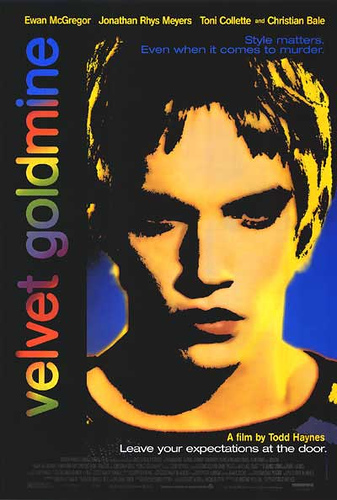
1998: Velvet Goldmine

Velvet Goldmine (Haynes, 1998) 8/10

"He was elegance walking arm-in-arm with a lie"

Since his controversial debut short film Superstar, American director Todd Haynes has been fascinated with pop music and its surrounding subcultures. In 2007, Haynes released I'm Not There, a film in which the director transmutes Bob Dylan into an array of fictional forms. While I'm Not There has received widespread critical acclaim, Haynes' earlier attempt at establishing a rock n' roll parallel universe Velvet Goldmine received lukewarm and tepid responses.

Almost a decade removed from its initial release, Haynes' study of glam rock and its cultural effects has emerged as a neglected gem. Slant Magazine even named it in a 2004 list of 100 Misunderstood or Overlooked Films that includes such reappraised classics as Billy Wilder's Ace In The Hole and Sergio Leone's Once Upon A Time In The West. Ten years onward, Velvet Goldmine deserves a critical re-think.

Lost somewhere in the flurry of independent pop culture flicks of the mid-nineties such as Mark Christopher's 54, Mary Harron's I Shot Andy Warhol and Julian Schabel's Basquiat, Haynes' film has surprisingly become a forgotten chapter in a career that has included the similarly constructed I'm Not There and his award-winning Far From Heaven. Yet, Velvet Goldmine reveals itself to be more than simply a footnote in a burgeoning career. Nor is the film merely a mythicism of glam rock and its heroes. Instead Velvet Goldmine explores the creation of cultural mythologies and their effects on not only impressionable young minds, but on their creators as well.

In Haynes' alternative rendering of the history of popular music, real-life glam rocks superstars such as David Bowie, T. Rex, Roxy Music and their influences The New York Dolls and The Stooges are non-existent. Yet, this is not necessarily problematic, as the director skillfully weaves the central themes and stories of figures such as Bowie, Lou Reed and Iggy Pop into a Citizen Kane-esque search for truth. Set primarily in the mid-Seventies, Haynes' film focuses on rock superstar Brian Slade (Jonathan Rhys-Meyers: a fluorescent and flamboyant amalgamation of David Bowie, Marc Bolan and Brian Eno.

Like Welles' titular character in Citizen Kane, Brian Slade is an indirect participant in his own story. In Velvet Goldmine, Christian Bale's gay journalist Arthur Stewart fulfills the duties of Citizen Kane's Mr. Thompson in servicing a multitude of perspectives. Unlike Mr. Thompson, Arthur Stewart is not a detached participant, rather he holds a personal attachment to Brian Slade. He was an ardent fan of the latter's music, image and pan-sexual identity.

In 1984, Stewart, a young journalist for the New York Herald, is assigned by his editors to create a piece about Brian Slade. A decade earlier, Slade was a universally popular recording artist whose career imploded after his onstage assassination turned out to be a publicity stunt. High on cocaine and low on album sales, Slade's quickly career plummeted. According to Stewart's editors, his present-day whereabouts are a mystery.

What begins for Arthur as a routine assignment, turns into a deeply personal quest; unearthing long-forgotten memories about his tumultuous teenage years spent poring over copies of the New Musical Express and questioning his own sexuality. Haynes' film subsequently operates as a parallel study of both Slade and Arthur. Through interviews with Slade's estranged ex-wife (Toni Collette), his original manager (Michael Feast) and musical associate Curt Wild (Ewan McGregor) among others, Arthur Stewart begins to realize the problematic extent of his assignment. Not only are Slade's former confidantes unaware of his present status, but Arthur soon discovers they never felt they truly knew Brian Slade.

One could say the same about critical opinions of Velvet Goldmine. With its overt references to David Bowie in the character of Brian Slade and Iggy Pop in McGregor's Curt Wild, far too many critics misunderstood the film as simply an unauthorized fictional retread of Ziggy Stardust-era David Bowie. Certainly, the Slade character bears striking similarities to Bowie, however Velvet Goldmine is not The David Bowie Story, nor is it simply The Brian Slade Story.

In Brian Slade, Haynes supplies a moderately talented vehicle through which to study the cultural legacy of the era. Slade is not a chameleon-like musical visionary in the vein of Bowie or Eno, because he is neither Bowie or Eno. Rather, Slade is a fictional operative allowing for Haynes to study not only the effects of stardom upon famous individuals, but also the sociological effects of personas and movements upon the masses and youth.

In Slade, Haynes creates a typical rock superstar who reaches his critical and commercial zenith, only to burn out and fade away. In the case of Brian Slade, the release of his album "The Ballad of Maxwell Demon"- a play on Bowie's similarly themed Ziggy Stardust and The Spiders From Mars propels the musician into the cultural stratosphere. Quickly, a combination of critical pressures, personal relationships, fan expectations and cocaine-induced paranoia takes hold of Brian Slade. As Arthur Stewart's interviews note Slade was no longer able to discern from the Maxwell Demon character and himself.

Interestingly, Haynes parallels Slade's evolution with that of Bale's Arthur Stewart. Both flirt with bisexuality and alternative sub-cultures.The painful difference here is that for Slade, bisexuality becomes a fashion accessory for the period, whilst for Arthur it is his life. In the Seventies, glam rockers extracted the sexual revolution of the prior decade for their personal, artistic and commercial benefit. Slade toys with his sexuality to advance his record sales, stir up controversy and enhance his orgy-filled after-parties. As a naive youth, Arthur Stewart misinterprets these declarations. Brian Slade's "admission" of his bisexuality offers Arthur Stewart an outlet to express his own sexual nature. Whilst Slade expands his marketability, Arthur suffers humiliating abuse from his parents and friends.

The spectre of truth in Velvet Goldmine subsequently plays an important facet in Haynes' film. Arthur Stewart's search for the truth intensifies his personal memories involving his factual revelations. Yet, Brian Slade is a figure who has never represented the truth. He has always hidden himself behind a mask of characters befitting the social codes and mores of the period. Similarly, Slade's wife (Toni Collette) embodies the artificiality of the decade with her fake English accent and her closeted personal feelings about her husband's sexual behaviour. Thus, Haynes' film also denotes the failure of glam to fulfill its promises of a complete socio-cultural revolution.

While, artists pressed social buttons and allowed for a growing cultural acceptance of gay subcultures, their legacy is not one of social change but of hedonistic excess. Setting the film in 1984, Haynes expresses the Orwellian nature of the corresponding decade. No longer is the homosexuality of the glam and disco era a viable commercial identifier. Rather in the figure of Tommy Stone, Haynes represents glam's continued material consciousness wrapped in heterosexual clothing.

Unfortunately, like the majority of musical movements, Velvet Goldmine fizzles out as it reaches its nadir. The fragmented buoyancy, Haynes displays in the film allows for a overflow of ideas and images, which do not always resonate or neatly fit together. Yet, it can be argued that the director is simply providing a critical mythology of the decade: an era featuring a surfeit of glitter, glamour and perceived Godliness. Using zooms and a muddy palette, Maryse Alberti's cinematography is an astute stylistic representation of 70's cinema. Haynes also increases the authenticity through a series of garish music videos and a soundtrack featuring an appropriate mixture of commendable and noxious songs.

Jonathan Rhys-Meyers is commendable as Slade, an inferior Bowie-like artist who acquires celebrity through notoriety, than-unlike the real Bowie- via any existence of talent. Toni Collette is also solid as Slade's gnawing wife. Christian Bale provides an introspective performance as Arthur Stewart, for whom music has personally transformed his life. Yet,the real two stars of the film are Ewan McGregor as American garage rocker Curt Wild and Eddie Izzard as Slade's manipulative manager. Izzard oozes a sense of a young Oliver Reed in his visual appearance and attitude; whilst McGregor is dynamic as the Iggy Pop-like Wild.

Vividly expressive and trashily portrayed, Velvet Goldmine is an underrated diamond in the rough. A critical and commercial flop upon on its initial release, Todd Haynes' film is an assertive critique of glam rock, its excessive commercial triumphs and spiritual social failures. Velvet Goldmine is not purely a film about a rock star. Rather, Velvet Goldmine is a fictionalized study of musical movements in general and how they change individuals. Moreover, Haynes' film is a study of glam's social failures, primarily in its willingness to shift according to commercial tastes; resulting in its subsequent eschewal of its sexual fabric. Additionally, the importance of youth is fittingly addressed in Velvet Goldmine through suburban teenagers dreaming of a personal freedom that only exists in concept albums, music magazines and the alien world of superstardom.

* Velvet Goldmine is available on DVD through Miramax Home Video

Other Todd Haynes films reviewed:
I'm Not There (2007) 9/10

Copyright 2008 8½ Cinematheque

Labels: ,