Reviews and criticism of classic and contemporary films

Saturday, May 12, 2007

1991: Delicatessen

Delicatessen (Jeunet and Caro, 1991) 8/10
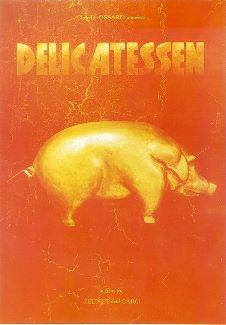
Before the worldwide success of his colourful romantic comedic fantasy Amélie, inventive French director Jean-Pierre Jeunet was perhaps most well-known for his ill-fated entry in the Alien franchise with 1997's Alien Resurrection. Six years earlier however, Jeunet along with his then directorial co-partner Marc Caro, created a film that would signal the rise of arguably France's most well-known contemporary director.

Set in a yellow-hued post-apocalyptic France, Jeunet and Caro's Delicatessen is a bizarre, dark comedy. Situating its action around a decrepit apartment block, the film focuses on the cannibalistic activities emanating from the apartment's connecting bucher shop. Despite the unsanitary conditions, the apartment is a popular locale due to Clapet the building's owner and resident butcher's (Jean-Claude Dreyfus) ability to supply his tenants with juicy cuts of meat. Due to the sparsity of food, lentils and corn seed are viable bartering tools and meat is a virtual unknown. Inventors are forced to create machines to replicate animal sounds in the hope of luring rats and other animals from their lairs. Yet, through his unethical business practices, Clapet routinely manages to utilize the notable resource of meat around: humans.

To counter the paucity of edible susistenence, the butcher places ritually want ads in a local newspaper: requiring a new building superintendant seemingly every fortnight. Clapet's latest gullible victim is Louison (Jeunet regular Dominique Pinon): a downhearted ex-clown still mourning the death of his partner Dr. Livingstone. Despite his small stature, Clapet hires him due to the rising discontent amongst his starved lodgers. Yet, when Louison falls in love with Clapet's equally quirky daughter Julie (Marie-Laurie Dougnac), the butcher carves up a plan to cut up his latest occupant.

Inspired by Jeunet's time living over a butcher's shop with his fiancée, Delicatessen is a gloriously original and dark creation. Featuring a typically Jeunetian wide-eyed innocent for a protagonist in Louison, Jeunet outlines the thematic approaches he would later explore in films such as Amélie and A Very Long Engagement. In the film Louison falls in love with the butcher's myopic-sighted daughter. Despite her impaired eyesight, Louison is perhaps the only character who truly loves her for who she is. With humanity and society engaging in caustic destruction, Louison's naive optimism shines throughout the film.

He truly believes there is good in every individual and that evil is something humans are directed towards due to unfortunate circumstances. Yet, in the cynical society in which Louison inhabits, his brand of cheerfulness is resented and viewed with suspicion. While the socially awkward Julie truly sees Louison for his genuinely warm heart, her authoritative father believes he is a threat: undermining the influence has upon in his daughter's life.

Like in his later productions 2001's Amélie and 2004's A Very Long Engagement, Jeunet instills warmth and pathos into his unfortunate eccentric characters without over-sentimentalizing his surreal vision. His protagonists see the world in a myriad of colours. They are eternal optimists: the proponents of fate, destiny, soulmates and so forth. Yet, as Jeunet often notes they are rarities in life. Thus, the other renters represent a view antithetical to Jeunet's protagonists.

These individuals are bitter, manipulative and suicidal. From the cigarette smoking children who steal parcels and panties to the man housing frogs and snails in his flooded apartment, they represent a selfish opponent to the benevolence of Louison and Julie. It is these people who are often the film's most arduous consumers of human flesh. Their parsimonious values hinder their social and ethical development throughout the film. This is notable in the routine visual inspections of a bespectacled woman who repeatedly engages in labryinthine failed suicide attempts due to the voices she hears in her head that her husband rejects as nonsense. Often it is through Louison's indirect handiwork that she is spared from calculated death.

Visually the film is reminiscent of Terry Gilliam's Brazil in its view of a dystopic world of dehumanized individuals and the counteracting underground rebels who are attempting to break the nation's propensity towards conformity. Given the sub-textual allusions to cannibalism throughout Delicatessen, it is only natural that the film's sewer-based guerilla fighters known as the Troglodins, are a group of inept vegetarians whose bumbling antics are not far removed from a Monty Python film.

Shot using coloured filters, Jeunet's film houses a jaundiced vision that mirrors the social and moral ills of its eccentric oddball characters. Although this method is similar to the approach Lars Von Trier used in his post-apocalyptic debut 1986's The Element of Crime, Jeunet and Caro's utilization of filters is much more agreeable: allowing for the richness of Aline Bonetto's expressionistic set designs to be sumptumously be captured through Darius Khondji's wide-angled lens.

Featuring Jeunet mainstay Dominique Pinon in the lead role as Louison, the actor infuses his rubber-faced character with all the quintessential trappings of an orthodox Jeuentian hero or heroine: brimming with goodness, innocence and optimism in a cynical and vile world. Like Pinon's Louison, the Marie-Laure Dougnac's Julie is similarly brushed with a degree of sadness, but never in a sappy manner.

Rather through Jeunet's eclectic characterizations and the complex visual jokes, the director provides a wonderful blackened edge to the sepia-tinted romantic underpinnings of the story. The film's sex scene in which the corpulent butcher and his frail mistress pressure their springbox is masterfully filled with humorous wonder: as the director simultaneously captures other sexual puns such as two children pumping up their bicycle in unison with other suggestive actions emanating from the apartment.

Upon its initial release Delicatessen was mostly overlooked by its contemporary audiences, but has particularly since the release of Jeunet's Amélie found a subsequent cult following initially spearheaded by Brazil and 12 Monkeys director Terry Gilliam. Evidently ahead of its time, the film is remarkably timeless and fresh in its dystopic setting and romantic storyline. A delightful cult classic, Delicatessen heralded the emergence of one of France's most important visual directors in Jean-Pierre Jeunet: yielding his unique aesthetic sensibilities to an increasingly receptive audience.

* Delicatessen is available on R1 DVD through Miramax Home Video and on R2 through Momentum

Copyright 2007 8½ Cinematheque

Labels: , , , ,

Thursday, March 29, 2007

1961: Last Year At Marienbad

Last Year At Marienbad (Resnais, 1961) 9/10

"Haven't we met before?"

It is a staple of dating culture: a cliched pick-up line designed to enhance the aura of association between two people. Through its inquisitive language, it expresses a tone which emphasizes rememberance, interpretation, connection and history. And yet it is this much ridiculed attempt at expressing a kinetic bond, which serves as the catalyst for one of world's cinema's most serious, complex and abstract films, Last Year At Marienbad .

In 1961, Last Year At Marienbad was released onto a changing world. Audiences and critics were split over its content and context. The film won the Venice Film Prize (The Golden Lion) and became the forebearer for similar enigmatic pictures during the decade such as Federico Fellini's , Ingmar Bergman's Persona and Michelangelo Antonioni's films L'Avventura and Blow-Up. Theatre owners were noted to have displayed signs or handed out pamphlets informing their audience that the film they were about to see was of a revolutionary nature: a radical break with traditional forms of cinema. Yet, countless filmgoers walked out in droves, due to the seemingly cold and pretentious nature of French New Wave director Alain Resnais's second film.

Directed by Alain Resnais ( Hiroshima Mon Amour, Night and Fog) and scripted by French novelist Alain Robbe-Grillet, Last Year At Marienbad was and is one of the most ambigious films to emerge from the Sixties. The interpretation over its meaning and essence is so varied that even Robbe-Grillet and Resnais were both to have drawn different conclusions about its significance. The film stars Giorgio Albertazzi as X a man who attempts to convince a (possibly) married woman named A (Delphine Seyrig) that the pair had an affair the previous year in the same baroque hotel-spa resort. Despite A's refusal to admit the pair had an affair the previous summer, X tries to resuscitate internal memories locked within her psyche; suggesting she pledged her love to abandon her lover/husband M (Sascha Pitoeff) and run away with X.

With its gorgeous black and white cinematography by Sacha Vierny, Last Year At Marienbad broke traditional cinematic logic by following the modern novel in its groundbreaking use of non-linear narratives, an unreliable narrator and an infusion of psychological complexity. Taking the elements of its plot into account, it is surprising that Hollywood has never erroneously tried to remake Resnais' film. However, it is likely that any Hollywood interpretation of the film would omit not only Vierny's dreamlike cinematography or Resnais' intellectual content, but also the film's chief focus on two individuals.

The psychological interactions between these two individuals is imperative to Resnais' film and the ambiguity that surrounds it. The three central critical debates regarding Last Year At Marienbad focus on this interplay. First, did X and A genuinely have an affair last year at Marienbad or some other spa resort? Secondly, is X simply a deviant who desires A and thus tries to concoct a counter-memory in her head? Or thirdly, is the entire film a dream or psychological experience transpiring within the head of either X or A?

Resnais' utilization of freeze-frames and supporting characters who are literally immobile enhances the film's individualization and psychological content. With Resnais' interest in the theoretics of history, one must wonder if the director was familar with works emitting from the Annales school such as l'histoire de mentalités or social historian Maurice Halbwachs and his doubts about the validity of memory due to its lack of impartiality. Halbwachs' argument suggests that memory is a flawed process, which is suspectible to changes of opinion, socio-political change and outside debate. This ability to subvert, distort or suppress memory is a theme examined by Resnais in his film.

In his conquest to steal A's heart from M, one could argue that X is simply playing upon A's personal weaknesses and frailties. Throughout Last Year At Marienbad the film utilizes imagery relating to games. Repeatedly X indulges in games of chance such as cards and matchsticks. There are paintings and floors shaped like chessboards that suggest X is utilizing A as a pawn in his erotic and intellectual game of seduction. The accentuation on mirrors advances the theory that X is simply projecting a counter-memory which suits his own passions and psycho-social desires.

There are also psycho-architectural references to doors, corridors and windows, which are either closed or open. In symmetry with the film's fluid camerawork and dialogue, X notes that sometimes these portals of memory are open or closed, when he is speaking to A: possibly musing on his ability to metaphorically penetrate her psyche with new ideas or concepts, or unearth buried memories. As a narrator X's own "memory" is possibly fallible. He repeatedly brings up the existence of clothing and paintings in A's bedroom, which she repeatedly denies. One could argue that the lack of evidence of their existence points to X's forged status as a charlatan, or X's attempts to conceal an embarrassing past.

The suppression of memory in Last Year At Marienbad is a topic recently discussed by feminist film historians. Their arguments center on the possiblity that A and X may have become acquainted the previous year and that a likely (sexually) traumatic experience between the two resulted in A suppressing her memories of their previous encounter. Another possible argument involving suppression that is rarely addressed is that X himself is simply a ghost.

Throughout the film there are repeated verbal references to "the past" and "forever;" the film also features a funereal solitary organ soundtrack; characters frozen in time like statues; as well as games which nobody can ever win- like an attempt to overcome death.While in the hotel's lavish garden, A notes that X is like "a phantom." The fractured wall along A and M's balcony that X purportedly hid upon suggests that perhaps X plunged to an accidental death, from which A has never recovered.

Other clues involve references made to a freak storm, which killed thousands within the region or Resnais' subtle emphasis on the inability to escape the hotel through references to labryniths and the fact the camera never goes beyond the forests at the edge of the hotel's grounds. Resnais' utilization of spatial concepts and mathematical approaches to time provides plausible evidence that time in the film is indeed frozen, as the hotel guests are in a permanent state of immobility through death. Furthermore, the haunting and floating nature of Vierny's camerawork and the emptiness within the cavernous hotel suggests that as well as X, perhaps A is dead also and the former is attempting to inform her of her present phantomorgasmic state.

Since its initial release in 1961 Last Year At Marienbad has divided critics, audiences and historians with its investigations into philosophical truth, memory and history. With its ambivalent nature, gorgeous cinematography, episodic editing and intense performances, Last Year At Marienbad is a film which openly defies concetre interpretation. In its abstract logic, critics have summized the film is a parody of Hollywood romantic melodramas or an anti-nuclear allegory. Yet, while for many the pretentiousness, icy personalities and liquid summarization of Resnais' film is a turn-off, others have found intrigue and suspsense in the interpretative openess of one of cinema's greatest and most complex jigsaw puzzles.

Last Year At Marienbad is available on R2 DVD through Optimum Home Video

Copyright 2007 8½ Cinematheque

Labels: , ,

Thursday, March 22, 2007

1967: Weekend

Weekend (Godard, 1967) 8/10


- Didn’t you hear what he said? Marx says we’re all brothers! (Corinne)
- Marx didn’t say that. Some other communist said that. Jesus said that (Roland)

What a rotten film, all we meet are crazy people (Roland)

On a warm summer Friday, bourgeois couple Roland (Jean Yanne) and Corinne (Mireille Darc) prepare for a weekend trip to visit Corinne's mother in the country. But this is no ordinary visit. For five years, they have been poisoning Corinne's father's food in an attempt to collect his life insurance. With his death in sight, the couple plan to intimidate Corinne's mother into giving them more than their alloted share.

On the road to Corinne's mother's estate in Oinville, the couple come across an extensive car crash; prompting them to careen and twist amidst the cacophony of horns through the debris of mutilated bodies, burning cars and eccentric characters playing cards, tossing beach balls and drinking wine to pass the time. Oblivious to the events around them, Roland and Corinne are slow to discern that the world around them has changed, prompting them to belatedly ponder whether they are still in reality or part of a film.

Jean-Luc Godard's Weekend is one of cinema's most incendiary and political pieces. While its overt sloganeering is dated, Weekend is still one of cinema's most adventurous and biting black comedies. Filmed at the beginning of his period of blatant anti-commercial cinema, Godard's attitude toward traditional modes of cinema can be summed up in his final credits which read: End of Film. End of Cinema.

With its radical chic, Weekend was representative of both Godard's own immersion into the avant-garde, as well as a shift in 60's (particularly Europrean) cinema towards counter-culture, anti-narrative and "conscious" cinema in films such as Ingmar Bergman's Persona, Michaelangelo Antonioni's Blow-Up and Federico Fellini's . While in North America, this trend would only gain mainstream signficance upon the release of Dennis Hopper's Easy Rider, this movement was alive and kicking throughout world cinema's new wave movements.

This emphasis on consciously deconstructing cinema is prevalent in Weekend. Structurally, Godard playfully tinkers with the medium's most orthodox elements such as inserting dramatic swells of music at inappropriate moments, placing intertitles with revolutionary slogans and utilizing non-linear editing. Cinematographer Raoul Coutard uses slow tracking shots and long takes that increasingly become shot from further distances as the surroundings become less familiar to present-day reality. Additionally he uses Brechtian dramatic techniques by having his character's consciously break the "fourth wall" between performers and audience:. This is notable in scene in which revolutionally-aligned Middle Eastern and African garbage men speak to the camera about the state of the third world in Marxian socio-economic language. Several other instances are found when Roland and Corinne question the cinematic nature of "reality."

"Reality" itself in Weekend is a misnomer. As a film focusing more on cinematic and political ideas than narrative concerns, Weekend is a surrealist evocation of radical politics in the style of Spanish filmmaker Luis Buñuel. With its radical leftist sympathies, Godard's film is drenched in Marxian and Gramscian debates over class struggle, political and cultural hegemony and the crass materialism of the bourgeoisie. Yet, in a recent interview with Andrew Sarris, the pioneering director claimed that he never was a committed Marxist, but rather used the ideology's provactive nature to dissect the social and political concerns of the time. Additional viewings of Weekend slightly corrolate with this position, as Marx's philosophies still have support in a post-structuralist dominated academe.

And while Godard espouses these radical philopshies in Weekend and his later films with radical cinema collective Dziga Vertov, the film's nature as an ironic and surreal black comedy seems to undermine previous critical attempts to pidgeonhole Weekend as a distinctly Marxist film. Given Godard's predilection with the then fashionable cause of Maoism, Weekend focuses more on the agency of agrarian peasants rather than industrial workers. Yet, Godard does not frame the peasants in a favourable life. They are posited as uneducated imbeciles who heartily sing atop their tractors, but lack the intellectual or economic capacity to run society.

Contrarily, the bourgeoisie are neither assumed to be responsbile enough for contemporary society. The middle-class characters in Weekend are petty, arrogant, immoral, reckless and materialistic: flamboyantly displaying their wealth and status. After being forced at gunpoint to pick-up a hitchhiker who grants wishes, the couple's suggestions are all purely object-oriented such as weapons, an evening with James Bond and dresses. Similarly, when Roland and Corinne's reckless driving gets the better of them, resulting in a fiery crash, Corinne's only concern is the loss of her Hermes handbag.

Throughout Weekend, the film's bourgeois members are continually shown to be ignorant of the changes around them; thus heightening their disturbed response to these shifts upon their belated realization. Furthermore, they are constantly shown as bored. When listening to two garbage men discuss politics, Roland and Corinne pass each other cigarettes in order to fill their lethargic void. Furthermore, each of them openly engages in adulterous affairs; with Corinne telling her lover an erotic adulterous story of a menage a trois in order to arouse him.

The violence within human nature and modern life in also shown in Corinne and Roland's actions: running other motorists and cyclists off the road, fantasizing of murdering Corinne's mother and standing emotionless while others are raped, killed or beaten. When other characters refuse to offer them assistance, they engage in acts of theft and violence in order to pursue their selfish aims such as their attack on another middle-class man (Jean Pierre Leaud) singing to his children on a rural telephone, who refuses to drive them to Oinville in his sports car.

The abrasive and careless nature of the bourgeoisie is apparent when Roland and Corinne enter a quaint village, only for class distinctions to become heightened when a gruff farmer crashes his tractor into a young couple recklessly speeding in their Triumph convertible. Pejorative language and accusations are thrown around as the woman proclaims the working classes are "pissed off because we fuck in the Riveria and you don't...", only for the farmer to retort "If it weren't for me and my tractor, the French would have nothing to eat" But when Corinne and Roland refuse to drive neither part to Oinville for help, the two warring classes unite in what Godard's intertitle asserts is a "Phony Graph."

This aforementioned sequence is a rare instance of harmony in Weekend in which contemporary society devolves into anarchy and chaos: a post-apocalyptic world in which the products of industry are scattered and strewn in fields. From the film's opening moments, society slowly erupts into an orgy of death and destruction; that results in cannablist Maoist guerillas stalking the countryside. Thus, rather than being a purely didactic Marxist film Weekend is more or less a critique of contemporary society's dissolution into violence and savagery. Although released in December 1967, Weekend is the visual template for 1968: arguably the most radical and violent year of the post-WWII era. It is in this year of assassinations, student protests, war and repression that Weekend's apocalyptic vision holds true in its animated and extremist surreal outlook on society.

In Weekend Godard does not appear to prescribe revolution, but rather shows the aggressive flaws within modern society. Thus, when Godard includes several real and imagined figures from the Enlightenment and Romantic eras such as Emily Brönte, Tom Thumb, St. Just (Jean Pierre Leaud) and Joseph Balsamo, he appears to be satirically critiquing a society which has purged these elements inquiring into the nature of truth from its schema. When characters ponder the origins of civilization or question the nature of reality in Weekend, Godard seems to be suggesting the artificial nature of modern life and a need to restore organic elements of life. Unlike Roland's belief that life is film, Godard seems to assert that life is not cinema, but rather one which addresses and rectifies the violent tendecies of human nature; in order to avoid the type of surrealist apocalypse the film proposes.

* Weekend is avaiable on R2 DVD by Artifical Eye and on R1 DVD by New Yorker Video

Copyright 2007 8½ Cinematheque

Labels: , ,