Reviews and criticism of classic and contemporary films

Wednesday, July 16, 2008

1955: Picnic

Picnic (Logan, 1955) 7/10

In the 1950's, the influence of the Motion Picture Production Code regulating the content of American films was waning. Foreign imports, the advent of television, social changes and the establishment of independent theatres were among the factors aiding the dissolution of the code's influence throughout the mid-Fifties. Previously restricted in their sexual context and language, the 1950's saw through the release of several films displaying a new openness towards sexual relations and class.

Joshua Logan's 1955 adaptation of William Inge's Pulitzer Prize winning play Picnic is one such example of this movement. Set in rural Kansas, Picnic focuses on Hal Carter (William Holden), a muscular drifter sweeping into the sleepy backwater prairie town via a freight train like a sexual tornado. Desperate for work, Hal aims to track down college fraternity chum Alan Benson (Cliff Robertson), the heir to a fleet of grain silos that dominate the community's economic landscape. Nevertheless, Hal's arrival on the day of the local Labour Day picnic overturns the rigid class and sexual conforms rested within the town.

In particular, Hal's entrance affects a group of single women in a working-class household located near the railroad tracks. Whilst cleaning an elderly woman's yard for food, a shirtless Hal brings out the primal sexual emotions suppressed within the admiring women next door. The release of these inhibited feelings immediately unbalances the cloistered world the rural women reside in: unearthing a volatility and unhappiness previously buried in community life and future goals.

The emergence of a sense of personal fragility and impatience with life brooding throughout the picture coincides with Hal's appearance. Despite her looks and seemingly destined marriage to the wealthy Alan Benson, town beauty Madge Owens (Kim Novak) begins to question her life motives. Ill-educated, the soft-spoken Madge has been contoured by her single mother Flo (Betty Field) to marry Alan as soon as possible, before Madge's beauty and looks fade. With so much attention paid to her appearance, rather than her personality, Madge desires to find someone willing to talk to her as an individual, rather than as a distant goddess.

On the other hand, her bookish sister Millie (Susan Strasberg) is fed up of burying her head in dog-eared Flannery O'Connor novels. She envies Madge's extroverted characteristics and beautiful appearance. Desperate for acceptance and admiration from the opposite sex, Millie yearns to find true love as quickly as possible. An additional woman, the Owen's lodger and local middle-aged school teacher Rosemary Sydney (Rosalind Russell) is equally desperate for love, whether through her incompetent longtime beau stationary salesman Howard Bevans (Arthur O'Connell) or through another man. Feeling her age, Hal's arrival impresses in Rosemary a high-strung need to feel young and sexually vigorous.

Hal however simply wishes to settle down and find some security, at least for the immediate future. After failed stints in college, the army and other ventures, the former college football star yearns to do something meaningful with his life. Yet, through his status as a drifter and the emotions he unleashes, Hal unwittingly commits himself to a program of nomadism. His antics and liveliness are far too out of place in the unyielding and insular world he has briefly immersed into.

By unconsciously releasing these emotions, Hal indirectly tears and gnaws at the regional modes of decorum and restraint; cracking sexual and class conscientious mores. Rosemary and Flo are particularly affected: the former turning into a drunken and embarrassingly over-sexual being, the latter seeing her dreams of climbing the social ladder via her daughter's marriage crumble at every turn.

Upon its initial release, Picnic was seen as a dynamic, erotic and controversial piece of American filmmaking. Today, much of the film's upfront and raw sexuality appears tame. Additionally, Logan's once vaunted documentary-style footage of the picnic itself, now appears clunky, crude and wasteful in its overabundant images of crying babies, three-legged sack races and pie-eating contests that add little to the plot or the Midwest ambience. The film's melodramatic plot appears particularly overblown at times, especially in relating the swiftness of the events within a twenty-four hour period.

Yet, one could argue that Logan's film captured an undercurrent within Middle America during the Eisenhower years. A notable critical and commercial hit during its original run, audiences certainly reveled in the film's uncovering of a simmering sensual identity in a small rural community, as well as the desperation to escape from the placid stillness and unwavering patterns of life in rural life. Thus, the film's portrayal of the four women in the Owens' home is telling as each, prior to Hal's entry into town, is stranded and isolated from fulfilling their own ambitions and establishing their own identity separate from the expected socio-cultural standards of the period.

Kim Novak's muted performance as Madge displays a woman lacking any personality created from within herself; rather she appears as a composite of the expectations of others. Rosalind Russell's work as Rosemary vaults through a tidal wave of emotions, ascending and descending from highs and lows with a rapidity significantly entwined to her character's heart-breaking inability to accept a life without marriage. Along with Susan Strasberg and Arthur O'Connell with their respective portrayals of an introverted teenager and a bumbling salesman, Russell offers one of the film's strongest performances. William Holden's effort however is more troubling. Despite his talent, Holden at age 37 was too old to truly convince in the role, a fact the actor later himself admitted. Nevertheless, his combative performance offers a template for his far more successful work in David Lean's Bridge On The River Kwai two years later.

Transcending from smoldering sensuality to overblown histrionics, Picnic rests as an astute encapsulation of Hollywood cinema during the 1950's. Controversial in a conservative era, Picnic appears today more as a document of an era, than a progressive cinematic work. Picnic was one of Joshua Logan's first entries into the world of cinema after a prolonged period as a director on Broadway. Logan's primary experience in theatre lends the film a deep sense of theatricality that seeps into the work, resulting in some overdone performances and choppy editing by editors William Lyon and Charles Nelson. Thankfully, this is for the most part saved through some beautiful compositions by famed cinematographer James Wong Howe's and the film's melodramatic insights into sexuality in 1950's Middle America.

* Picnic is available on DVD through Columbia Home Video

Copyright 2008 8½ Cinematheque

Labels: ,

Tuesday, January 22, 2008

2007: Across The Universe

Across The Universe (Taymor, 2007) 1/10

In the past decade, two strongholds of twentieth century popular culture, The Beatles and the Cinematic Musical have reveled in a renewed popularity. In 2000, The Beatles released the popular greatest hits collection 1 and followed it up with a Fab Four-themed Cirque de Soleil show.

Around the same period, the extinct cinematic musical genre staged an unforeseen return into popular consciousness with the critical and commercially successful releases of films such as Baz Luhrmann's Moulin Rouge and Rob Marshall's Chicago.With both The Beatles and the Musical enjoying deserved revivals over the past decade, the implementation of a Beatles-themed musical would appear to be a creative synthesis, especially when helmed by Frida director Julie Taymor who first gained fame for her successful adaption of The Lion King to Broadway.

Instead as Peter Frampton and Bee Gees fronted Sgt. Peppers Lonely Hearts Club Band learned thirty years earlier, Beatles-related films sans Paul, George, John and Ringo are a recipe for disaster. Across The Universe is no exception. With a "plot" loosely fabricated from the remnants of butchered Beatles cover songs, Across The Universe is a emotionally vapid, cartoon parody of the 1960's. Utilizing embarrassingly literal interpretations of Beatles songs and a string of stereotypical Sixties moments and characters, Taymor's film is more Forrest Gump: The Musical than Magical Mystery Tour.

Beginning in a parallel version of mid-Sixties Liverpool filled with an endless array of dock workers, but no Beatles, the film follows idealistic artist and dreamer Jude (Jim Sturgess) who leaves his mother to head to America in order to find his long-lost biological father. Along the way he meets up with naive love interest Lucy (Rachel Evan Wood) and her mischievous brother Maxwell (Joe Anderson), with whom he eventually shares a Greenwich Village loft. The fact they reside above a store called Psychedelicatessen clearly distinguishes Taymor's emphasis on an urban counter-cultural perspective.

Alongside, their Janis Joplin cut-out landlord Sadie (Dana Fuchs), Jimi Hendrix replica Jo-Jo (Martin Luther McCoy) and former cheerleader Prudence (T.V Carpio), the characters participate in a myriad of stock Sixties moments- burning draft cards, doing drugs, sticking it to the man- against a pastiche of the decade's most iconic moments from race riots in Detroit to Martin Luther King's assassination.

Yet, throughout Across The Universe their moments and actions are insignificant, not only because of their ineffectiveness on the world at large, but also due to the paucity of a genuine filmic narrative constructed outside the iconic melodies of a compilation of Beatles melodies. While The Beatles were the soundtrack for many lives during the era, Taymor's absurd reality has these songs as the pre-eminent force in shaping the characters' actions.

In Taymor's narrow "For Dummies" conceptualization of the Sixties, the screen is bombarded with heavy-handed images of protests, radicals, bohemians and anti-corporate and anti-American sloganeering: each outdoing the other in degrees of contextual emptiness and excessiveness. Sequences often emerge not because of their importance to the story, but for their ability to utilize yet another familiar note from The Beatles canon: a concept evinced in particularly dreadful workings of Beatles' classics such as Helter Skelter, A Day In The Life and Across The Universe.

Overflowing with flat caricatures, dreary musical arrangements, dreadfully cliched dialogue and a grandiose sense of self-importance, Across The Universe is a film that attempts to utilize its orgastic bounty of colours and psychedelic imagery to capture the spirit of period. Yet, for all its anti-establishment and anti-commercial rhetoric, Across The Universe is an endemically hollow corporate conception of the decade, tie-dyed shirts and all. Only a somewhat vivid number built along I Want You (She's So Heavy) awakens the rubber souls from their slumber.

Minus an actual feasible storyline that does not need to adhere to a Beatles iPod playlist, Across The Universe is simply a dreadfully misguided mistake. The poor acting, lifeless images, forced script and the failure to develop workable themes and messages within the film is the collective fault of cast and crew. Worst of all, Across The Universe is simply a film without a heart and subsequently without a pulse. Despite all its opulent colour and fanciful sequences, the film is an emphatic bore: a stagnant attempt to re-fashion Ken Russell's sub-Fellini-esque Tommy into the twenty-first century.

Given Taymor's Broadway background, one wonders if Across The Universe would be better suited to the stage rather than the screen. Then again after simply witnessing Bono's cosmically misaligned cameo as Dennis Hopper meets Timothy Leary drug baron Dr. Robert, it is clear cut that Taymor should have not cinematically gone down this long and winding road.

One of the worst and most disappointing films of 2007

* Across The Universe is available on DVD through Columbia Home Video

Copyright 2008 8½ Cinematheque

Labels: ,

Wednesday, May 09, 2007

2003: Big Fish

Big Fish (Burton, 2003) 9/10

" I've been nothin' but myself since the day I was born, and if you can't see that it's your failin', not mine" (Senior Edward Bloom)

Edward Bloom (Albert Finney) is a storyteller. Correction. In his mind, Edward Bloom is a storyteller: a dispenser of wisdom, joviality and authenticity. In the opinion of his journalist son, Will (Billy Crudup), his father is less of an accurate recollecter of memories and more of a charlatan, a myth of a man: a novelty salesman engrossed by the egotistical nature of his yarns. He is the Aesop of Alabama.

The chaotic conflict between father and son produces an aeon of accepted silence. The internalized stubborness of one man, rejects the embellishments of another. But when tragedy strikes and Will is forced home, his journey is less of a desire to see his ailing father in his dying days, but rather to find the allusive pieces to the latter's puzzling and enigmatic life. The result is a Fellini-esque cauldron of visual delights in director Tim Burton's second masterpiece after 1994's Ed Wood.

Known for his eccentric Gothic style, Burton has become marginalized as a distributor of dark charms and ghoulish imagery. A former Disney cartoonist, who left animation to create some of the most ecletic visuals of the past two decades. Films such as Beetlejuice, Edward Scissorhands and his two dated offerings to the pre-Christopher Nolan Batman catalogue have cemented this position. Yet, Burton's best work has often been found in the films, the general public has most readily neglected such as 1994's Ed Wood. The latter, like Big Fish is a wonderful blend of gregarious enthusiasm and melancholic surroundings. Whereas Depp's portayal of the title character instilled colour into Burton's monochrome vision, the director flushes Big Fish with a hyperactive style that strangely complements its low-key emotionalism.

A diverse pastiche of cinematic flavours, Big Fish re-creates the dynamic, hyperactive tall-tales of Ed Bloom through a romanticized interpretation of his past. Several critics including Jonathan Rosenbaum have criticized Burton for creating a film set in the Deep South that negates and downplays the racist aspects of southern society in the 1950's. Yet, Rosenbaum and the majority of the film's other detractors have overlooked a key facet of Bloom's stories. In each interlocking tale, Bloom's character is the centrepiece with a revolving door of stock characters at his disposal. The characters symbolic latitude far outweighs their authentic context.

These are centerpieces in a larger metaphor: embellishments designed to sparkle mundane events. Like in many collective memories, the past becomes distorted and romanticized to the point of absurdity. Edward Bloom's tales are absurd. Nothing terrible ever occurs to Bloom in these stories, as they are merely ways to demonstrate his majestic conquering of love, destiny and life. Genuine social and personal problems are selectively overlooked, because they do not adhere to the populist positivist outlook on life Bloom has. Showing civil strife and unrest is unlikely in Bloom's memories, not necessarily because the character is not interested in them, but because the character's rememoration operates in a space of absolute harmony.

The perceived selfishness of Bloom's stories belies their selfless metaphoric qualities. This is not like Robert Zemecksis' Forrest Gump in which one ordinary simpleton achieves extraordinary feats; rather this a film in which an ordinary dreamer concocts and manifests the extraordinary out of life's everyday activities: spicing them up with peppered layers of intrigue to allow for better dissemination. Through Ewan McGregor's portrayal of the young Edward Bloom, Burton allows these stories to be grounded in an earthiness, despite their oddball nature. This is clearly due to McGregor's charming ways in being able to extract some of the Fifties charm he satirized in Peyton Reed's Down With Love and ensnare it once more into Burton's film.

At its core, Big Fish is a picture about father-son reconciliation, yet Burton's handling of the film's emotional sequences is grafted with great integrity. Big Fish never becomes sappy or corny: its sentimentality is utilized for more investigative purposes. Through his mawkish analysis, Burton pushes forth the notion of a fearless individual attempting to craft a narrative synchronized to his epic scope.

Utilizing the fish motif, Burton is able to address the elder Bloom as a human "fish out of water." This is done through repeated references to Bloom requiring water, noting the slippery qualities of his nature and his unquenchable thirst for life and adventure. The film's moving bathtub sequence between the dying Bloom and his wife Sandra (played by Jessica Lange) further re-inforces this concept in the notion that Bloom fears he "will dry out:" losing his vitality and in the process the exaggerations and half-truths that shape his version of the past.

In piecing together, his father's stories, the journalistic and investigative Will begins to realize the two separate halves to the art of storytelling. Will represents the accurate, literal tendencies of modern journalism, while his father represents an oral tradition of a bygone era: a time of contextual storytelling in which the moral of the story held greater intent than the individual words. Through his investigations, Will uncovers the true essence of his father. Yet, he begins to realize that arguably the carefully constructed memories his father has told for decades are arguably a more accurate definition of his father's character. The truth is caught between the fantastic and realistic elements of life, in which fantasy and reality intertwine.

Here, Edward Bloom is less of a liar and more of an original folk artist: a product of his culture and environment. Through his stories, we see a man readily combating prejudice, fear and doubt. The town of Spectre demonstrates Bloom's perspectives clearly. Over time his opinions and memories become altered and thus his actions reflect in due course. In saving Spectre, Bloom preserves the collective romanticized memories of an entire people from modernism.

Public heritage and private recollections are important interlocking ideas for Edward Bloom because through preservation and oral recollection, the stories of others and himself can live on beyond what French memory historian Pierre Nora would term the memory's "shelf life:" the expiration date all memories hold when all their original participants are lost through the natural effects of time and age.

And it is these morals and life lessons that Edward Bloom accrues and disperses through his stories: a collection of images, ideas and concepts true to heart. It is through their ritualized reinforcement that his purpose as a storyteller is achieved and thus by passing on his legacy to his son, Edward Bloom is able to immortalize himself. In creating a film of beautiful imagery, poignant drama and surrealist Fellini-esque ideas, Tim Burton has created a wonderfully acted celebration of life's joys, imagined or not.


* Big Fish is available through Columbia Home Video

Other Tim Burton Films Reviewed:
Sweeney Todd: The Demon Barber of Fleet Street (2007) 9/10

Copyright 2007 8½ Cinematheque

Labels: ,

Sunday, April 29, 2007

1969: Easy Rider

Easy Rider (1969, Hopper) 6/10

"You know this used to be a helluva good country. I don't know what's gone wrong with it" (George Hanson)

In southern slang an "easy rider" refers to a man who is financially supported by his prostitute girlfriend. Almost forty years later, the term has come to equate to other things: rebellion, motorcycles, counter-culture, drugs and so forth. The notions of spiritual bankruptcy and indolence attached to its initial colloquial meaning have all but disappeared from our modern vocabulary. Most audiences would connect the parlance with stretching out on one's motorcycle, rather than taking shortcuts at the expense of others and one's integrity.

Easy Rider is a film entrenched in myths. Passing through pastoral landscapes and arid strips of desert, the film is a cross-country journey between two men Wyatt a.k.a. Captain America (Peter Fonda) and Billy (Dennis Hopper) who search for America, or the more precisely the American Dream, and fail to find it anywhere. Fashioned as two modern outlaws, the film's anti-heroes begin their quest in Mexico, where they purchase cocaine sold onto a Los Angeles pusherman (Phil Spector) for profit.

Dipping into their funds, the pair acquire two motorbikes. Stashing the remaining money in their gas tanks, Wyatt and Billy head to Florida in order to "retire" after a brief stopover in New Orleans to celebrate Mardi Gras. Along the way, they meet farmers, communards, rednecks, prostitutes and a drunken ACLU laywer named George Hanson (Jack Nicholson). Camping on the outskirts of the string of southern towns they traverse through, the group take copious amounts of drugs, philosophize and come into confrontations with individuals unsympathetic to their nomadic, long-haired lifestyle.

Filmed in 1968, the picture sat in an editing room for almost a year, while Hopper tried to make sense of the four and a half hour rough cut he had assembled. Reputedly costing under $350,000, Easy Rider made $60 million dollars worldwide and changed Hollywood overnight. Or so popular memory has told us. In actuality, the groundwork for change had arguably been simmering since the mid-Sixties. The influence of French Nouvelle Vague directors such as Godard and Truffaut, as well as other Europeans like Michaelangelo Antonioni and Federico Fellini had already creeped into popular British films released in the United States such as Richard Lester's A Hard's Day Night and Antonioni's Blow-Up. The controversy over the latter film's sexual content was a key movement in the collapse of the Production Code.

The power of the studios prevented the type of laissez-faire narrative and editing structures popularized by Godard from being incorporated into American cinema until around 1967. For over a decade, the aging studio heads had believed a continuation of cinematic orthodoxy was key to wooing audiences. But the audiences had long left cinema for television and as a result the former was in a crisis. The studios scrambled to find the next "thing" to lure in young audiences. Thus prior to the release of Easy Rider the major studios had released Arthur Penn's 1967 Bonnie Clyde, John Boorman's Point Blank, Mike Nichols' The Graduate and Stanley Kubrick's 1968 film 2001: A Space Odysseyto success with younger audiences. With their utilization of avant-garde cinematic techniques in editing, blatant anti-heroes and moral complexities these films certainly demonstrated that Hollywood was granting directors more freedom in order to fill their coffers.


But the most influential changes toward the creation of Easy Rider came from a smaller company outside the system. Most famously known for the Edgar Allan Poe adaptations starring Vincent Price, AIP were signficant in creating properties suited to the tastes of America's youth. Unafraid to import dubbed versions of European films such as Fellini's La Dolce Vita and Roger Vadim's Brigitt Bardot vehicle ...And God Created Woman, AIP had long tested the restrictive measures of the Production Code. Furthermore, through their "Beach Party" films starring Frankie Avalon, the studio garnered a receptive teen audience. Yet, perhaps their biggest contribution was in the resurrection of the biker sub-genre. With its roots in Lazlo Benedek's The Wild One was biker film used by Roger Corman's American International Pictures (AIP) to corner the youth market.

Still associated with rebellion, the biker films offered an exploitative counter-product to the placid histronics of Hollywood. Peter Fonda became the sub-genre's biggest star in films such as Roger Corman's 1966 Wild Angels. Fonda also starred in the emerging counterculture films the studio was producing such as 1967's Jack Nicholson-scripted The Trip. Nicholson himself had starred in the 1967 biker film Hells Angels On Wheels. The Trip can be seen as the starting point for Easy Rider in that it brought to together Nicholson, Fonda and Hopper: the former scripted the film, the latter two starred in it.

And while Nicholson only appeared in his star-making, Oscar nominated supporting role as George Hanson after Rip Torn abdicated, his contacts enabled the picture to be developed. Nicholson had developed and produced The Monkees psychedelic film Head. The man behind The Monkees and Head, Bert Schneider had created the show in part due to classic Hollywood nepotism. His father Abe was the head of Columbia Pictures and Bert was assigned to the studio's television division in order to stay out of trouble. When The Monkees became a cash cow, Abe agreed to release any films his son produced. Subsequently this gave Easy Rider major studio distribution, although the film's box-office numbers were fostered via word of mouth rather than studio marketing.

While Dennis Hopper has long claimed with the creation of Easy Rider he was attempting to make the first American art film, history proves him wrong. Kubrick's 2001: A Space Odyssey, Boorman's Point Blank and John Schlesinger's 1969 film Midnight Cowboy were not only all released prior to Easy Rider, but they are also far more abstract and indebted to European filmmakers such as Resnais and Godard than Hopper's film. What truly was revolutionary about Easy Rider was perhaps not its content or narrative structure, which had already been the subject of various other films, but three key points.

First the film was able to blend the exploitative elements of the biker and counterculture sub-genres into a setting that was more realistic than in its predecessors. Secondly, although copious drug use had been seen in American films prior to Easy Rider such as 1959's Gene Krupa Story and 1955's The Man With The Golden Arm, Easy Rider was one of the first major American films to have its characters suffer no moral consequences because of this drug use. Thirdly, while young European-influenced, university trained filmmakers had already begun to work their way into Hollywood, the financial profits from Easy Rider made it easier for those filmmakers to develop their own pictures. For instance in 1967 Martin Scorsese had released his debut film Who's That Knocking On My Door? at a Chicago Film Festival, but it would only be after the release of Easy Rider that filmmakers like Scorsese and Coppola were given more leverage in Hollywood.

Steeped in the folkloric qualities of the Old West, the film posits itself as a modern western. With motorcycles replacing horses, gasoline stations substituting for trading posts and paved highways instead of dusty trails, Easy Rider procures a variety of elements from the Western genre. Utilizing the names Wyatt and Billy, the mythical auras attached to those names bore through with the reflective Wyatt always trying to serve the public good and the wild Billy selfishly nitpicking over inocuous issues.

Although in terms of editing the film is heavily influenced by Godard and Resnais, there are several sequences that could easily have been extracted from a John Ford or Howard Hawks western two decades earlier. Camping out on the outskirts of town next to Indian burial grounds and abandoned houses, the pair replicate an image of anti-conformity: two outlaws trekking across a topography filled with decay and greed. Remnants of ghost towns such as Sacred Mountain provide a brief rest from the vacant landscape surrounding them.

The theme of the American Dream is prominently displayed amongst the buttes and mesas. With his jacket and motorcycle prominently displaying the American flag, Fonda's Wyatt represents notions of American pop culture in his nickname (Captain America) and the Japser Johns-esque fetishization of the American flag. Yet, the dream Wyatt and Billy is a perverted one. Through their drug smuggling, the pair mistakenly assume they have bought freedom. Wyatt even throws away a gold watch symbolizing the release of further responsiblities and pressures. But as Nicholson's lawyer informs them, freedom is not equated with money or materials. Yet, it is this type of freedom, he informs is the cause of conflicts and violence. And it is this backward and racist conception of "freedom" that Wyatt, Billy and George encounter on their travels.

The real type of freedom Hanson alludes to is perhaps found in the two communities Fonda's Wyatt dearly admires at a distance. Their first encounter is with a New Mexican farmer. In a symbolic gesture of the times, while he mends a horse shoe, they repair a wheel on their motorcyle. With his young Hispanic wife and their brood, they are slowly reaping the pleasures of working their land. The same can be said for the hitchhiker who takes him to a commune on the outskirts of the desert. Impoverished, but connected the community has been fostered by like-minded youth who are blighted by the materialism of the city. Despite their inability to grow anything, their belief and spirit touches Wyatt. He admires their intellectual and communal freedom.

Conversely, Billy is unamused by their antics. His rebellious attitude is fabricated on reckless behaviour more than non-conformity. His attitude toward the commune is centered on the possibility of scoring more drugs and free love. His dream is found in a teardrop gas tank emblazoned with the American flag on it. Yet this not money earned not by painful labour, but by deception. In the late Sixties, cocaine was associated with paranoia and wealth and thus when Wyatt informs Billy that "We blew it," he is referring to their chance of real freedom.

Instead, by selling an affluent drug, the pair have conformed to the same goal as every middle-class American: to make a lot of money and then retire in a sunny locale. Billy doesn't seem to understand this. The theme of "selling out" is also related to the film's infamous LSD trip in a New Orleans cemetery. In return for driving the hitchhiker, Wyatt is offered in secret drugs to take with the right people at the right place. With death and decay still enveloped around them, Wyatt shares the drug with Billy and two prostitutes played by Karen Black and Toni Basil. The subsequent result is a "bad trip" in which the Christ-like Wyatt foresees his future in this twisted Garden of Gethsemane.

Severely dated at times, Easy Rider is an interesting capsule into late 60's American counterculture. Filmed in an improvisational manner, Easy Rider can often be endearingly beautiful such as Lazlo Kovacs' cinematography of Monument Valley, or utterly annoying as in Dennis Hopper's Billy. Dropping "man" as about as many times as his character drops acid, Hopper's Billy is a condescending and often vicious perma-stoned character. His paranoia constrasts with Fonda's gentle charm and Nicholson's career-shaping manic performance.

The film's unique editing structure is an ideal method for the snapshots of life, Hopper seeks out. The film's thematic symbolism focuses on ideas pertinent to the Vietnam-era culture: issues of violence, spiritual decay, death, selling out, freedom and non-conformity. Therefore, the savagery and cynicism imbuing Easy Rider is an ideal counterpoint to the naïvete of the counterculture movements, which were engrossed with the film. Yet, unlike Godard's Weekend, Hopper's film lacks the sardonic visual wit that thrusts Weekend or the films of Buñuel which Hopper claimed to be influenced by.

Thus, contrary to popular opinion Easy Rider appears more to be subtly attacking American counterculture than lauding it. The appraisal that even rebels have a cause to "sell out" for adds a sharp edge of realism to the proceedings. However, the agrarian lifestyle the film promotes as an alternative is more in-tune with anti-modernist conceptions during the era than a genuine solution. Within the simplicity of the agrestic commune filled with starved children and demoralized hippies engaging in childish sing-alongs and (in what has to be an allusion to Blow-Up) pantomime one can find all the spontaneous optimism and violent despair that the Sixties represented.

* Easy Rider is available through Columbia Home Video

Copyright 2007 8½ Cinematheque

Labels: ,

Tuesday, April 10, 2007

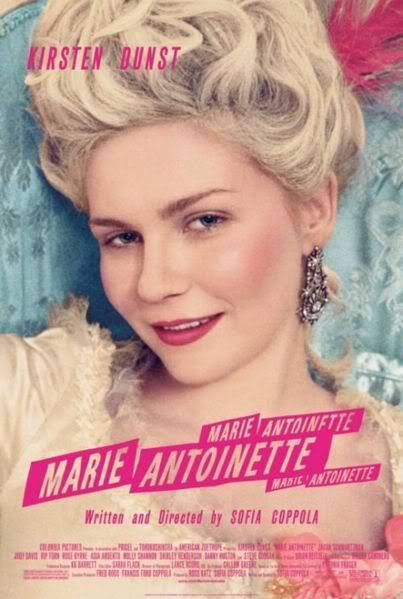
2006: Marie Antoinette

Marie Antoinette (Sofia Coppola, 2006) 10/10

"This is ridiculous" (Marie Antoinette)
"This Madame is Versailles" (Comtesse de Noailles)

Was there a film more critically misunderstood in 2006 than Sofia Coppola's Marie Antoinette?

Critics derided the film's apparent lack of historical insight, while audiences expecting a dialogue-driven period film were befuddled by Coppola's post-punk soundtracked sugary vision. Adapted from Antonia Fraser's acclaimed biography, Coppola's film is a revisionist epic, which is influenced less by authentic historicism and more by Coppola's filmic interest in examining isolated women trapped in societies alien to their concerns and needs.

Tracking Marie-Antoinette's rise from sheltered Austrian royal to despised foreign Queen of Bourbon France, the film focuses on the difficulties and tribulations affecting a teenage girl (Kirsten Dunst) forced into a political marriage with an incompetent Dauphin who later become Louis XVI (Jason Schwartzman). In its basic sub-text, Marie Antoinette is an extension of the embattled portrayals of womanhood Coppola analyzed in Lost In Translation and The Virgin Suicides.

Thus, the film is social commentary disguised in the conservative confines of the period epic. Conservative however is not a word to best describe Marie Antoinette: a visually gorgeous and contextually anachronistic film that re-writes the genre's sturdy rule-book. This is a film bristling with vitality on the surface and critically examining human nature underneath it.

Coppola begins her film by striking an important dichotomy between the royal courts at Vienna and Versailles. Housing the Austrian royal family, the Austrian court is sparse in its decor and dull in its colourization. In Vienna, the members of the court interact with one another on an informal basis through physical interaction. Upon her arrival into Bourbon France, Marie-Antoinette is subjugated to antithetical French modes of decor and deportment. She is stripped of her foreign clothing, but is reluctant to relinquish her ideals. Instantly, Marie-Antoinette abhors the rigid logistics of French protocol in which personal emotion is shunned and privacy is non-existent. Whereas the Viennese palaces Marie-Antoinette grew up in contained only her family, the court at Versailles as built by Louis XIV houses an entire city consisting of royals and French nobility.

Located ten miles from Paris, The Palace of Versailles was constructed by Louis XIV in order to control the nobility in a paradisal country setting. When Marie-Antoinette inquires about visiting Parisian operahouses, a noble sneeringly remarks "Why go to Paris, when you can have the opera come to you!" After the death of the Sun King, the problems of operating the government within this isolated community became painfully obvious. The world Marie-Antoinette enters is a community accustomed to haute coutre, back-stabbing and privilege, yet blissfully ignorant of the economic and social crises occurring a little more than ten miles away.

By neglecting to provide any exterior historical information, Coppola aims to insert her audience into a world self-insulated from the painful realities surrounding them. In Marie Antoinette Coppola exposes the hypocrises and sheer boredom of a life filled with monotonous routine. Through the film's sharply crafted editing by Sarah Flack, Coppola shows the apathetic responses of a fourteen year-old teenager to the protocol of a stagnant aristocracy. By way of these responses, Coppola posits her title character as a rebellious teenager who attempts to push boundaries. Her decision to applaud theatrical performances, go to Parisian parties and flirt with other men such as Swedish officer Count Fersen (Jamie Dornan) puts her at odds with the modes of decorum prescribed by her advisors Comtesse de Noailles (Judy Davis) and Ambassador Mercy (Steve Coogan).

Even as a blue-blooded woman in the late 18th century, there are very few avenues of power at Marie-Antoinette's disposal. The most viable method of influence available to Marie-Antoinette is through her sexuality. The need to provide an heir to the throne is crucial to the survival of a fragile Franco-Austrian alliance, which Marie-Antoinette's marriage to the future King Louis XVI is expected to cement. However, Louis is more interested in hunting and lock-making and thus the pressure on Marie-Antoinette to consumate the marriage intensifies.

With the strain of a loveless marriage and the fate of two empires resting upon her teenage shoulders, Marie-Antoinette shuns her responsibility and finds temporary happiness in rabid materialism. In a seemingly never-ending blitz of cakes, shoes and champagne, Marie-Antoinette frivolously splashes the Bourbon fortune in order to obtain some method of control and individuality in her life. However, this lifestyle dissipates after the birth of her first born Marie-Therese. Through this child, Marie-Antoinette garners an element of control and influence; allowing her to reside on a quaint provincial farm, which allows her to indulge in her favourite pursuits such as a hands-on lifestyle raising her daughter in a parochial abode filled with artists, flowers and plain white dresses.

As history records, this world came crashing down in 1789. Following the recommendations of his advisors, Louix XVI begins to financially aid the American Revolution in order to antagonize their imperial rivals across the English Channel and demonstrate French military strength. Yet, the might the French wish to propagate is vacuous. Bankrupted by erratic spending, Louis XVI calledl upon the French Parliament (Les États-Généraux-) for the first time since 1614 in order to obtain funds to refill the royal coffers. In 1789, France still operated on an archiac system of taxation in which the clergy and nobility were exempt from taxation, which placed the financial burden of the nation-the empire even- on the lower classes and an emerging bourgeoisie. But the Estates-General composed of the nobility, the clergy and the French population were tired of the King's abandonment of his citizenry. Ironically influenced by the French-funded American revolutionaries, the Estates-General called upon social reforms, which decreased the King's power. While Louis XVI attempted to resist these reforms, the damage was already done.

In Marie Antoinette, Sofia Coppola does not show these exterior events beyond whispers and gossip. This heightens the overall effect of the film's stunning final shot of a once lavish room swiftly tattered and broken by the outside world: paralleling that of Marie-Antoinette and her young family. Sumptously shot by Lance Acord, Marie Antoinette is a sparsely scripted film, which relies on the power of its exquisitely beautiful images and strong performances by an excellent cast featuring Dunst, Schwartzman, Davis, Rip Torn, Asia Argento, Molly Shannon, Danny Huston and Steve Coogan.

Booed at Cannes, Marie Antoinette went onto to become an undeserved North American box-office failure: raking in domestically fifteen million of its forty million dollar budget. While Coppola's film was unable to find a contemporary audience, its aesthetic beauty and directorial acumen should enable this film to become a forgotten masterpiece. A richer film than Coppola's lauded Lost In Translation, Marie Antoinette will be a spectacular find for future cineastes and critics a quarter century from now.

The best film of 2006.

* Marie Antoinette is available through Sony Home Video

Copyright 2007 8½ Cinematheque

Labels: ,

Tuesday, March 20, 2007

1954: The Wild One

The Wild One (1954, Benedek) 3/10

“This is a shocking story, it could never take place in most American towns- but it did in this one. It is a public challenge not to let it happen again.”

Over restrained jazz music and scenes of an open highway, the aforementioned plea appears in hard capitalized block print before the opening credits. The crisp summer silence is then muted by a guilty male voice apologizing for his past, only to be erased by the grunting roar of a fleet of motorcycles. Naturally, producer (and future director) Stanley Kramer’s statement and the entire approach to The Wild One was outlandish, regressive and hysterical. But in an America still lingering from the effects of McCarthyism and living in the placid Eisenhower era, the message was palpable.

Before they inspired the name for a neo-shoegazing band, the Black Rebel Motorcycle Club of Lazlo Benedek’s The Wild One were the kings of cinema’s “outlaw outfits:” as much a threat to the preservation of white picket fence America as rock n’ roll, Reds and flouride. One of several films from the Fifties featuring stories “ripped from the headlines,” The Wild One was based upon an actual event in 1947 in the California hamlet of Hollister on July 4th weekend. Four thousand bikers converged on the town for the purpose of refueling their bikes and drinking beer; eventually destroying and looting the town only to flee a few days later. The Hollister story was published in Harper’s magazine four years later and despite the magazine’s employment of staged photographs (or perhaps because of it) , the story caught the eye of liberal-message film producer Stanley Kramer, who developed it into a cheap, low-budget project starring Marlon Brando.

Already known for his anti-social behaviour and riveting Method performances, The Wild One was the film that elevated Brando from eccentric actor into cult icon. Brando stars as Johnny, the leader of the BRMC (Black Rebel Motorcycle Club):a gang of drunken deliquents, petty thieves and social miscreants, who disrupt the harmonious atmosphere of an unnamed California community. Over the course of a few days, Johnny and his gang drink heavily, pester innocent bystanders, court loose women and pollute the air with hepcat language, loud jazz and sexual aggression. When the BRMC’s rival gang led by the cigar-chomping unshaven Gino (an actually intoxicated Lee Marvin) enters town to settle old scores, the violence is revved up; resulting in a series of tragedies, assaults, suspected rapes and eventually the rise of vigilantism to combat the naive appeasement policies of the local sherriff (Robert Keith).

The danger of the BRMC and the Beetles is found in their collective cohesion: as the respective members continually follow the every whim of their brooding leaders. This produces a factor that intimidates meek law officials and threatens worried residents. Their lewd behaviour, raw jokes and street brawls undermine community spirit and conventional ideas of morality and civility. Yet, for some character’s such as the Sheriff’s daughter (Mary Murphy) this hyper-masculine identity is simply a ruse: a pent-up aggression brought on by the bikers inability to express their true feelings within an appropriate gendered form.

Kramer’s warning at the beginning of the film, coupled with the anonymous quotidan nature of the town, stresses the culpability of this occuring in any American town. In this quaint town untouched by asphalt or television and where everyone knows one another, the desire to proudly welcome strangers into their community is seen as part of the rustic American spirit of goodwill. Yet, the bikers abuse this cordial response; terrorizing the small community with their motorcycle races, their drinking sesions and their pogo sticks.

At the merest pull on the throttle of their bikes, a string of sexually loose women seem to flood the town, one is even a former lover of Johnny absurdly telling him: “I’m singin’ tonight Johnny, I’m really singin’...I want the Christmas tree.” Yet Johnny shrugs nonchalantly. The bikers also attempt to dismiss in laconic fashion interactions between parents and children. When restaurant waitress Kathy (Mary Murphy) excitedly informs Johnny that “My father was gonna take me on a fishing trip to Canada once. We didn’t go;” the biker again disaffectedly shrugs before muttering “Crazy” in a lethargic tone. Thus their behaviour by 1950's standards is anti-social to the core: rejecting the traditional family unit and ideas of proper heterosexuality in favour of immorality and a neo-family unit in the institution of the gang.

The gathering of a variety of stock characters and the dusty appearance of a town untouched by modernity enhances this notion of tradition. There is Jimmy, the aging mentally blunt barkeep who unbeknowst to him is being made the object of a series of jokes by the crass hoodlums; there is the money hungry restaurant owner who desires to keep the BRMC in town for purely monetary reasons, despite objections by prominent citizens; there is the innocent girl next door working at the restaurant, who prior to Johnny’s arrival figured that going to a picnic was an idea of a good time: but is now corrupted by his potent sexuality and raw language; and there is the diplomatic police officer who is framed as an inept peacemaker who continues to promote conversation against the advice of others.

Given the film’s 1954 production, it is interesting to note the similarities in appearance and approach of the police officer and British interwar Prime Minister Neville Chamberlain. Both characters view themselves as great peacemakers and wish to use diplomacy and appeasement to resolve the crises affecting their community. Returning from Munich with a piece of paper guaranteeing a “peace for our time,” Chamberlain assumed he had placated Hitler’s demands in acquiring the Sudetenland from Czechoslovakia. A year later, Britain were at war and Chamberlain’s political career was ruined. In The Wild One, Robert Keith’s Sherriff continually acquiesces with Brando’s Johnny: himself aa despotic leader of his own black attired gang. By ignoring claims such as“You let this go by, anything can happen!” and “I’ve seen hoodlums like this before, if you don’t stop them...” the sheriff becomes a Chamberlain-esque figure; who writes his own downfall by failing to aggressively combat forces dangerous to the safety and security of the community.

Reluctantly accepting the role as a favour to Kramer who gave him his Hollywood debut in Fred Zinneman’s The Men, Brando appears bored throughout the film despite his researching of real life bikers, choosing his own wardrobe and bringing his own Triumph motorcycle. In The Wild One, Brando sits uncomfortably in his performance; offering an ill-postured effort drenched in personal apathy and overstatement. Yet, within his performance one can find a template and the essence for his Oscar garnering role as Terry Malloy in Elia Kazan’s On The Waterfront. Later, the actor recalled his disappointment in the picture stemmed primarily from the picture going “off track:” Attesting the film’s initial intent was to explain “the psychology of the hipster,” Brando astutely observed that rather than showing why youths gather into groups as a form of expression, the film simply “show[ed] the violence” caused by youngsters: making the film's supposed guilty parties alluring and chic.

Financially, the film flopped as hundreds of theatre owners refused to carry the film because of its controversial and violent content. The film was even banned for decades in Finland and Britain from fear of arousing gang secretarianism. However for younger audiences in the Eisenhower era brought up on staid artificial television shows and films, The Wild One was viewed less as a portrayal of a sociological menace and more so as a forebearer of cool. In an era when black music was deemed immoral and dangerous to the moral-social fabric of white America, The Wild One was an aggressive, sexualized threat. Despite the inferior nature of its style and context, The Wild One is arguably one of the most important cultural documents of the 1950s.

In the decades since its initial release The Wild One has shaped popular opinion and stereotypes not only about bikers, but about teenagers in general. Both social groups gather their ranks in packs and create micro-communal identities from this system of interaction. These identities define them not only with their spheres, but in their interactions with the outside world. Teenagers and bikers are viewed as loud, obnoxious, criminal and loose; they are presented as threats to accepted norms of communal interaction, sexuality and vice. It can be argued that The Wild One not only provided archetypes of the appearance of these groups roaming in animalistic packs, but it also gave these groups a material code of how to operate and interact with each other and within society.

Time has not treated The Wild One with dignity. Like its adolescent characters, it has aged: becoming more of a socio-cultural document, rather than a contextual important film. Certainly, Kramer and director Lazlo Benedek would have aspired for the film to be an important picture, but this can also be argued as the film’s core issue. Its self-importance undermines everything else about it. In an era were respectable and affluent teenagers were silently rebelling against their parents generation, The Wild One does not provide a cinematic forum for debate on inter-generational relations. Rather, it demonizes and condemns one group of society without searching for or addressing the social roots of the problem.

The film’s only truly realistic sequence is a wonderfully shot moment when Johnny out of breath and fleeing from an angry mob runs to the security of his motorcycle. Interestingly, the end of this sequence contains a shot strikingly similar to the opening of Nicholas Ray’s Rebel Without A Cause made three years later in which a drunk James Dean attempts to pick up a children’s toy from the floor; whereas in The Wild One Brando seeks to pick up his stolen motorcycle trophy from the floor.

Ray’s film however deconstructs the notion of teenage disillusionment, alientation and generational miscommunication. The bikers in The Wild One are framed as nomads, cut-off from their point of origin. In Rebel Without A Cause that middle-class origin is exposed as the teenagers “rebel” against their parents standards. This can be seen in the most famous lines from each film. In Rebel Without A Cause Dean claims “You are tearing me apart” to his ineffectual parents; Brando when asked by a fellow teenager “Johnny, what are you rebelling against?” ,the Method actor coolly responds “Whaddya Gat!” Thus the explosion of inward anger in Rebel Without A Cause is not evident in The Wild One; rather the act of rebellion seems to have no meaning or source: a sociological point which critics then and today have scrutinized The Wild One for failing to have.

Despite claims of authenticity in language, appearance and tone, The Wild One is an artificial mess. The dialogue is woefully contrived, the story paperthin and the direction overtly staged. Nothing feels natural or organic in The Wild One, but rather a hyper-aggressive and hyper-exaggerrated depiction of a social sub-culture antithetical to traditional America. Only Benedek and Kramer appear to be taking their subject matter seriously; as Marvin drunkenly stutters around, leaving Brando to impassively stare off into the distance. While contemporary viewers will see it for the churlish camp it is, audiences in 1954 saw The Wild One as a portent to social and cultural upheaval: identifying subversive bikers as the source of their public ills, rather than debating the social-cultural dilemmas affecting their own public communities and private lives.


* The Wild One is available through Columbia Tri-Star Home Video

Copyright 2007 8½ Cinematheque

Labels: , , ,